San Luis Obispo

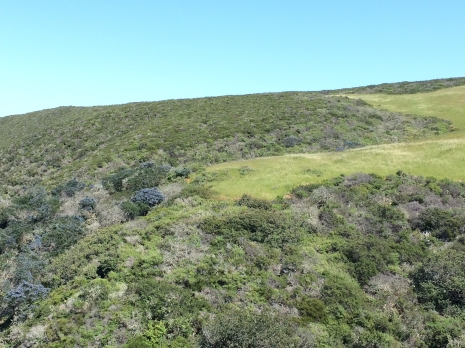
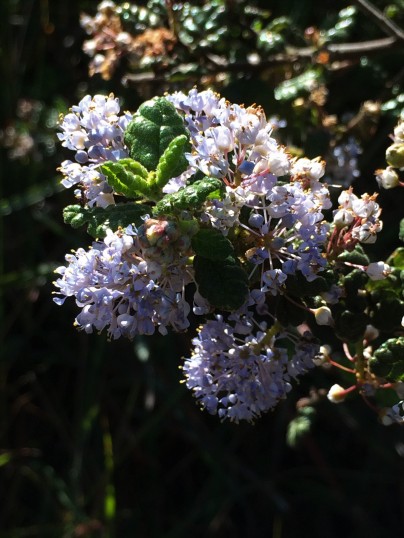
I day-tripped westward yesterday to a few locations in San Luis Obispo County (North of Santa Barbara and South of Monterrey) in what was likely my last coastal botany trip of the year. The trip was a bit of a mixed bag, as I couldn’t locate a few of my target flowers. I did, however, find the plant I most wanted to meet–the bizarre Calochortus obispoensis (San Luis Mariposa Lily, Liliaceae). This plant only grows on dry, rocky serpentine hillsides around the city of San Luis Obispo. Its habitat and bizarre appearance reminds me a bit of Calochortus tiburonensis (the Ring Montain Mariposa Lily) found in the North Bay last year (see post from May 25 of last year), but apparently it’s not that closely related within the genus. I guess serpentine just brings out the crazy in these plants.
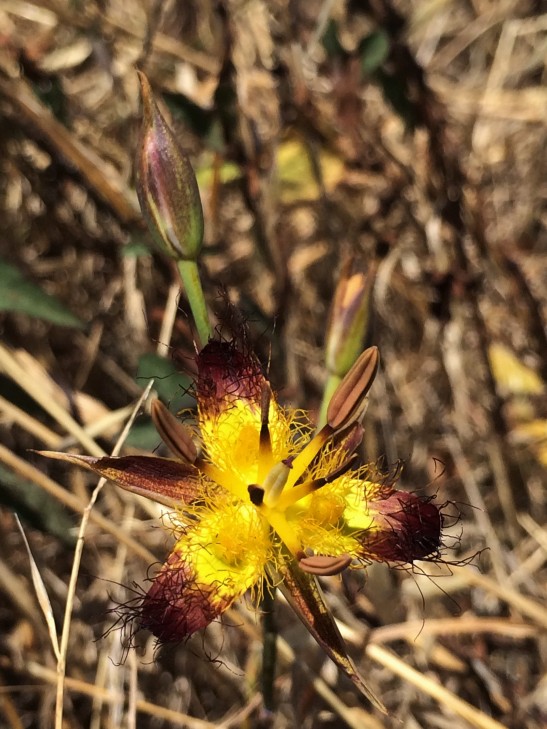
Calochortus_obispoensis_2

A few more late season plants were hanging out on the same serpentine hillside, an uncommon congener, Calochortus argillosus (Clay-loving Mariposa Lily)
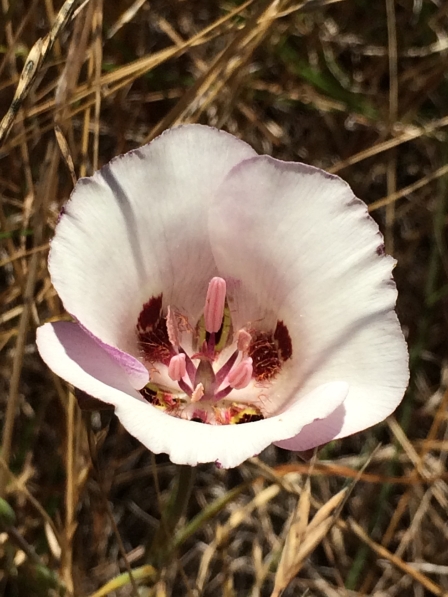
Calochortus_argillosus

and the rare Dudleya abramsii murina (San Luis Obispo Liveforever, Crassulaceae)

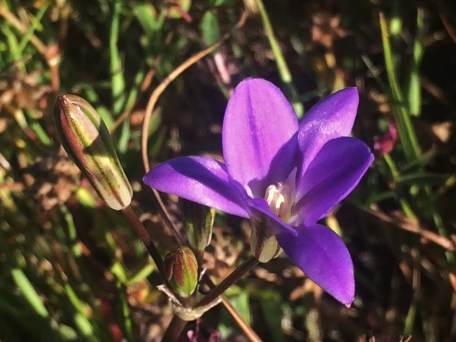
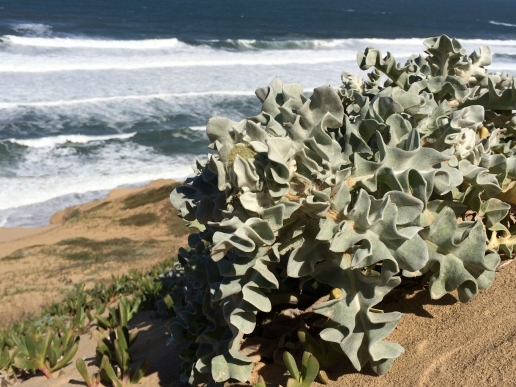
I also visited the immediate coast south of Morro Bay, for some sand dunes botany. Highlights here included Abronia maritima (Red Sand Verbena, Nytaginaceae)
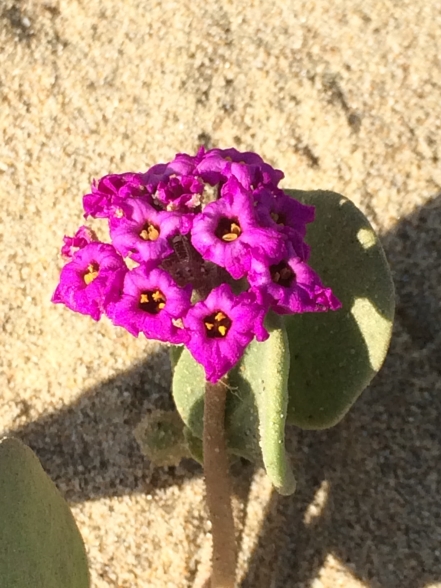
Abronia_maritima

Chorizanthe angustifolia (Narrow-leaf Spineflower, Polygonaceae)
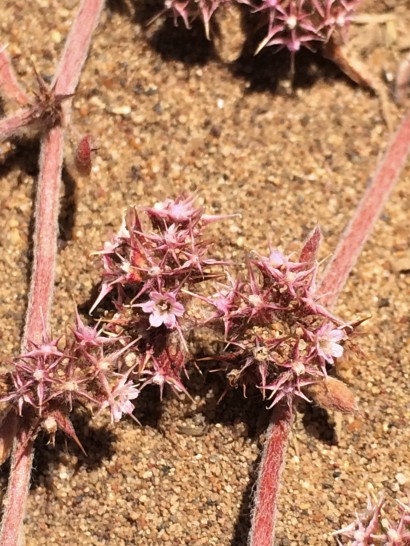
Chorizanthe_angustifolia

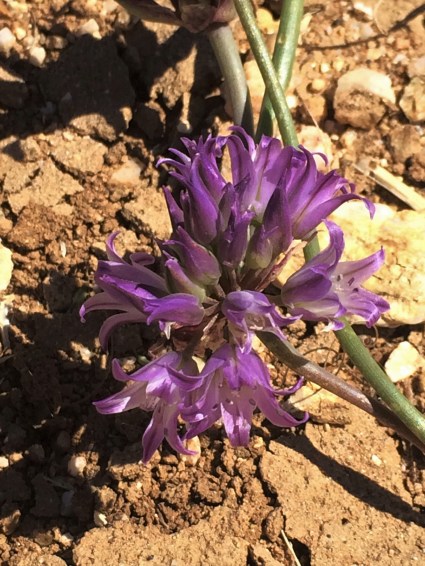
and Monardella sinuata (Curly-leafed Coyote Mint Lamiaceae). This last plant is not to be confused with one I posted a couple months ago, Monardella undulata (Wavy-leafed Coyote Mint, Lamiaceae), which is also a rare mint from the dunes of the South-Central Coast. The biggest difference is that this guy is an annual, while M. undulata is perennial. It seems crazy that in a genus of straight-leafed plants, two different species went curvy in the same area, but I guess that’s what happened!
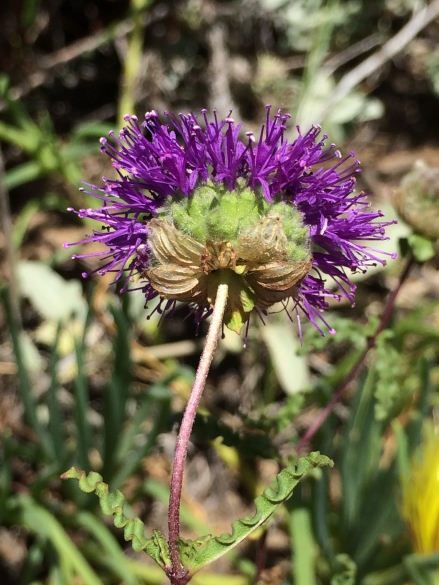
Monardella_sinuata_2

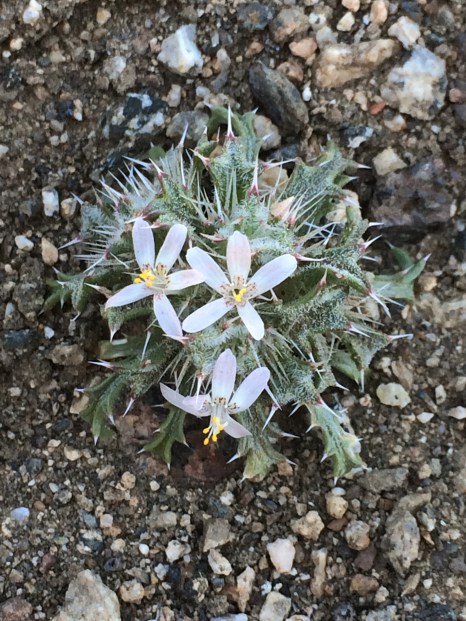
I spent most of the late afternoon and early evening trying to chase down a couple showy inland rarities without success. I did get a couple tiny rewards for my efforts, rare plants with flowers only a couple millimeters wide. First, here’s another spineflower, Chorizanthe breweri (San Luis Obispo Spineflower, Polygonaceae). Spineflowers often form large carpets of plants in flat, somewhat disturbed areas. Therefore, so despite their miniature stature, they can be fairly easy to find. Their nifty, spine-tipped bracts and six-part flowers can only be appreciated at very close range, however.
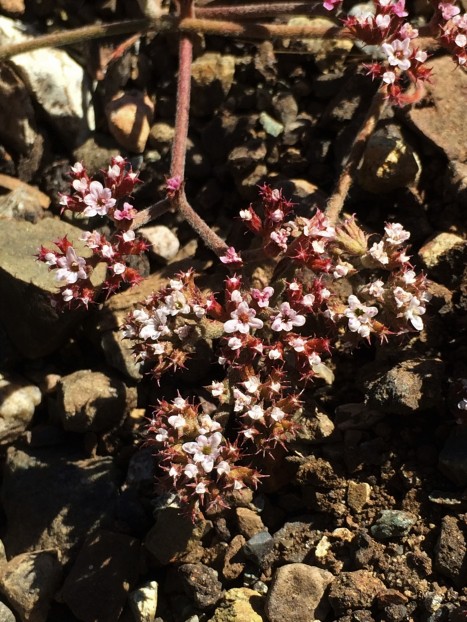
Chorizanthe_breweri

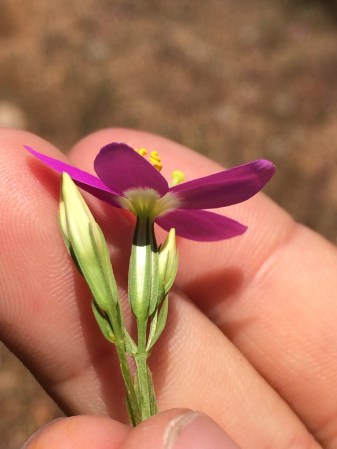
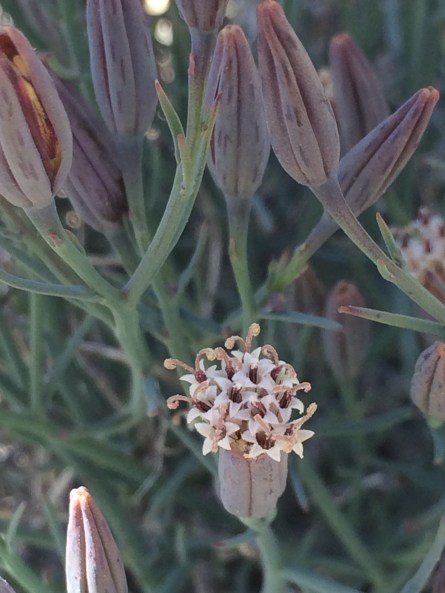
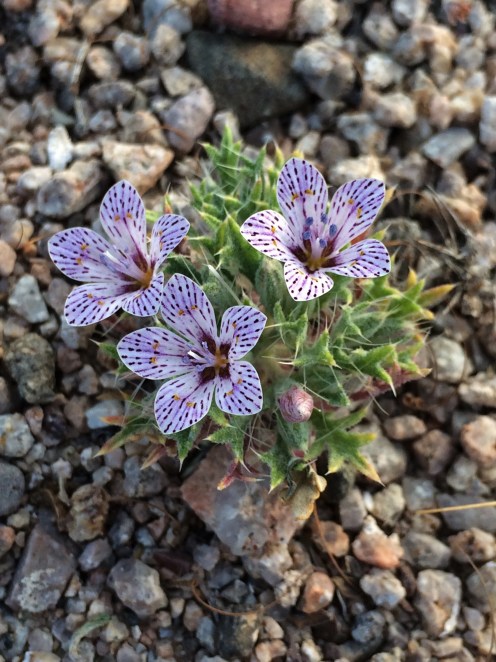
Finally, here’s Nemacladus secundiflorus (One-sided Threadplant, Campanulaceae). Plants in this genus also can occur in large patches. However, their thread-like stems make them almost impossible to see. I’ve only ever found them when crouched down looking at other plants.

Big Bear Lake

From the Chimney Peak Wilderness, I drove through the (now mostly flowerless) desert, to the northern San Bernardinos. The San Bernardino Mountains are the Easternmost of California’s Transverse Ranges. They quickly rise out of the southern Mojave Desert, topping out at well over 11,000 feet, making them tallest Southern California. Due to their size and location, they are extremely diverse, combining elements of the Peninsular and Western Transverse Ranges, the Desert mountains to the east, and even the Sierras far to the north. But most excitingly, they have many plants found here and nowhere else, particularly in the mid-elevations (~6,500-8,000 feet) around Big Bear Lake. This area has a unique habitat called pebble plains. These are flat places covered in small quartzite rocks that were deposited during the last ice age. Because the soils are too rocky for trees to put down roots, the habitat is open for tiny annual plants to thrive. Additionally, a whole second set of rare plants occurs in the treeless wet meadows that occur in some of the small valleys. In the pictures below, if the background is tan and rocky, the plant is on a pebble plain. If the background has dark soil, the plant is in a meadow (I found some of the plants in additional habitats as well). Okay, enough talk–onto the plants. I found so many uncommon and rare plants, I’m just going to skip some of the less showy ones. In addition to the usual common name and family, I’ll also put where else the species occurs in parentheses.

Horkelia rydbergii (Rydberg’s Horkelia, Rosaceae, Transverse Ranges)

Horkelia_rydbergii

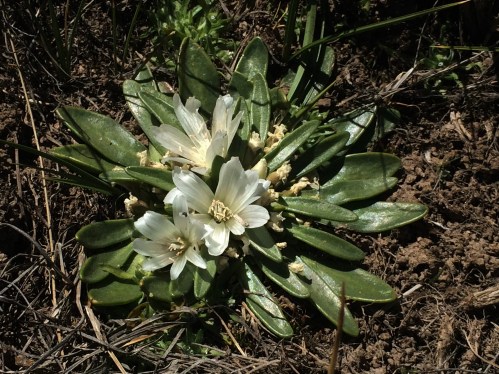
Lewisia brachycalyx (Short-sepaled Bitterroot, Montiaceae, only the Peninsular Ranges in CA, but elsewhere in the western US)

Lewisia_brachycalyx

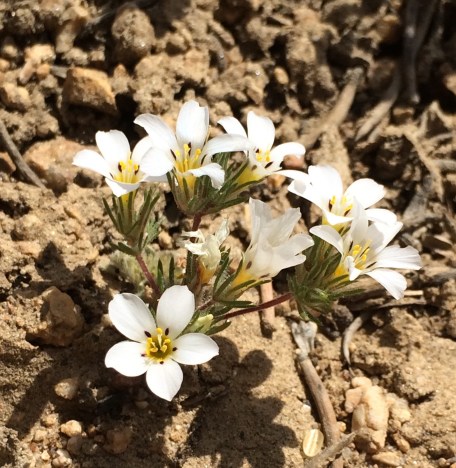
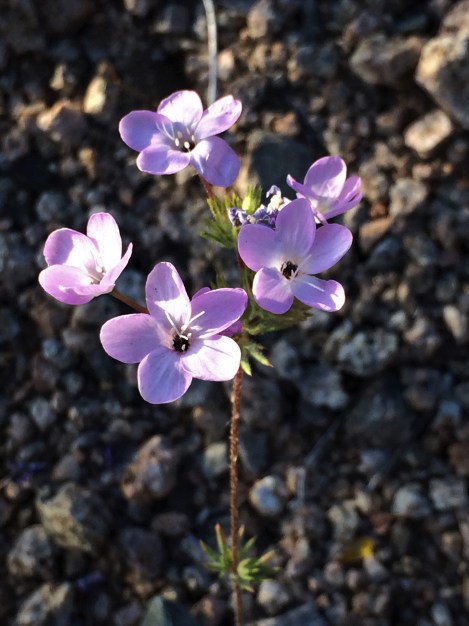
Linanthus killipii (Balwin Lake Linanthus, Polemoniaceae, nowhere else)

Linanthus_killipii_1

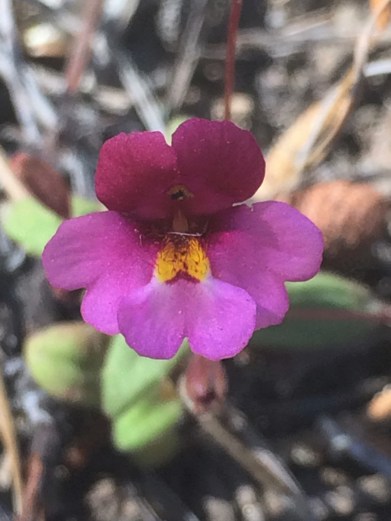
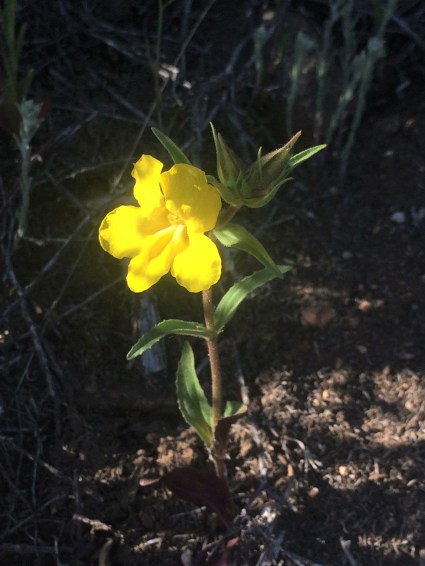
Mimulus purpureus (Little Purple Monkeyflower, Phrymaceae, nowhere else)

Mimulus_purpureus_2

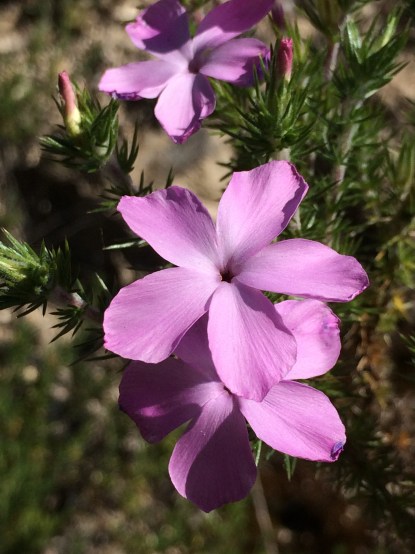
Phlox dolichantha (Big Bear Valley Phlox, Polemoniaceae, nowhere else)

Phlox_dolichantha_1

Potentilla wheeleri (Wheeler’s Cinquefoil, Rosaceae, southern Sierras)

Potentilla_wheeleri_1

Taraxicum californicum (California Dandelion, Asteraceae, nowhere else)

Taraxacum_californicum

You can tell that last one isn’t the closely related, weedy European Dandelion because the leaves aren’t lobed. Okay, lets go double time.

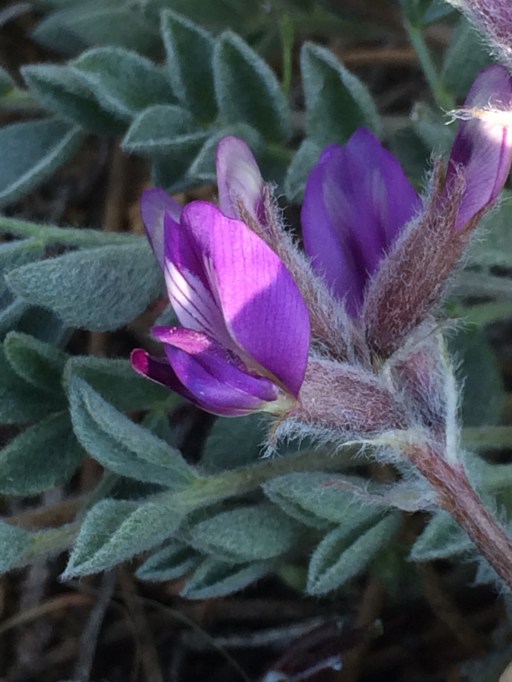
Astragalus bicristatus (Two-grooved Milkvetch) and Astragalus leucolobus (Big Bear Valley Woolypod, Fabaceae, both also found in the San Gabriels just to the west)

Calachortus invenustus (Plain Mariposa Lily, Liliaceae, Sierras, Transverse, and Peninsular Ranges), and Calochortus plummerii (Plummer’s Mariposa Lily, Transverse Ranges). I found the latter species on a quick stop on the way home on the western foothills of the San Bernardinos

Castilleja cinerea (Ashgray Indian Paintbrush, Orobanchaceae, nowhere else) and Castilleja lasiorhyncha (San Bernardino Mountains Owl’s Clover, northern Peninsular Ranges)

Erigeron aphanactis (Rayless Shaggy Fleabane, Asteraceae, Great Basin), and Erigeron parishii (Parish’s Fleabane, nowhere else). The latter is a limestone specialist that I found on the way to Big Bear Lake).

And finally, as promised, more Phacelia! Phacelia curvipes (Washoe Phacelia, Boraginaceae, mid-elevations throughout Southern California and further West), and Phacelia exilis (Transverse Range Phacelia, Southern Sierras and Transverse Ranges). Check out the beautiful transparent “windows” on the petals of that last one.

Big Bear Lake was one of my favorite stops all spring. I was actually a bit too early for some of the species, and so I already have plans to head back in a few weeks. Until then, I know a few more places that deserve a visit.

Chimney Peak Wilderness

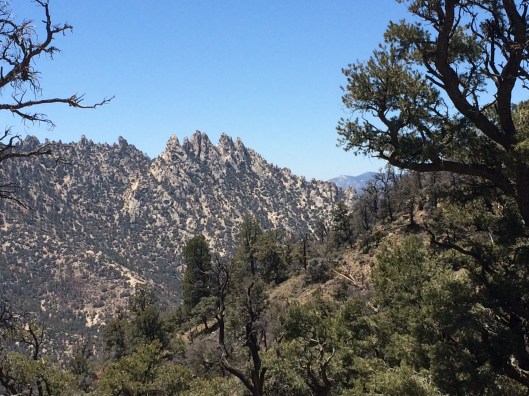
It’s been a while since my last post, as I was stuck in Bakersfield wrapping up the semester of teaching. It turns out grading 110 papers and 200 finals leaves little time for nature. I’m off work now, and making up for lost time. My first trip of summer was about half birding and half botanizing, and both components were highly successful. The bird highlights included Hepatic Tanager, Mexican Whip-poor-will, and Brown-crested Flycatcher. The plant highlights…well there are enough of them that I’ll break this into two posts. My first stop was the Chimney Peak Wilderness in the Southeastern Sierras. Rather than my normal routine of short walks and long drives, I decided to do a longer day hike along the Pacific Crest Trail. The main goal here was a rare onion species only found on two mountain-tops in the world. Unfortunately, I failed to bring a detailed map. When I got back, I realized I had walked right past the correct mountain without stopping and instead diligently searched the completely wrong area. I did not add a third location to the species range. Despite the mishap, it was an amazing hike in a beautiful area. Pictured: the incorrect peak.

view

I found several botanical goodies, including a different, relatively uncommon onion, Allium burlewii (Burlew’s Onion, Alliaceae).

Allium_burlewii_1

A couple more belly plants–cute, but not particularly showy flowers not more than an inch tall. I did get on my belly to photograph them. Chorizanthe watsonii (Five-tooth spine flower, Polygonaceae), and Mimulus suksdorfii (Suksdorf’s Monkeyflower, Phrymaceae)

I also found another Monkeyflower that, while still quite small, was much more showy: Mimulus montioides (Montia-like Monkeyflower)

Mimulus_montioides_1

On the ridge tops, I found large patches of a little yellow Aster that I didn’t recognize at all. Turns out its in a monotypic genus–the only one of its kind: Orochaenactis thysanocarpha (California Mountain-cushionplant)

Orochaenactis_thysanocarpha_2

Per usual, I found and photographed a few, similiar-looking Phacelia species. There are even more coming in the next blog post, so I’ll just put up the most boring-looking one: Phacelia novenmillensis (Nine-mile Canyon Phacelia, Boraginaceae). Why this one? Well it’s the rarest, of course! It’s only found in about a 20 mile stretch of mountains.

Finally, the clear highlight of the hike was Fritillaria pinetorium (Pinewoods Fritillary, Liliaceae). I actually unsuccessfully looked for this uncommon plant on my last trip. I ran into this (presumably) previously unknown population while scrambling around in the middle of nowhere on that incorrect peak. By itself, it completely made up for the mishap. What a plant!

Fritillaria_pinetorum_1

The Greenhorn Mountains

At this time of year in California, the flowering season is practically over in the valleys and lower foothils, but it hasn’t even started high in the mountains. That means the best place to go for flowers are the mid-elevations (~3,000-6,000 feet). Yesterday I day-tripped to a couple nearby mid-elevation spots. Piute peak to the south of Lake Isabella and the Greenhorns, West of the lake. Below is a shot from the former, looking north at the later.2017-05-05 09.44.58

The tree on the left of the image is the rare Hesperocyparis nevadensis (Piute Cypress, Cupressaceae). There are only a few thousand of this fire-dependent conifer in the world, most of which occur in this one giant grove. Here are a few more shots, the last one showing the extremely resinous (sticky) foliage

In the shade of these impressive trees was another rare plant that was just beginning to flower, Streptanthus cordatus piutensis (Piute Mountain Jewel Flower, Brassicaceae). I said it before about the related genus Caulanthus–these guys just don’t photograph well because their cool features are too far apart. So here’s a montage showing the urn-shaped flower, the glaucous, heart-shaped leaves, and a deconstructed flower.

I unsuccessful looked for a rare pink species Delphinium in the area, instead finding a different species with interesting hairy leaves–Delphinium hansenii kernensis (Hansen’s Larkspur, Ranunculaceae)

The rest of my trip was focused on finding some rare lilies. Along the way, I encountered a few other goodies, mostly in genera of which I have recently posted photos: a Clarkia, Clarkia xiantiana (Gunsight Clarkia, Onagraceae, the common name refers to the notch between the two petal lobes),

Clarkia_xiantiana

a couple small, pink monkey flowers: Mimulus constrictus (Dense-fruited Monkey flower) and Mimulus palmeri (Palmer’s Monkeyflower, Phrymaceae), the later occurring in dense colonies in burned area,

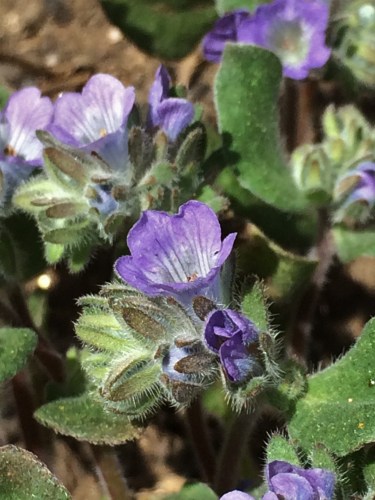
and Phacelia congdonii (Congdon’s Phacelia, Boraginaceae).

Phacelia_congdonii

Here are a couple plants in genera that weren’t previously represented on this blog: Pediomelum californicum (California Indian Breadroot, Fabaceae) with its purple and white flowers almost hidden among long hairs,

Pediomelum_californicum

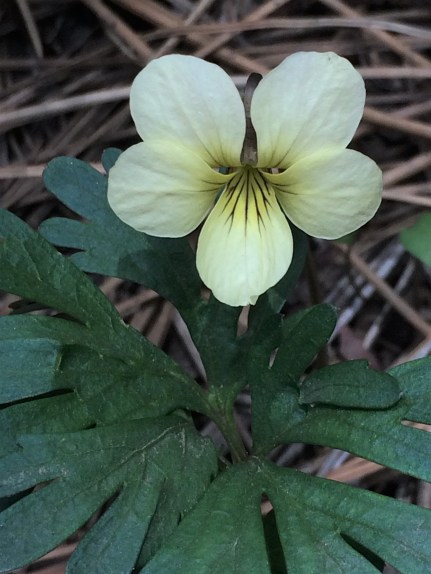
and Violia sheltonii (Fan Violet, Violaceae). I think this is my favorite species of violet.

Viola_sheltoni

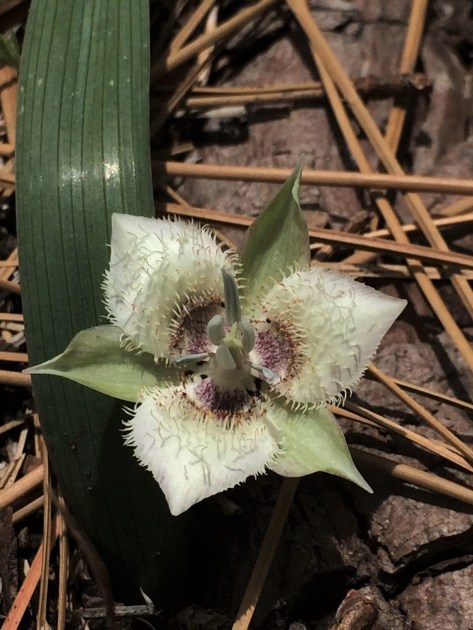
As for those lilies… I struck out on the two rare species of Fritillaries for which I was looking, and now have gone 0-4 this spring in trying to find targets in this genus. I don’t know what’s going on here. I did, however, find my Calochortus targets. This amazing genus has three looks– Mariposa Lilies are tall plants with large, fan-shaped petals. The Calochortus striatus from my last post is an example. Star-tulips have smaller flowers with pointed petals that grow closer to the ground. During this trip, I found a large population of the very rare Calochortus westonii (Shirley Meadows Star-Tulip). I love the beautiful fringed edges to the petals.

Calochortus_westonii_3

And finally, fairy-lanterns have pendant, globe-shaped flowers. Calochortus amoenus (Purple Fairy-Lantern) is a lovely example.

The inside of all three of these groups have a nectary at the base of the petals which attracts all manner of pollinators. The Crab Spider in the left picture is lying in wait, hoping to make a meal out of one of them. The petals of all three types can also be quite hairy. I opened up one of the flowers in the right image to show off the dark pink nectary and the long petal hairs.

I am really enjoying my trips into the Greenhorns, which are practically in my backyard. But there are a few more mid-elevation locations I need to visit before going back. In a month or so, it will be time to head up to their highest peaks.

Botanizing while birding

The main goal of this weekend was to find some migrating birds, meaning that flowers took a bit of a back seat. The Western Mojave, in addition to having amazing flowers, is one of the better places to find birds traveling from their tropical wintering grounds to the Sierras and points north. Migrants tend to concentrate around places in the desert with trees and water, stopping to recharge during the day and continuing on under the stars. Thus, hanging out at desert oases at dawn in the spring can be pretty fun. Despite the avian focus of the weekend, I did track down some pretty great flowers. I’ll start with the rarest one, Astragalus ertterae (Walker Pass Milkvetch, Fabaceae). This plant is only known from a couple locations around one Mountain pass in the Southern Sierras (which is incidentally also a great place to find some locally uncommon birds such as Pinyon Jay).

Astragalus_ertterae_1

I also made it into the San Gabriel Mountains, south of Bakersfield, where I added to my growing collection of Blazing Star photos by finding large fields of Mentzelia gracilenta (Graceful Blazing Star, Loasaceae) mixed in with Gilia capitata abrontanifolia (Ball Gilia, Polemoniaceae)

Besides these two stops, most of the botanizing happened in Eastern Kern County. I’ve already been a couple times this year, but I certainly haven’t run out of flowers. Here are a few relatively common Mojave flowers that were new to me this trip:

Eriogonum nudum westonii (Weston’s Buckwheat, Polygonaceae),

Eriogonum_nudum_westonii

Glyptopleura setulosa (Holy Dandelion, Asteraceae),

Glyptopleura_setulosa

and Pensetmon incertus (Mojave Beardtongue, Plantaginaceae).

Penstemon_incertus

An uncommon, but somewhat inconspicuous species, Chorizanthe spinosa (Mojave Spineflower, Polygonaceae)

Chorizanthe_spinosa

And finally, that great combination of rare and beautiful, Calochortus striatus (Alkali Mariposa Lily, Liliaceae).


Southwestern California

I had so much fun in the Peninsular Ranges last week that I headed that way again. This time, I stay much more coastal, botanizing in a three spots north of San Diego–Mission Trails Regional Park, Torrey Pines State Reserve, and Santa Rosa Plateau Ecological Reserve (confusingly, the Santa Rosa Plateau is not in the Santa Rosa mountains where I botanized last week, nor is it anywhere near the bay area city of Santa Rosa). I chose these locations to be about as different in their vegetation as possible. Mission Trails has fairly typical Coastal Sage Scrub–a chaparral habitat characterized by aromatic shrubs such as Salvia apiana (White Sage, Lamiaceae), and Mimulus aurantiacus var puniceus (Red Sticky Monkeyflower). The later is a hummingbird pollinated coastal form that grades into the more typical orange, bee-pollinated form as you move inland.

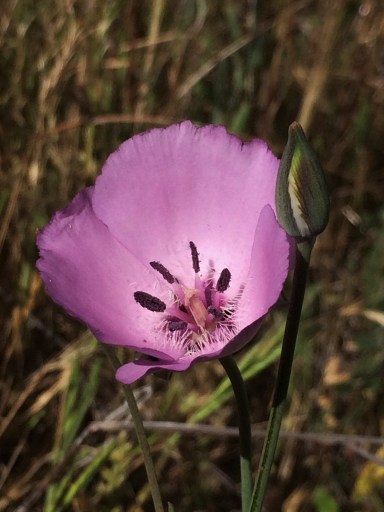
These two plants, along with the delightfully abundant Calochortus splendens (Splended Mariposa Lily), were the only species I photographed that were present at all three locations.

Calochortus_splendens

A couple bushy pink flowers in the mallow family were blooming in good numbers in the park–  Malacothamnus fasciculatus (Chapparal Mallow), and Sidalcea sparsiflora (Southern Checkerbloom). These species are in the same plant family as hibiscus and cacao (the plant from which chocolate comes).

Zeltnera venusta (Charming Centuary, Gentianaceae), with its crazy corkscrew-shaped anthers and ribbed sepals, was a nice surprise on an open hillside.

Zeltnera_venusta_2

I was the most excited to see a couple southern Clarkia species–the only all white flower in the genus, Clarkia epiloboides (Willow-Herb Farewell-to-Spring), and the rare Clarkia delecata (Delicate Farewell-to-Spring).

As their common name suggests, these are some of the last spring flowers to bloom in an area, which makes seeing them a little bittersweet. Luckily, however, I can just move my botanizing north and up in elevation.

My next stop was the Torrey Pines Reserve, just up the coast from San Diego and home of the one of the world’s rarest Pines, Pinus torreyana, a species found only here and on Santa Rosa island (Another place in California named Santa Rosa that is not near the other 3! What’s going on here?).  I managed to forget to photograph the pine trees, as I came for the coastal bluff plant community:

2017-04-21 15.54.31

If you are ever in the San Diego area, I highly recommend making a stop here–it’s San Diego’s version of Point Lobos, for bay area folks familiar with that State Park. I’ve written about coastal bluffs previously on this blog. The south coast’s version of this habitat receives much less rain and fog than the central or north coast, and subsequently has cacti, such as the Opuntia sp in the above photo and the rare Ferocactus viridescens (San Diego Barrel Cactus).

Ferocactus_viridescens_2

A few more stand outs from this location:

The showy and rare Leptosyne maritima (Sea Dahlia, Asteraceae)

Leptosyne_maritima_2

The tiny Linanthus dianthiflorus (Fringed Linanthus, Polemoniaceae)

Linanthus_dianthiflorus

And the honey-scented Piperia cooperi (Cooper’s Rein Orchid, Orchidaceae)

Piperia_cooperi

For my last stop i headed North and inland to Santa Rosa Plateau, an area with unique soils and vernal pools. Oak woodlands and grasslands dominate the landscape. This is still Southwestern California, so even here, cacti are everywhere, even growing out of the grass near a large vernal pool.

2017-04-22 08.50.28

This is the only place in the world where Brodiaea santarosae (Santa Rosa Brodiaea, Themidaceae) is found. This species is told from more common relatives by its small, triangular stamenodes (sterile stamens).

Brodiaea_santarosae

Navarretia prostrata (Pincushionplant, Polemoniaceae) was just beginning to bloom

Navarretia_prostrata

And finally, I found a couple species of one of my favorite genera, Downingia cuspida (Toothed Calicoflower, Campanulaceae) Downingia bella (Beautiful Calicoflower).

The Santa Rosa and San Jacinto Mountains

I saved the best for last on my spring break botany trip. I spent a day in one of the coolest places in California you’ve (probably) never heard of–The Santa Rosa and San Jacinto Mountains National Monument in Riverside County. Although parts of it had been previously preserved, the park was created by Congress in 2000, back when Congress did that nice sort of thing. The slightly taller San Jacintos sit to the north of the Santa Rosas. From them, the Peninsular Ranges head south for 900 miles, forming entire spine of Baja California. These mountains have a split personality. Hiking on their eastern slopes you are clearly in the desert.

2017-04-12 11.42.37

And the flora on this drier side reflects that. Here are some species that are also found in higher elevations in the Mojave or Sonoran Deserts

Allium fimbriatum (Fringed Onion, Alliaceae)

Allium_fimbriatum

Phacelia curvipes (Washoe Phacelia, Boraginaceae)

Phacelia_curvipes

A couple plants with close relatives in my last post, Loeseliastrum schottii (Schott’s Calico, Polemoniaceae)

Loeseliastrum_schottii

and Porophyllum gracile (Odora, Asteraceae)

Porophyllum_gracile

And, of course, a cactus–Echinocerus engelmanii (Calico Hedgehog Cactus)

Echinocereus_engelmannii

On the western side, however, rather than desert scrub, these mountains are covered in good old California chaparral.

2017-04-12 16.57.13

Here, many of the species also occur in the Peninsular Ranges to north and west of here. For instance, Phacelia minor (California Bluebell, Boraginaceae)

Phacelia_minor_3

Mimulus brevicaulis (Wide-throated Monkeyflower, Phyrmaceae)

Mimulus_brevipes

Linanthus californicus (California Phlox, Polemoniaceae)

Linanthus_californicus

and Antirrhinum coulterianum (Coulter’s Snapdragon, Plantaginaceae)

Antirrhinum_coulterianum_2

But I really came for all the plants found in the Peninsular Ranges and nowhere else. And I found several of them. I’ll start with a couple of mustards–Caulanthus hallii

And C. simulans

Why do two closely related species of rare mustards both choose to grow in the same section of trail? I have no idea. But I do know they are both way cooler in person–it’s really hard to capture their lanky shape well in a picture.

Shrubs, such as this Ceanothus perplexans (Cupped-leaf Ceanothus, Rhamnaceae) are a bit easier to photograph.

Ceanothus_perplexans

As I frequently do, I’ve saved my favorites for last. Monardella nana (Little Coyote Mint, Lamiaceae), is definitely the most interesting-looking member of its genus that I’ve met. I didn’t even recognize it at first, as this group of plants usually has tight clusters of purple flowers (see Monardella sinuata from a couple posts ago). I just love the fuzzy white bracts and pink anthers.

And finally, the ridiculously bright pink Penstemon clevelandii (San Jacinto Beardtongue) seen here in its preferred rocky perch.

Thus concludes my spring break flower report. I haven’t yet made up my mind as to where I’m headed this weekend, but rest assured that there will be flowers involved.

The Mohave Grand Tour

I just spent a good portion of last week driving around Southern California chasing flowers. My last stop in at Santa Rosa and San Jacinto Mountains National Monument had enough beautiful and unique things to warrant its own post–I’ll add that in a couple days. But first I want to show off some of the highlights from the rest of the trip, in which I looped around the Western, Northern, and Central Mohave. My first stop was the Kelso Valley, where the western Mohave meets the Southern Sierras. I had stopped here a few weeks ago, but not much was blooming then. This time I got the timing right, and found the rare monkeyflower for which I was looking, Mimulus shevockii (Kelso Valley Monkeyflower, Phrymaceae)

Mimulus_shevockii_3

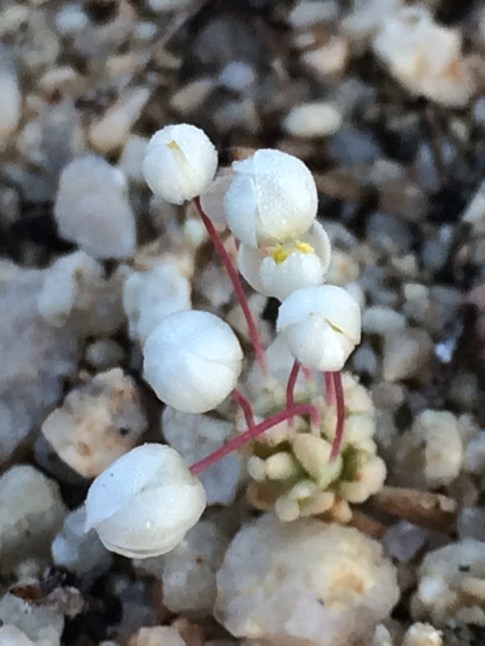
The spot also had another uncommon and extremely tiny plant, Canbya candida (Pygmy Poppy, Papaveraceae). I was there early in the morning so the flowers are still closed from the night before. For a sense of scale, the “pebbles” around the plant are actually grains of sand.

Canbya_candida

I then headed over Walker Pass toward the desert floor, stopping to look for a rare species of Astragalus which was not yet in bloom. I did get a consolation prize of a more common species in the same genus, Astragalus purshii (Woolypod Milkvetch, Fabaceae).

Astragalus_purshii_1

I hit the desert floor around Red Rock State Park, and fairly quickly found large numbers of a rare species of Blazing Star, Mentzelia eremophila (Pinyon Blazing Star, Loasaceae).

Also in the area were some nice patches of Linanthus parryae (Sand Blossoms, Polemonaceae). Individuals either have white or purple flowers, sometimes in the same population, as you can see from the second photo.

Further to the southeast at lower elevations, I made a quick stop in some Saltbrush Flats and found the uncommon Goodmania luteola (Yellow Spinecape, Polygonaceae). I know it doesn’t look like much, but it’s the only species in its genus, and to a plant nerd like me, that makes it pretty interesting.

Goodmania_luteola_2

From the Western Mohave, I made the long drive to Death Valley National Park, where I had hoped to find a few beautiful and rare species that only occur on limestone cliffs in the Northern part of the park. Unfortunately, I got the timing wrong, and I was too late to catch these short-lived annuals. That’s not to say the trip wasn’t worth it though. On the way in, I found a couple common, but interesting species

Cleomella obtusifolia (Blunt-leaf Stinkweed, Cleomaceae), a small plant found around salty lakes.

Cleomella_obtusifolia

Eucnide urens (Desert Rocknettle, Loasaceae), a shrub with extremely sharp hairs that I know now not to touch.

Eucnide_urens_2

Despite striking out on the limestone specialists, I did find a couple of rare plants. Salvia funerea (Death Valley Sage, Lamiaceae) is a unique, incredibly woolly shrub with a funky smell found in the mountains around the valley.

Salvia_funerea

The clear prize of the Death Valley leg of the trip was Enceliopsis covillei (Panamint Daisy, Asteraceae). This beautiful sunflower is only found in gypsum soils in a few canyons on the western side of the Panamint mountains. It’s the logo for the California Native Plant Society:

wy8OXHYe

When I got to the area, I was dismayed to find the only road that goes through the range of the species was closed. I quickly formulated a back-up plan, driving as close as I could to the mountains, picking what looked like an interesting canyon with gypsum (the white rock below), and walking in.

2017-04-10 17.30.06

About a mile up the canyon, I found one individual growing completely by itself on the side of the canyon. I shouted pretty loud when I saw it.

After leaving death valley, I spent an evening and morning botanizing around the Barstow area in the Central Mohave. There were a number of interesting plants in the area, including a couple more species from the extremely diverse sunflower family (Asteraceae), Nicolletia occidentalis (Hole-in-the-Sand Plant) and Adenophyllum cooperi (Cooper’s Dogweed, shown with a sleeping bee-fly, Bombylius sp.).

But another plant family, Polemoniaceae, led the highlight reel here. A pink patch of Leptosiphon breviculus (Mohave Linanthus) looked lovely in the evening light

Leptosiphon_breviculus


Loeseliastrum matthewsii (Desert Calico, Polemoniaceae) was just beginning to bloom in the area.

Loeseliastrum_matthewsii_2

And another tiny prickly annual with intricately patterned petals Langloisia setosissima (Lilac Sunbonnet) was surprisingly common.

Langloisia_setosissima_1

From Barstow, I made the long drive south to the Santa Rosa Mountains. I’ll detail those highlights in my next post.


Central Sierra Foothills

I’m about to head out to the desert, but before I do, here’s a quick post about the overnight trip I just took up to Tuolumne County. I stopped along the South Fork of the Stanislaus River and at a nice outcrop of iron-rich serpentine soil called the Red Hills. Both spots have a bunch of uncommon or rare plants, but I was too early or too late for most of them. The couple I did manage to scrounge up definitely fall under the category of “plants only a botanist would love”.

Lomatium congdonii (Congdon’s Lomatium, Apiaceae). A rare plant only found in serpentine in Tuolumne and Mariposa counties

Lomatium_congdonii

Leptosyne stillmanii (Stillman’s Coreopsis, Asteraceae), also a serpentine specialist.

Leptosyne_stillmaniiLeptosyne_stillmanii_fruit

The botanical highlights of the trip were actually three beautiful species that are common in the Sierras, but new to me (as far as I remember).

Lathyrus sulphureus (Snub Pea, Fabaceae)

Lathyrus_sulphureus

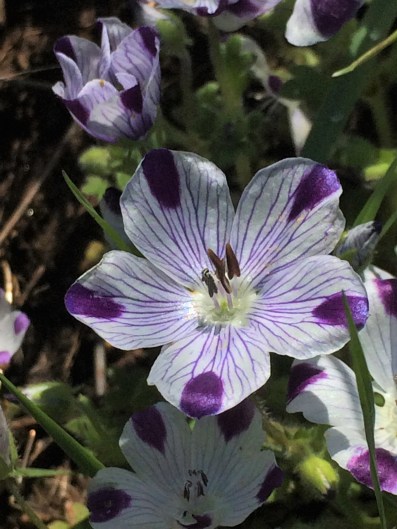
Nemophila maculata (Fivespot, Boraginaceae)

Nemophila_maculata_2

and Calochortus monophyllus (Yellow Star Tulip, Liliaceae)

Calochortus_monophyllus

I’m feeling generous, so I’ll even throw in a couple plants that range widely across the Western US and Canada:

Phlox speciosa (Showy Phlox, Polemoniaceae)

Phlox_speciosa

Lewisia redivia (Bitter Root, Portulacaeae)

Lewisia_rediviva

I’ll be hitting the road tomorrow with an ambitious itinerary wherein I will attempt to find many plants that are both rare AND beautiful.

The North Coast of Santa Barbara County

The superbloom is in full swing in California’s deserts, so for my trip today of course I headed in the complete opposite direction.  I did find some sand though!

2017-03-31 07.40.56

These are the Guadalupe Dunes in the Northwestern corner of Santa Barbara County–due east of Bakersfield. Don’t worry–I’ll be back to the desert soon.

I hiked around the dunes all morning, and I’ll give them 10/10, would botanize again. Coastal Dunes–never a common habitat to begin with, have suffered much habit loss through coastal development. This was the largest dune complex I’ve been to in the state, and other than a couple of invasive species, it was amazingly pristine. In addition to many more familiar species, I found four rarities here, all of which only occur on coastal dunes.

Erysimum suffrutescens (Woody Wallflower, Brassicaceae). Wallflowers have made a habit of speciating in sandy places–for instance there’s a species in the Santa Cruz Sandhills and another on the Monterey Peninsula. This one is found at scattered populations from San Luis Obispo County (the county north of Santa Barbara) south to the Long Beach area, and as it’s name would suggest, it was impressively bushy.

Erysimum_suffrutescens

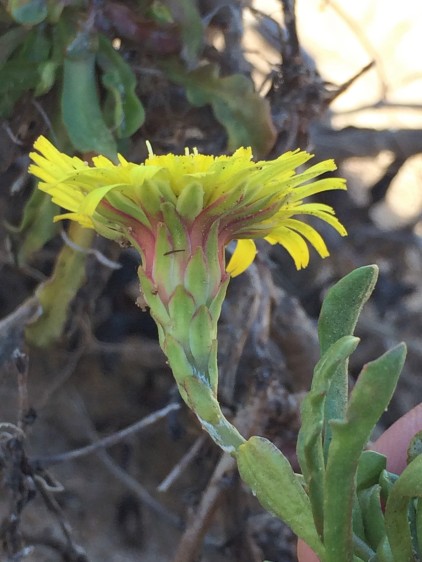
Malacothrix incana (Asteraceae). This might be my favorite common name for a plant ever–Dunedelion! It was the only one I found all morning, so I felt pretty lucky.

Malacothrix_incana_1

Monardella undulata (Wavyleafed Coyote Mint, Lamiaceae). A species only found on the Southern San Luispo and Northern Santa Barbara Coast. You can see the characteristic wavy leaves in the upper right. This genus usually blooms later in the season, but because the coastal climate is more constant than inland, many coastal species have longer bloom periods. This one blooms from April through November.

Mondardella undulata

Cirsium rhothophilum (Surf Thistle, Asteraceae), with surf in the background! Another very rare plant (with the same range as the Monardella). This plant is still in bud–you can see the white flower head starting to stick out on the left side).

Cirsium rhothophilum 2

After a morning hiking around on the dunes, I headed several miles south to spend the afternoon in the coastal chaparral and prairie at Point Sal State Park.

2017-03-31 13.35.53

This was also a very successful stop, with three particularly noteworthy species.

Ceanothus impressus (Santa Barbara Ceanothus, Rhamnaceae). I try to look up all the potential rarities for the spots I’m going to, but this species somehow wasn’t on my radar. However, I knew Ceanothus is very diverse , and I hadn’t seen this one before, so I made sure to snap a picture and grab a small branch to identify later. It turns out, it’s only found in a few spots in Western Santa Barbara County

Ceanothus_impressus

Scrophularia atrata (Blackflower Figwort, Scrophulariaceae). This one I did know was here. It’s a relative of the way more common Scrophularia californica but the flower differs in having a much more constricted opening and that dramatic dark reddish-brown color.

Scrophularia_atrata

Amazingly that wasn’t the only flower with a very dark color palate that I found today. Fritillaria biflora (Chocolate Lily, Liliaceae). This is a fairly uncommon plant that I’ve been wanting to meet for a while, but it’s actually the most common species in this post. It was a good day!

Fritillaria_biflora