Ten days ago, I looked at the long-range weather forecast, and saw days with temperatures in the high 60’s and days with snow!
Early spring is maybe the time of year most noted for wild swings in weather. Over the last ten days, we’ve had temperatures as high as 69 and as low as 19. It’s also, amazingly, a time when the ground begins to show pops of green as long dormant spring flowers unfurl their leaves. In our backyard, daffodils, crocuses, tulips, and other bulbs are rapidly racing towards flowering. But do these plants continue to grow when the weather turns wintry? What matters more to a growing plant, warmth or sunlight? From February 16-26, I tracked the growth of ten leaves (5 daffodils and 5 various other plants). To do so, I marked focal leaves with a sharpie and measured their length with a ruler every day around noon. Then I charted their growth in relation to the weather.

This stretch began mild, but quickly turned frosty. I ended up having to brush away snow on the 20th. However, by the end of the ten days, spring had definitely sprung. The graph below clearly shows the plants responding to the weather. Most plants showed some growth on the first couple days before shutting it down during the cold stretch. As the weather warmed again, growth happened even faster than before. The record was daffodil #3, who grew 1.6 cm in a 24-hour period.
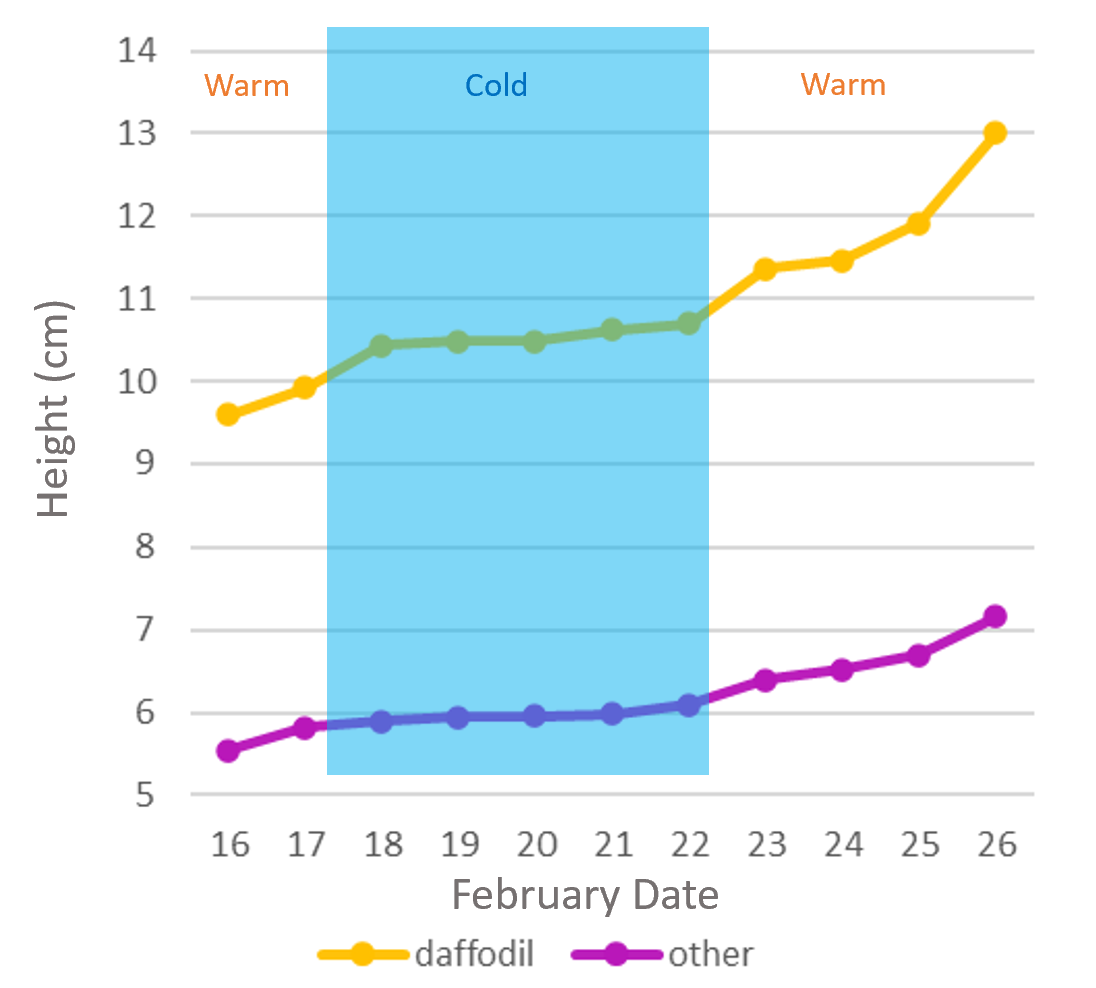
Doing a little study like this often unlocks more questions than it provides answers. Unfortunately, during these ten days, there weren’t really days that were cold and sunny or warm and cloudy. Therefore, I couldn’t disentangle the effects of warmth and sunlight on plant growth. On a couple days, it seems like the daffodils grew but not the other plants. Are the daffodils responding to different environmental cues than other spring flowers? Also, I didn’t control for things like shade and soil type which varied a lot even in the small confines of our back yard.
If studying back-yard plant growth was something that seriously interested me, I could use the information I collected as pilot data to help me design the next iteration of my data collection. As a scientist in general, and an ecologist especially, you’re never going to design the perfect study right out of the gate. There are simply too many unknowns going into a new study system. Without a bit of preliminary data collection, you’re not going to know the best ways to measure the things you do care about and to control for the things you don’t. For instance, I measured the height of the leaves from flush with the soil surface. However, I noticed that ground height shifted around some plants due to the freeze-thaw cycle. Therefore, if I was doing the study again, I might mark a location at the base of the focal leaf from which to start my measurement every time.
While finding that plants grow when it’s sunny isn’t going to win me the Tyler Prize for Environmental Achievement (there’s no Nobel in this field), it was nice to get back into data collection mode. In a month I’ll be helping students collect their own pilot data and I need to make sure I’m not rusty!
 botanicalramblings