March 30, 2025: A new landscape

I arrived at Blue Oak Ranch Reserve (BORR) today to a landscape completely different from when I last left it in mid-November. Brown hills are now verdant. Green leafed oak canopies are now lichen and mistletoe covered branches devoid of foliage. Dust and hard-packed earth are gone, replaced with puddles and mud. That this transformation happens every year doesn’t make it less remarkable.

I’ve now spent over a year of my life at this University of California property in the hills above San Jose. The fifty-day-long class I teach three times a year, California Ecology and Conservation, begins and ends each run here. Therefore, my six yearly visits are regularly spaced one-week stints. It feels as though I experience BORR as a series of vignettes, each visit a snapshot unique enough that I can name it based on which new flowers are in bloom or which new critters abound: late March (shooting star), mid May (mariposa lily), late June (dragonfly), mid August (tarweed), late September (tarantula), and mid November (tiger salamander). In most years, the most dramatic mid-year change is May to June, when the hills shift from green to golden.

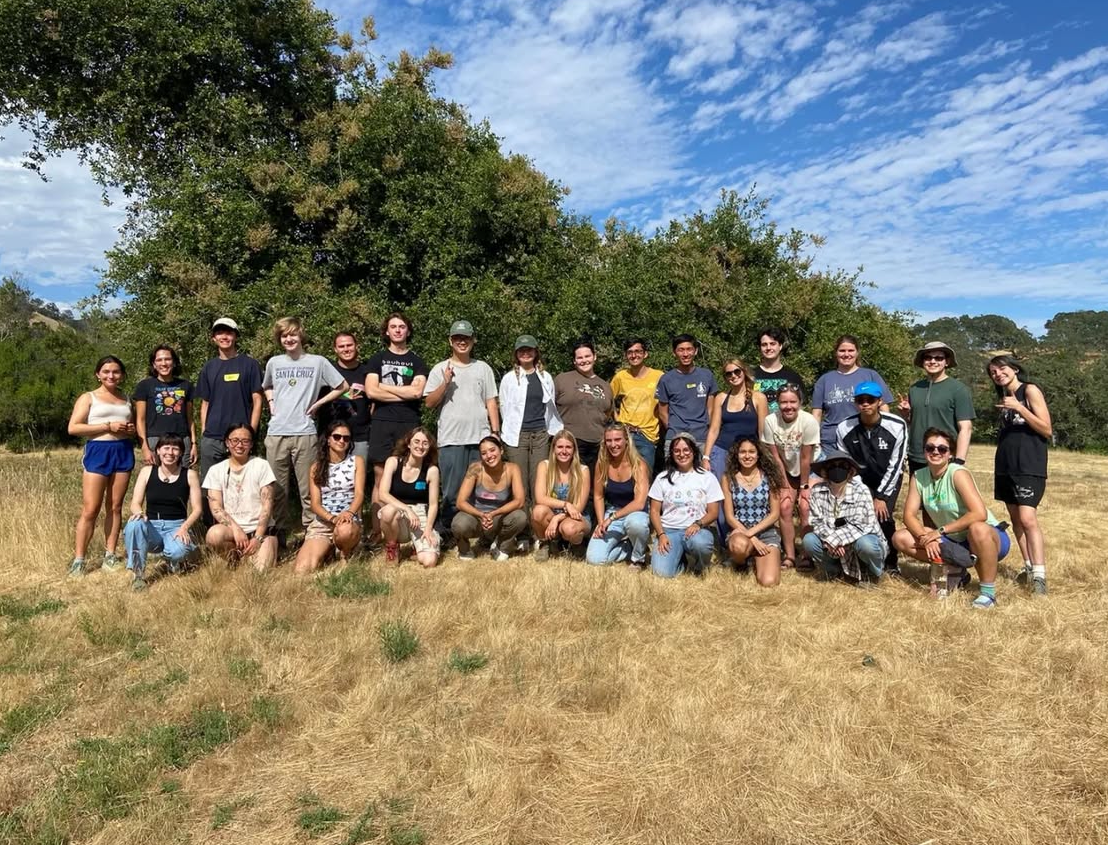
start of a spring class

start of a summer class

end of a fall class

I’ve been visiting BORR regularly since 2018. It’s amazing to think about how much change I’ve seen in even that narrow window. A fire burned half the reserve in 2020. A snow storm in early 2023 caused major damage to many tree limbs. Drought years and wet have shifted the timing of seasons and the levels of the ponds that dot the landscape. Feral pigs have uprooted large areas of meadows in their relentless search for roots and grubs. Invasive star thistle populations have been brought under control, but invasive mustard seems to be taking over the wetlands. The turning of seasons begins to feel like a background beat underpinning a larger song of change.

However large the transformations I’m witness to, they pale in comparison with those that happened 200 years ago. Spaniards first, and then Americans pushing west, hunted out the native elk and pronghorn, replacing them with cows. To feed their bovine investments, they seeded the land with annual Mediterranean grasses and introduced many additional non-native flowers in the process. That most noticeable of annual changes—hills vacillating from tan to green and back—didn’t occur before the 1800’s.

With the perspective of deeper time, the current landscape looks even stranger. When human populations began increasing in the state around 12,000 years ago, they hunted out megafauna and introducing much more frequent fire. Before then, BORR would have been a densely brushy place full of mastodons and ground sloths. Even the climate itself has been in its current form of cool wet winters and hot dry summers for less than 5 million years. Prior to that—a mere blink of the eye in geologic terms, BORR was a cool, wet temperate rainforest. But that long ago the hills themselves weren’t even there. BORR is part of the Diablo Range, which only formed 2 million years ago.

I’m planning on visiting BORR for many years still, and I’m excited and (and a little nervous) to see what changes the future holds. While prolonged droughts and the continuing onslaught of invasive species chip away at native biodiversity, the reserve staff and others are fighting back, planting oak trees and native grasses, and mowing and pulling invasives. All I know for sure is the next time I’m back, things will be different.

December 23: Biases.

This year, I’ve decided to keep a nature journal. As I already have this (previously dormant) blog, I’ve decided I’ll just post my entries on here. The plan is to write once a week, loosely basing my entries off prompts from Margaret Renkl’s new book Leaf, Cloud, Crow.

Here’s my first entry:

Our backyard has a tyrant. Marty the Northern Mockingbird is the undisputed despot of our birdfeeder. A flash of white and a flutter of wings mean that Marty has once again descended from a high oak or holly branch to reign terror upon all feathered foes. Yet again, another poor bird is prevented from nabbing a tasty sunflower seed or nutritious bit of suet. What a jerk!

Marty

I’m not proud of it, but it’s time to admit to everyone that I’m biased against mockingbirds. They are extremely loud vocalists, especially in the spring, with the annoying habit of beginning their continuous singing before sunrise They are common in suburban landscapes; thus, if I’m seeing a lot of them, it means I’m not in my preferred wilderness habitat. Plus, I really do hate a bully.

I readily admit feeling animosity toward Marty and kin is ridiculous. Mockingbirds have a lot to like. As both their common name and scientific epithet (Mimus polyglottos, the many-tongued mimic) imply, they have the amazing ability to incorporate the songs of other birds, frog calls, or even car alarms into their acoustic repertoire. While omnivorous, they are important seed dispersers of native plants, especially in fall and winter, as their diet shifts to mainly fruit. And they are willing to fearlessly take on potential predators, harassing hawks and ousting owls. I seem to be quite alone in my distain for the species, as evidenced by numerous positive references in art and literature (think, To Kill a Mockingbird). In fact, five US states have chosen the mockingbird as their official bird, trailing only beloved cardinals and meadowlarks by that popularity metric. Even Marty specifically has an admirer. My partner loves watching Marty splashing around in the bird bath that is the outside dog bowl, or hopping from fence to tree-trunk and back, head cocked at a jaunty angle, or scampering across our outdoor table, feet pattering and golden eye gleaming intelligently.

What is going on inside Marty’s little bird brain? After an hour of observation, I began to wonder if this bird is, like me, a biased creature. I started to think Marty wasn’t treating all birds equally. Carolina Wrens, in particular, seem to invoke Marty’s wrath. When a wren stopped by, not only did Marty immediately swoop in with wings outstretched, a chase often ensued, with both birds acrobatically weaving chaotically across the backyard. While Marty often displaced finches, nuthatches, and titmice from the feeder, both the intensity and duration of the rage appeared greater when a wren is involved. At the other end of the spectrum, Carolina Chickadees seemed to get a free pass as they snuck seed after seed right out from under Marty’s watchful gaze.

I wonder what forces are driving Marty’s differential treatment of competitors. Maybe Carolina Wrens, another common omnivorous resident here in North Carolina’s suburbs, share more overlap in diet, habitat, and behavior with mockingbirds than any other species. If so, then it would make evolutionary sense for Marty to pay more attention to their biggest rival! But before I build a complicated story that explains Marty’s actions, I need to check my facts. Is Marty really chasing wrens more aggressively and more often than any other species? Or are my observations of Marty’s biases themselves biased?

I came up with my wren prediction based on some initial observations. Without rigorously collecting additional data, I may subconsciously favor evidence that supports my claim. This tendency of conformation bias is why we shouldn’t just rely on antidotes when stating conclusions. In fact, as I continued to watch, Marty began aggressively chasing Eastern Bluebirds, a species that simply wasn’t around earlier in the morning. I also started noticing times when a wren snuck an unmolested snack.

So is Marty biased? In order to test my hypothesis, I would need many more observations of interactions between Marty and each species of bird. I could then statistically test if the likelihood of being chased off the feeder by the mockingbird depended on species. I probably would also need to account for things like the time of day, the length of the visit, and the number of other birds present. Then, if I wanted to make the claim that all mockingbirds (not just Marty) were biased in which species they chase, I would need to watch different mockingbirds across multiple locations. And even after all that, I still couldn’t be 100% certain in my claims. This time-consuming process is why people can get annoyed with scientists. We can’t quickly give a straight answer without couching it with an “it seems” or a “probably!” But it’s also why people can trust the conclusions of peer reviewed studies much more than their own gut feeling or the claims of a TV talking-head. We systematically eliminate sources of observational bias to get closer to the objective truth. What’s more–this careful accounting of the natural world has great side effect. It almost inevitably leads to a greater appreciation of the being you are watching. Even after just a morning of observation, I can already conclude that Marty is more beautiful, charismatic, and maybe even benevolent than my biased perspective initially had me believe.