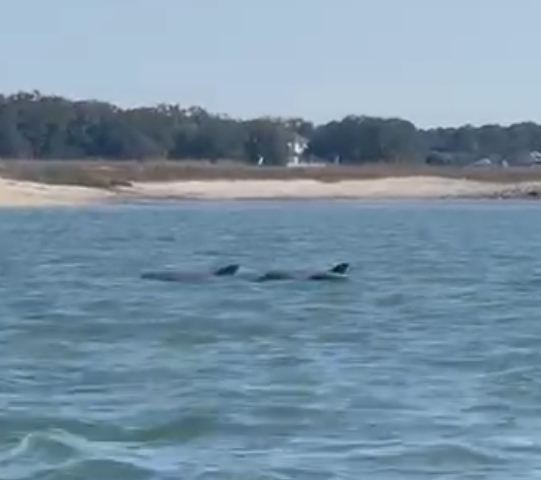
This weekend, Jenny and I went to Hilton Head Island, South Carolina, to meet up with our friends, Charlotte and Eric. One of the highlights was a dolphin-watching trip through the saltmarsh inlets that surround the island. The dolphins here are a newly described species, the Tamanend’s bottlenose dolphin (Tursiops erebennus), which was recently split from the common bottlenose dolphin (Tursiops truncatus). While the former averages smaller, the two species more or less look the same. However, their behavior and genetics are quite different. The Tamanend’s are an inshore species that’s resident year-round from New York City south to Miami. The common’s are generally an offshore species found across the globe.
Before we left the harbor, Captain Sebastian told us if we noticed anything that might be a dolphin, regardless of our confidence level, we should let him know. He told us of trips where customers mentioned they thought they had seen dolphins when they were back on shore and it was far too late. While obeying the slogan “If you see something, say something!” in a dystopian totalitarian regime might make you a collaborator, it was sage advice from our captain. Having a fast trigger on the phrase “What’s that?” should be a rule whenever two or more naturalists are gathered.
While the concept is easy in theory, people are surprisingly bad at calling things out while still uncertain. The simple psychological truth is that people don’t like to be wrong. I get it. It can feel embarrassing when you think something is going to be cool, you make a big deal about it, and it turns out to be…not that thing. In order to get over that fear, I play a game while naturalizing called Stick or Snake.
Pronounced “sticker snake”, the goal of the game is to be the first to correctly guess whether the object in front of you is a stick or a snake. You win by determining something is a snake and it is! There are two ways to lose. Occasionally, you might claim something is a stick, but it’s actually a snake. Assuming you didn’t run it over in your car or get bitten by it, losing this way isn’t the end of the world. However, it does mean you should start searching much more carefully—you’re probably missing lots of cool snakes. Far more often, you will think something is a snake but it’s actually a stick. Especially if you’re a newcomer to the game, you should lose this way A LOT. And each time you do, you should proudly declare “I lost stick or snake.” If you’re not losing often, you’re not playing hard enough.
Stick or Snake has lots of variants. Leaf or Lizard. Log or Croc. Plastic Bag or Snowy Owl (that one’s really hard). The version we played at Hilton Head could be called Dolphin or Nothin’. The wonderful thing about these games is how quickly folks improve. Visual pattern recognition is one of the greatest skills of our species possesses. Students on my course are often amazed by how quickly they learn the search image for their study organism, and how they accidentally continue to find them long after their study is complete. But, in order to train our brain to recognize what something looks like, we also need negative data. What doesn’t it look like? Playing these games gives us a better training set on which to hone our detection abilities.
On our boat trip, it turned out Dolphin or Nothin’ was pretty easy to win. A boat ahead of us had already spotted a pod of Tamanend’s Dolphins. We watched in wonder as they foraged and tail slapped in the bay, sometimes even swimming directly under the boat. On the way back to shore, we even had time to play another game—Wood Stork or Another Tall White Bird that Isn’t as Cool as a Wood Stork. I lost a lot.

 botanicalramblings