Despite being in quite early stages of developing our garden, the insect diversity in our yard has been quite high this summer! Maybe I’m grading on a curve based on my experience with California and Oregon. In places with hot, dry summer, many plants have senesced up by August, which doesn’t leave much food for bugs. In any case, it’s been fun meeting some of the local insect species.
The plant in our yard that has lately seen the most visitors is Jenny’s luffa sponge gourd (Luffa aegyptiaca). The few individual luffa vines have taken over an entire raised bed, and are producing a beautiful display of yellow flowers. Like many species in the squash family (Cucurbitaceae), this plant is visited primarily by bees. Also like many squashes, plants produce separate male and female flowers. In order for a plant to produce fruits, bees are absolutely essential. I decided to watch the flowers for an hour in the late morning, photographing and identifying as many floral visitors as I could.
I ended up finding eight different species of bees over the hour (names bolded below). Most species were represented by several individuals and there was never a moment when the plant was completely unoccupied! I was expecting to see at least a couple rogue beetles, flies, or butterflies on the flowers, but nary a one stopped by. I also thought I would see some honey bees (Apis mellifera), but they were also absent. I know current fashion is to pledge to “save the honey bee”—we even have a NC license plate with the phrase. However, honey bees are non-native in the US, can be quite invasive, displacing the native species and doing a worse job than them at pollination. Therefore, I was quite happy to only see native species. I’ll show some pictures and briefly talk about each.
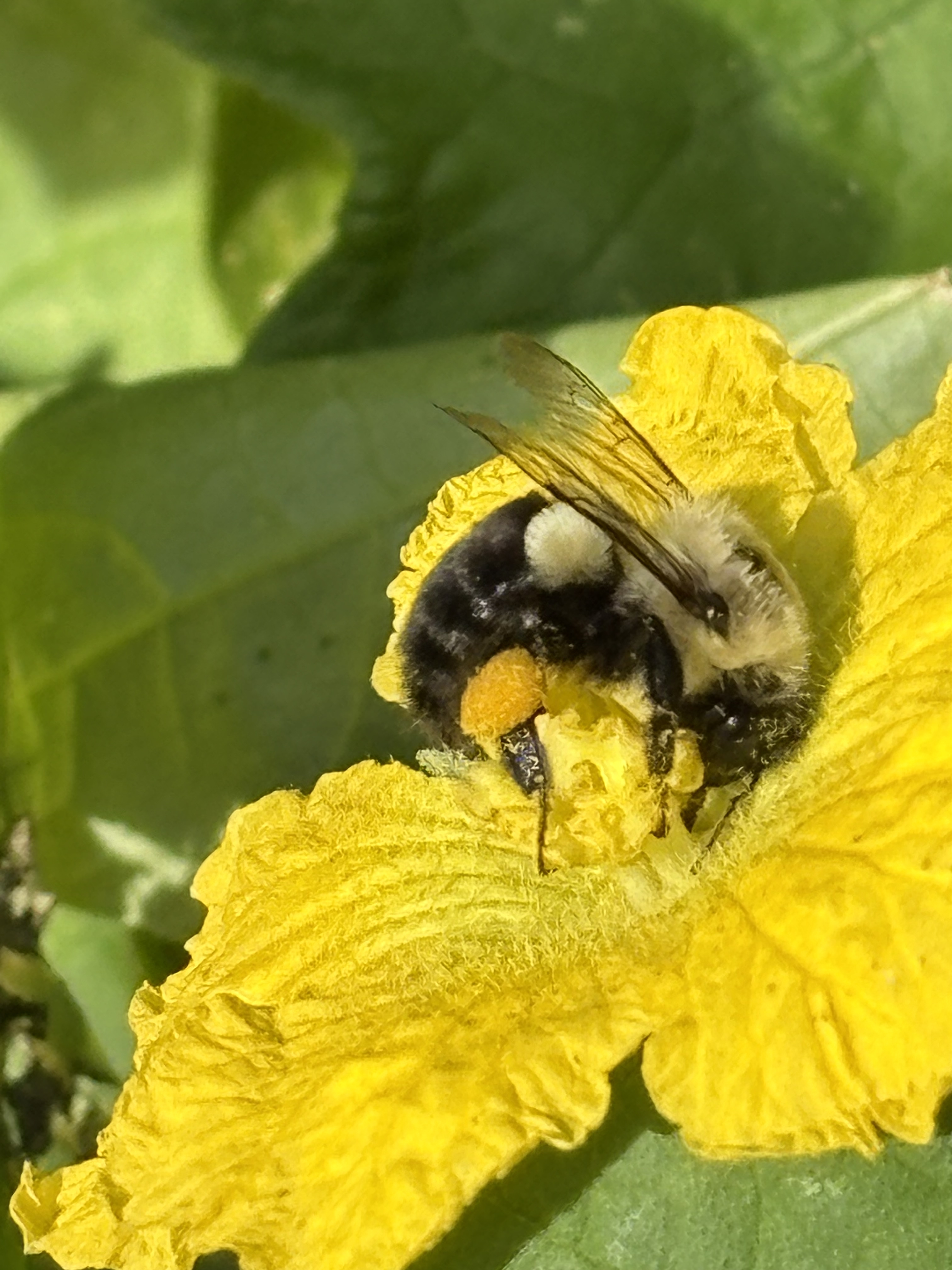

Bombus impatiens (top) and Bombus pensylvanicus (bottom). Bumble bees in the genus Bombus are among the most widely-recognized species of bees—they are probably the only native genus many people can identify. Like honey bees, but unlike most other bees, bumble bees are eusocial, meaning they have a sterile worker caste. They also make small amounts of honey, which they keep in honeypots in their underground nests. Bombus impatiens is by far the most common bumble bee in suburbs across the East. Bombus pensylvanicus, on the other hand, has recently undergone drastic population declines, especially in the northern part of its range. Ironically it has now become rare in places like Pennsylvania (and no, I don’t know why the species name drops the second “n” in “penn”).

Melissodes bimaculatus is in the bee family Apidae like bumble and honey bees. However, females are solitary, digging a hole in flat ground (males just sleep on a plant at night). Like many bees (but unlike honey and bumble bees), they carry pollen in scopae—modified hairs on their back legs. This species is distinguished by its two light spots low on the abdomen.

Ceratina sp. The “small carpenter bees” in this genus are tiny and dark metallic in color. There are a number of local species and it’s beyond my abilities to figure out which one this is from a photo. While they also provision their larvae with pollen, they are relatively hairless. Instead, they eat the pollen and regurgitate it at their nests inside which are inside of hollow flower stems. Besides their lack of hair, they are distinguishable by their barrel-shaped abdomen—thicker than other tiny black bees like Lasioglossum or Andrena. They are also in the Apidae, amazingly as is the largest bee in the area, Xylocopa virginica, which visited the luffa but was too quick for a photo.

Agapostemon virescens. This is an easily identifiable species—locally the only bee with a green thorax and black and white striped abdomen. This species makes communal underground nests, with multiple females sharing one exit hole. However, underground, each female makes her own chamber in which she lays an egg and supplies it with pollen to eat. Agapostemon is in the large family, Halictidae, or sweat bees. They are named because many of them are attracted to human sweat. Agapostemon species are not, but Augochlora pura, a tiny, all green species that I also saw on the luffa, is.
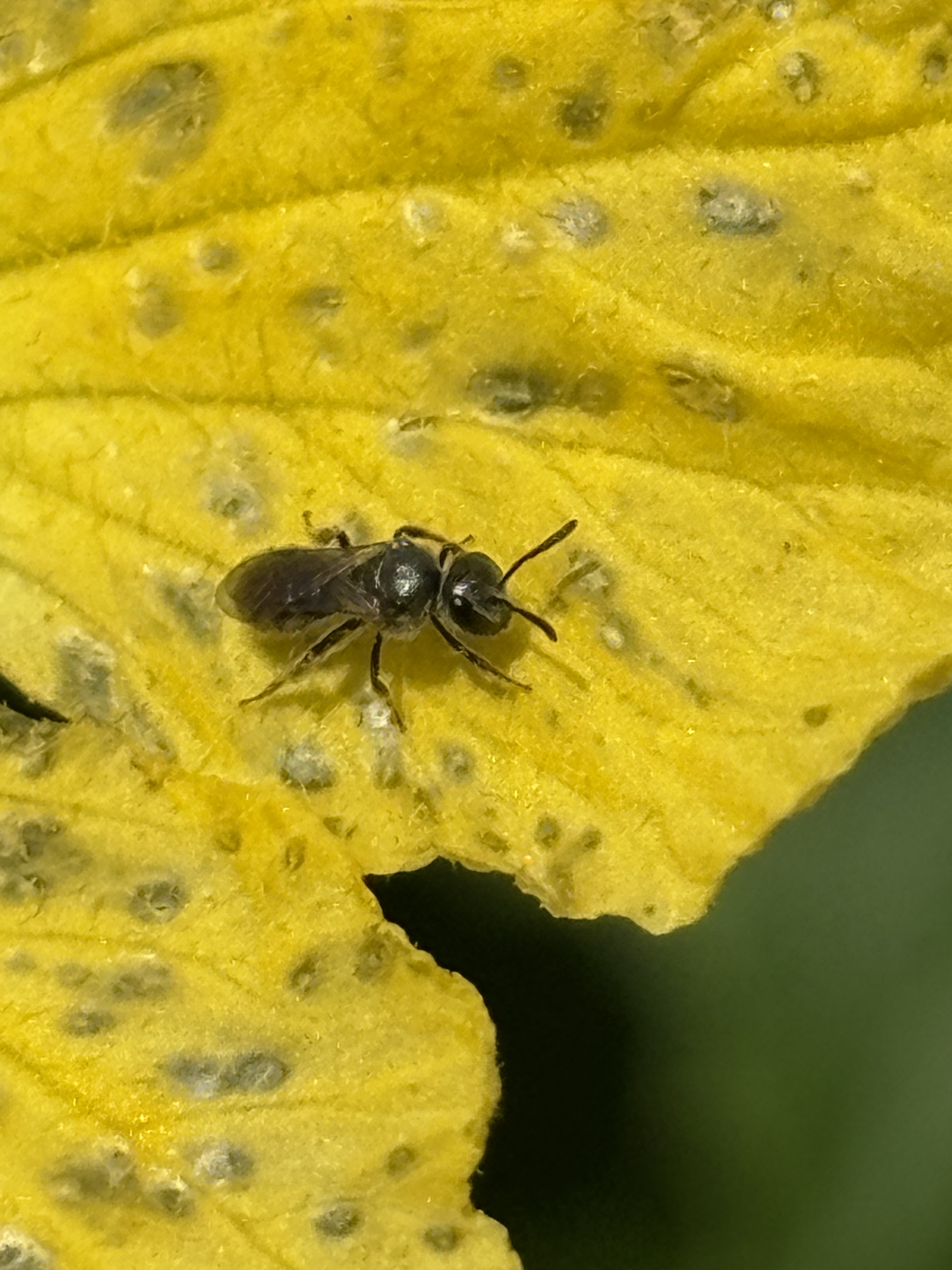
Lasioglossum sp. is another sweat bee that is true to the family name. This is an extremely species-rich genus with a lot of tiny similar-looking bees and I won’t attempt to identify it further (although many of the other species have more striped abdomens than this one).


Megachile exilis was the only visitor in my favorite bee family, the Megachilidae. This family is unique in that their pollen-carrying scopae are under their abdomen. You can see the hairs peeking out in the top picture. Bees in this genus are known as the leaf-cutter bees, because they slice up plant material as nest-lining material in their hollow-stem nests. As a result, they have large powerful jaws (bottom picture). I’m not 100% sure about the species identification (the genus is right), but if it’s correct, there are only a few hundred observations on on iNaturalist.
 botanicalramblings