Less than a week after returning to North Carolina from the course, Jenny and I decided to road trip to Maine. We saw amazing birds and flowers; toured mountains, lakes, and coastal islands; and spent quality time with friends and family. So, of course, this post won’t be about any of that. Instead, I’ll show some pictures of cool lichens!
There are over 4,000 species of macrolichens—that amazing tripartite collaboration among a photosynthesizing green algae or cyanobacteria, a filamentous ascomycete fungi that provides structure and water retention, and a basidiomycete yeast whose participation was only discovered in 2016 and whose role in the partnership remains mysterious. I became more aware of the lichens around me though a citizen science project in Eugene, Oregon. One cool and rainy winter, after learning some basics of lichen identification, I helped document the occurrence patterns of some pollution sensitive species in our local arboretum. North Carolina has plenty of lichens as well, but their abundance is greater in the mountains than locally in the Piedmont. Coastal Maine, like Oregon is cool and humid, leading to profusion lichen growth.
While diverse, many lichen species are fairly broadly distributed due to their ability to disperse via wind. Nevertheless, I hadn’t knowingly seen the following eight species before finding them during our exploration of Acadia National Park. Six of them are in the genus Cladonia, the reindeer lichens. This huge, cosmopolitan genus is characterized by a two-part body that has a scaly “crustose” component and a bushy or stalked “fruticose” component. Most lichen species can reproduce sexually and asexually. The sexual fruiting body is called an apothecium, which produces spores. Here’s two pictures of Cladonia maxima, the first of vegetative individuals, and the second fruiting. The light-brown blobs are the apothecia. This species is quite large for the genus—a few centimeters long, and while it has a broad range, it seems to be rare everywhere except for coastal Maine, Nova Scotia, and Prince Edward Island.

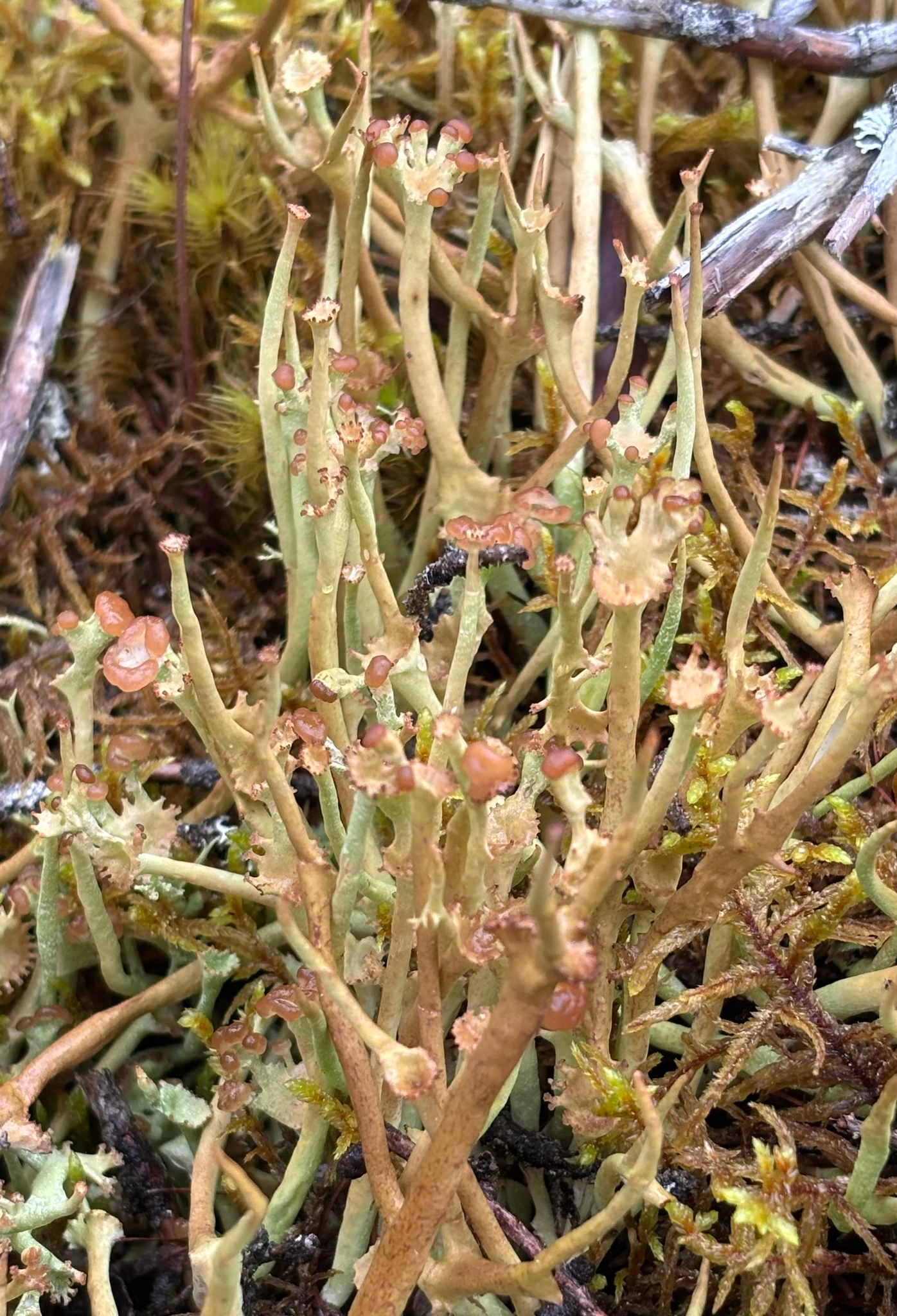
Here are thre more non-reproductive Cladonia—C. rangiferina, C. uncialis, and C scabriusula. These are tentative identifications—lichen, especially when they aren’t fruiting, can be quite tricky to get to species.


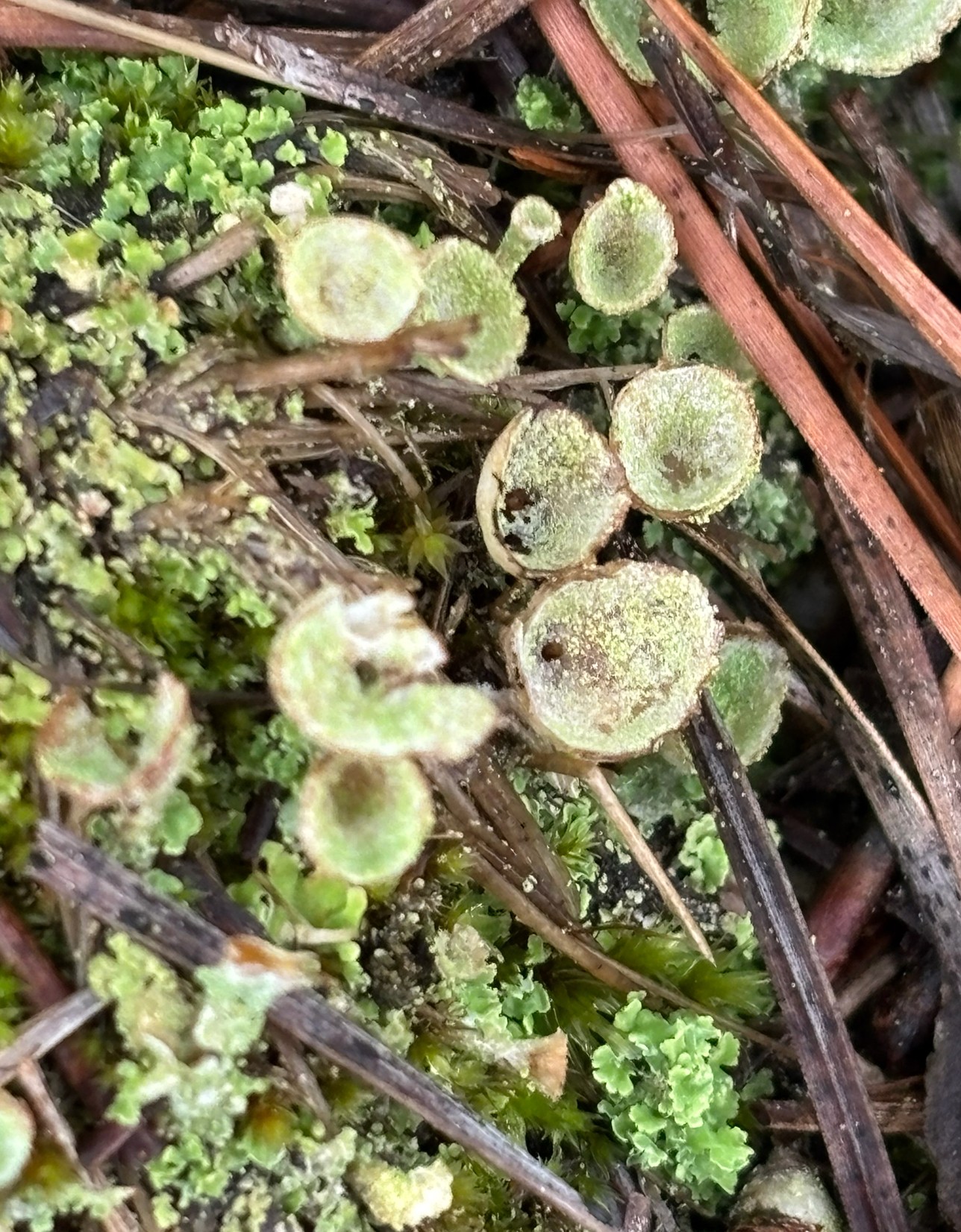
And two Cladonia that were producing apothecia, scaly green cups in C. chlorophaea and red lumps in C. cristatella, the British Soldier lichen.

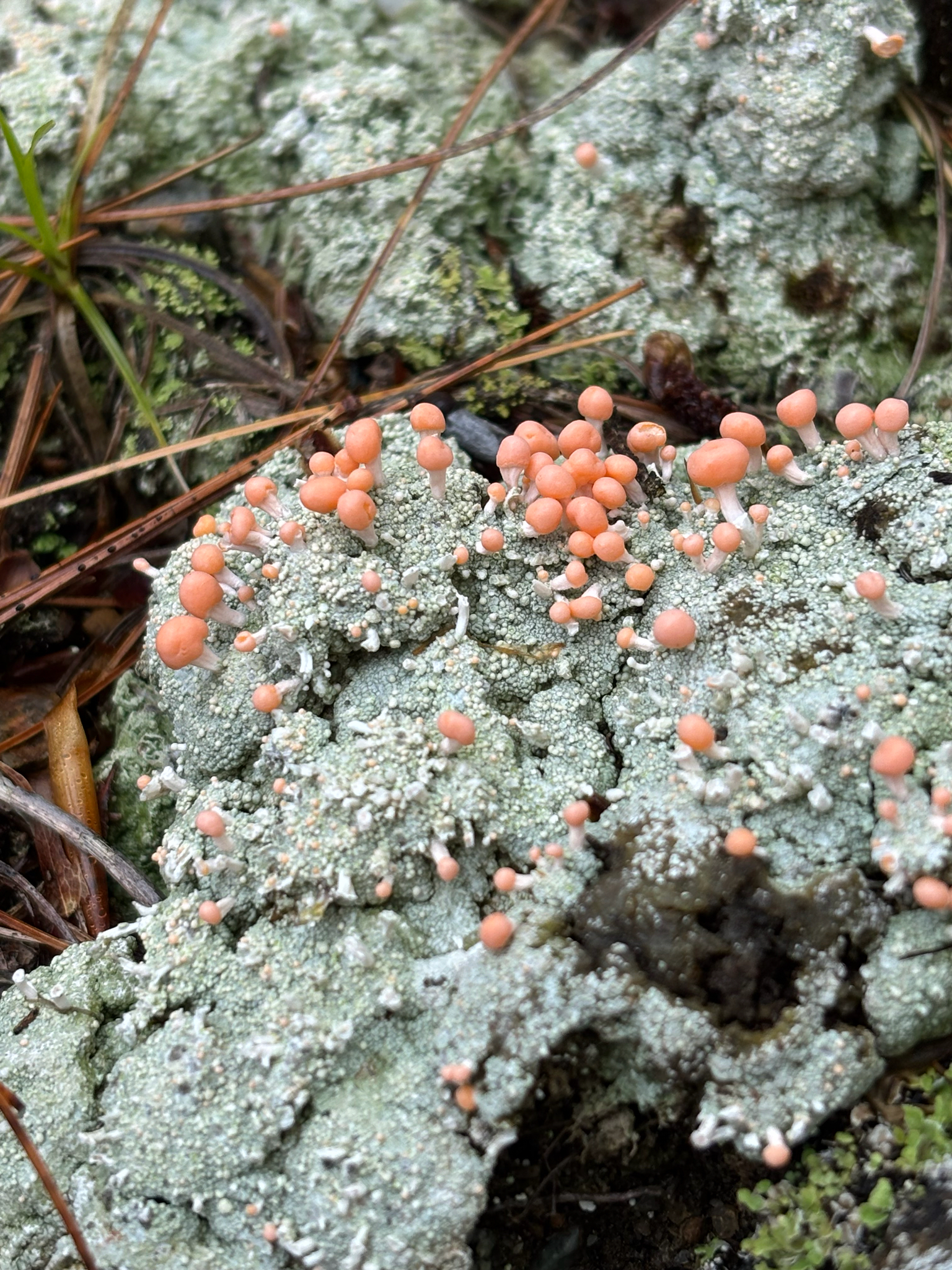
Finally, here are two crustose lichens in different lichen families that caught my eye by having interesting apothecia. The first is Stereocaulon saxatile (rock foam), and the second is Dibaeis baeomyces (pink earth lichen).

 botanicalramblings