North Carolina has an amazing number of amphibians. We’re at the center of world salamander diversity and there are at least 46 species of the slimy little slitherers in the state. But the anurans (frogs and toads) of North Carolina hold their own. There are 29 native species here—more than in all of California. This Wednesday we had a large storm system come through, with temperatures staying relatively warm into the evening. Despite a bit of wind, the conditions were pretty good for some night herping! I set out with some friends in the hopes of seeing some nocturnal amphibians.
The hope was that salamanders would be moving across the trail, but unfortunately the ground had dried since the morning rain. We put in a valid attempt, but we only were able to find one chunky southern two-lined salamander (Eurycea cirrigea). She was extremely gravid, and we could actually see her eggs through her somewhat translucent belly.


While our sally count was…low, there were many very active frogs. Finding frogs has some pros and cons relative to searching for salamanders. on the cons side, frogs are much harder to catch. Their cryptic coloration, tendency to hang out in middle of ponds, general skittishness, and notorious jumping ability all combine make it very hard to get satisfying looks. On the pros side, you can hear them from (sometimes literally) miles away! Most frogs and toads all have unique mating calls that the males use to attract mates. They are different enough that it’s possible to identify them confidently without seeing them. In fact, in some cases it’s the only way to differentiate species! For instance, Cope’s and gray treefrogs (Hyla chrysoscelis and H. versicolor) look identical, but the former trills more rapidly and harshly than the later.
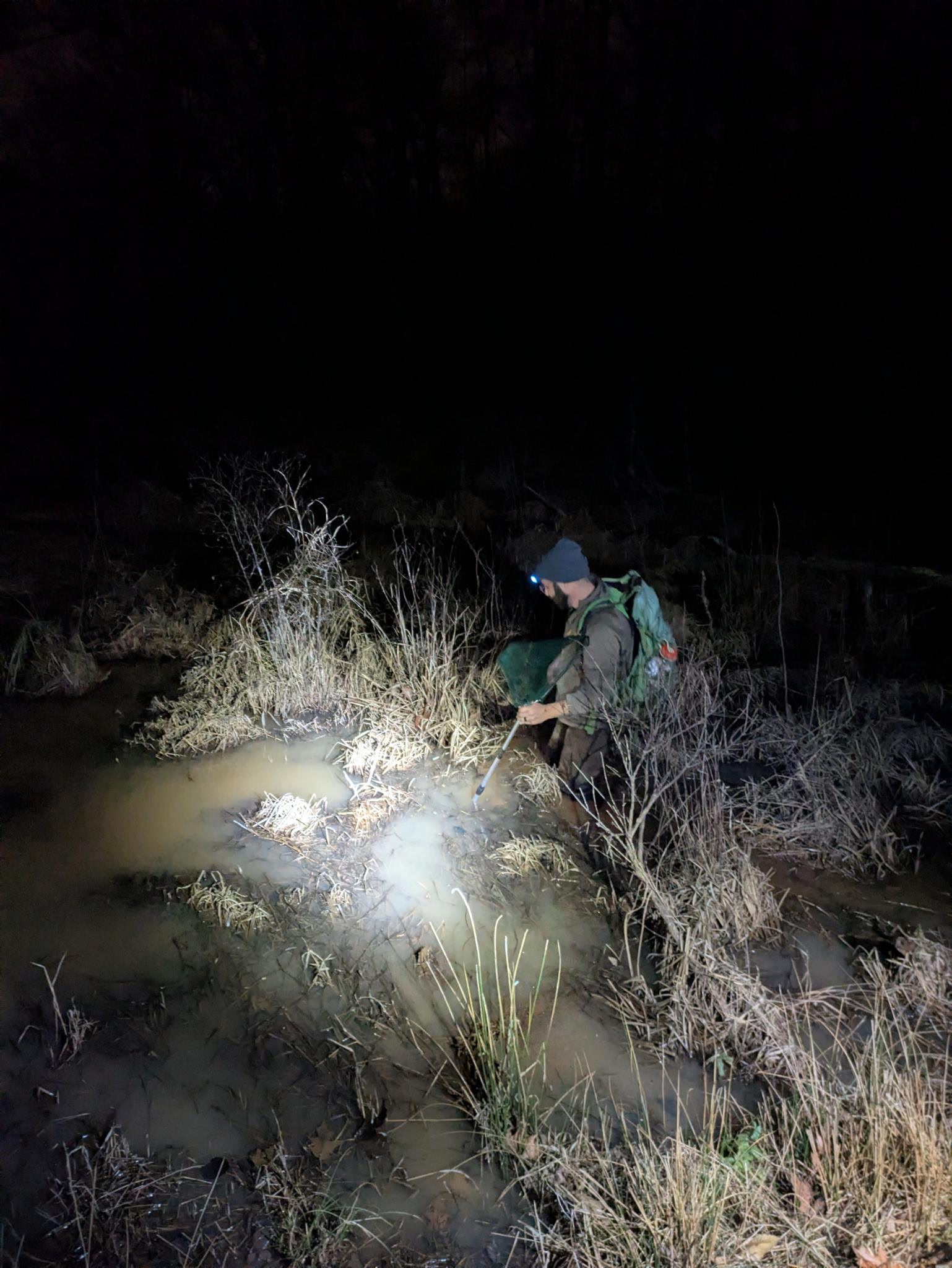
On our hike, we were able to track down and catch a spring peeper (Pseudacris crucifer).

It only took wading into knee-deep muck, and a carefully timed swing of a net!
The scientific name, crucifer, refers to the cross-shaped dark mark on their back, but their common name references their distinctive call—a high whistled “peeeeep”. Hundreds of them were calling from their breeding pond, creating an impressively loud symphony of sound.
We also heard many upland chorus frogs (Pseudacris feriarum). Despite being in the same genus as the peepers, their call is entirely different. They say a slow “crrrreeek” that sounds like fingers dragging over the teeth of a comb. They are extremely common here in the piedmont of North Carolina, but despite searching I still have yet to lay my eyes on one!
In a previous post I described keeping a birding life list. I am also nerdy enough to keep a list of all the reptiles and amphibians I’ve encountered in the US. It currently stands at 210 species, 43 of which are frogs. Upland chorus frog is on the list because I’ve definitely knowingly been within a few feet of one, but the entry gets the qualifying addendum of “heard only”. This is a term borrowed from birding—I’ve heard but not seen nine birds in the United States. Besides upland chorus frog, two additional heard only frogs make my list. While exploring the wetlands of Northern Minnesota, the knocking-on-wood sound of a mink frog (Lithobates septentrionalis) emanated from some nearby but inaccessible reeds. And just last week in the Savannah National Wildlife Refuge, SC, a pig frog (Lithobates grylio) called from the water’s edge next to an alligator haul-out spot. It really did sound like a pig grunting. I didn’t know what it was at the time, but I recorded the sound on my phone and uploaded it to iNaturalist. Within a few hours another herper was able to put a face to the sound.
Aural encounters are great, but as a member of a visual-centric species, I’d love the chance to “convert” these heard onlys into the spotted column. Goals like this will keep me adventuring on warm, rainy nights for decades to come.
 botanicalramblings