September 23, 2025: Fall Feeder Watch

I again waited until the last possible morning to conduct my seasonal feeder watch. I headed out to out to California on the 24th for the third and final run of the course for the year. As I mentioned in my last post, fall is a great season for migrants, so I was hoping to add something new to the yard list. When I get back to North Carolina in mid-November, migration will be mostly over and our winter residents will already be back in town!

7:00 Start of the observation hour. The only sounds are very loud crickets chirping.

7:01 I hear my first bird, a Northern Cardinal chip call.

7:03 American Crows call distantly.

7:07 A Downy Woodpecker calls from the neighboring yard.

7:08 Chimney Swifts circle overhead—my first seen bird. A White-breasted Nuthatch calls.

7:09 A Blue Jay flies into the yard calling.

7:10 Officially sunrise.

7:11 A Carolina Wren sings loudly in the yard. Carolina Chickadees join in.

7:15 An American Robin calls from the trees above.

7:17 A Northern Flicker calls.

7:18 I see a Brown Thrasher hopping around in the back bushes. A Song Sparrow calls from back there as well.

7:20 The local cardinals are calling loudly, but there is generally less bird song than any of my other three dawn feeder watches.

7:25 House Finches fly over calling.

7:33 A couple Eurasian Starlings fly over.

7:35 It is extremely quiet in the yard!

7:39 Three Mourning Doves fly over.

7:40A Tufted Titmouse calls

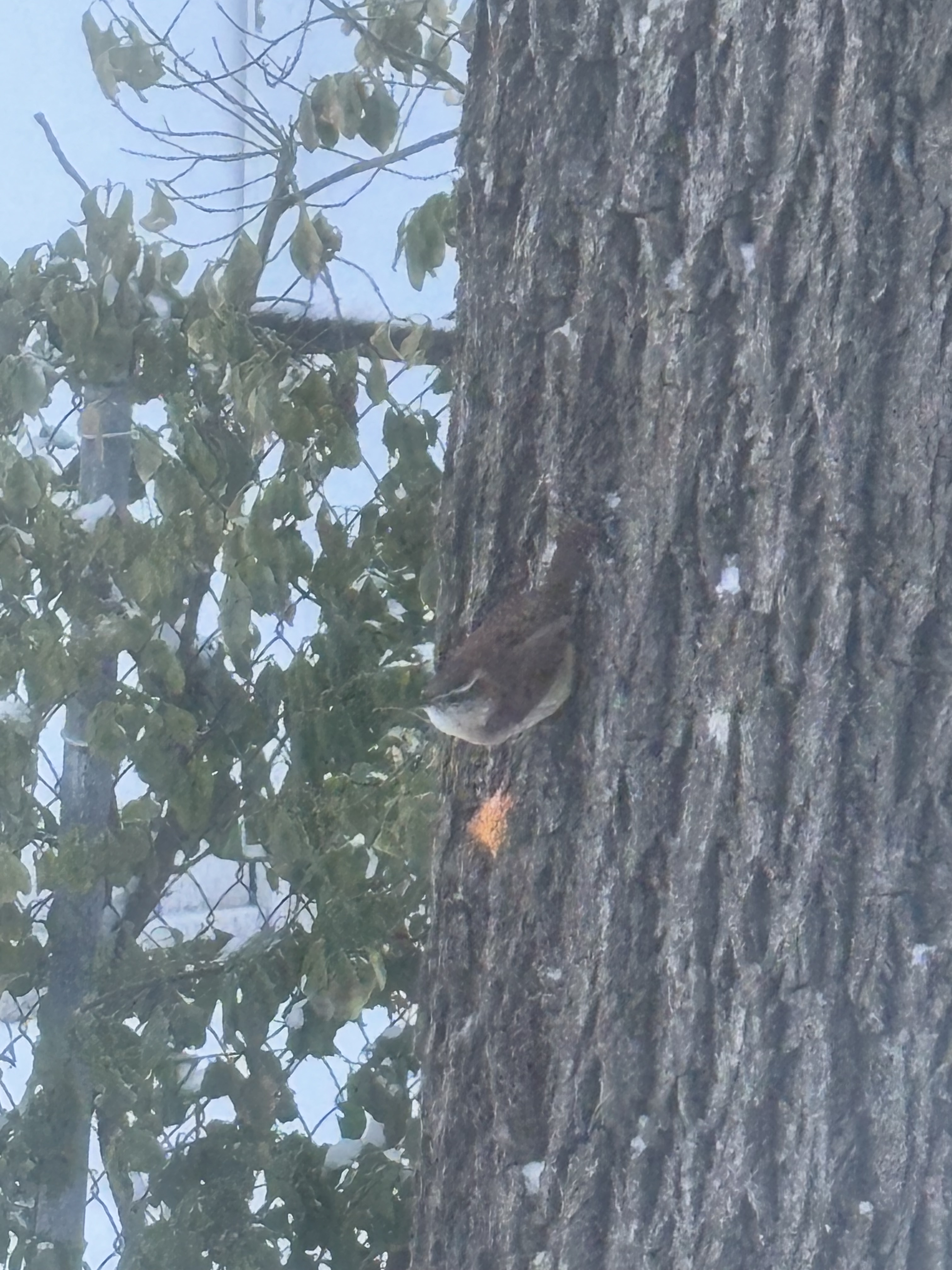
7:55 Wandering around to the front of the house, I see two small birds at the top of the large oak across the street. After staring for a few minutes, I finally identify one as a Cape May Warbler. The other bird is also a warbler, but I can’t make out which kind.

7:59 A Red-Bellied Woodpecker calls, the last new bird of the count.

Total: 19 Species

Most notable: Cape May Warbler! This is a true long distant migrant. The closest breeding populations are in Maine, and they all fly to the Caribbean for winter. While they are relatively common in the area in migration, they tend to prefer conifer trees. This was new yard bird #63.

Strangest miss: Eastern Towhee. I’m sure these large, resident sparrows were around somewhere, they just didn’t make their presence know during the hour. I was also hoping to tally a Ruby-Throated Hummingbird, as several have been around lately. Unfortunately, they didn’t put in an appearance either.

Comparisons: With everyone so quiet, I totaled five fewer birds than summer, only beating my winter tally by 1 species! All but two of the species overlapped with my summer watch, and only the Cape May Warbler was new (I had a flicker in the spring, but missed it in summer). Across all four seasons, I found 36 species of birds on these dawn watches—over half of the birds I’ve ever seen in the yard!
June 22, 2025: Summer Backyard Birding

Today is the last day before I head back to California, and a beautiful, warm morning for a feeder watch. The last northern-bound migrants finished passing through Forsyth county a few weeks ago. We currently only have breeding birds until shorebird migration and post breeding dispersal begin again in a month. Landbird migration will follow, not beginning in earnest until late-August. Overall, the backyard has been a bit quieter lately. While there still is a decent dawn chorus, the heat and the business of raising families has reduced a lot of the singing in the middle of the day. Birding is definitely now an early morning activity.

6:00 Start of observation hour. Already Song Sparrow, Carolina Wren, Tufted Titmouse and American Robin singing. Within the first minute, I also hear a Blue Jay and Common Grackle call.

6:02 A Gray Catbird flies into the yard. A House Finch and an Eastern Towhee call.

6:04 A European Starling flies over. A Tufted Titmousegrabs a seed from the feeder—my first customer of the morning.

6:05 Dawn officially breaks. A Northern Cardinal joins the morning chorus.

6:06 I hear a distant Mourning Dove and Downy Woodpecker.

6:08 Two male robins aggressively chase each other through the year.

6:12 A catbird visits the platform feeder. This feeder is new addition to our backyard array, and while setting out oranges on it to attract orioles has been a bust so far, it’s a big hit with the catbirds and towhees.

6:13 A Great Crested Flycatcher flies into the top of our acacia tree and begins calling loudly. We didn’t see this species last summer, but one bird has been hanging around the front yard since late May.

6:17 A Chimney Swift flies low overhead

6:22 The finches and cardinals are singing vociferously

6:25 A White-Breasted Nuthatch flies into our walnut tree and descends to the feeder

6:26 I spot a newly fledged robin in our oak, its spotted breast blending in well in the dappled light.

6:29 Brown-Headed Nuthatches are calling from the neighbor’s yard. They’ve been mostly absent all summer until showing back up a couple days ago.

6:32 A few American Crows fly by calling

6:33 A cicada begins calling briefly. A sure sign of summer, they started their clamorous chorus in earnest about a week ago.

6:35 Grackles and Blue Jays descend into the yard.

6:35 A Carolina Chickadee begins calling.

6:37 I spot a Great Blue Heron flying high overhead.

6:45 An Eastern Bluebird family (male, female, and fledgling) are in an oak tree across the street

6:50 The Downy Woodpecker comes to the feeder, and pigs out on seeds for the remainder of the watch

6:58 I walk to the back of the yard, and in quick succession hear a Fish Crow, Red-Bellied Woodpecker and spot a Brown Thrasher, the last birds of the watch.

Total: 24 Species.

Most notable: Great Blue Heron. While common in the area, we don’t really have any nearby wetlands or open fields nearby, which are the typical haunts of this species. This is the first time I’ve seen a heron (of any kind) from our place—and it’s my 57th species for the yard.

Strangest misses: The Red-bellied Woodpecker and Brown Thrasher I identified in the closing seconds would have both been big misses, as they are quite common summer residents. The local birds of both species have already fledged chicks, and are therefore keeping a lower profile than in the spring, when they were calling and singing almost constantly. Probably the next most likely bird that I didn’t see is a Northern Flicker. I see them most days, but it’s not strange at all to go an hour without one. A Brown-headed Cowbird visited the platform feeder 20 minutes after my watch ended.

Comparisons: As expected, I totaled fewer birds than spring, but more than winter. Nineteen birds overlapped with the spring watch, and five birds were new.

March 26, 2025: Spring Feeder Watch

I leave for California at the end of the week and won’t be back until the end of May. Therefore, this week was the last chance for a spring backyard bird watch. It’s still very early in migration in North Carolina, with the peak not happening until the end of April and early May. So far, I’ve only seen a handful migrant species in the area, and all our wintering birds are still present. However, many resident birds have begun establishing their breeding territories, practicing their songs, and I’ve seen some mating and nest building. Therefore, I was expecting a noisier feeder watch than my winter vigil, and was hoping for a migrant or two, as well.

6:45 Begin observation. It’s not even first light yet, but a couple Northern Cardinals and several American Robins are already singing, joined shortly by a Carolina Chickadee.

6:46 A Carolina Wren callsand a Brown Thrasher begins singing. In the past week our backyard thrasher has begun putting on virtuoso performances where he mimics many of the local birds. My favorite today was an excellent impression of the “potato-chip” flight call of an American Goldfinch.

6:48 An American Crow calls while flying by. A Song sparrow begins singing.

6:50 A Tufted Titmouse calls, then sings. Chickadees begin foraging in the oak trees overhead.

6:52 An Eastern Towhee calls

6:55 An Eastern Bluebird calls and gives a couple songs

6:56 A Yellow-bellied Sapsucker calls. This is our only migratory woodpecker—the pair that’s been wintering in our yard will be heading north in a couple weeks. The American Robins that have been singing and calling continuously begin chasing each other through the yard.

6:58 Two Blue Jays fly into our magnolia—the first bird this morning I saw before hearing.

6:59 Northern Cardinals visit both the bark butter and the bird feeder. A European Starling flies by. A White-Throated Sparrow calls.

7:02 A Downy Woodpecker calls

7:04 White-Throated Sparrows and a Carolina Wren visit the bark butter

7:09 Several European Starlings fly into our large oak tree, and one does a Killdeer impression that fools my Merlin bird sound identification app.

7:10 A Yellow-rumped Warbler calls from the trees. A few Dark-eyed Juncos attack the bark butter. A Ruby-crowned Kinglet begins to sing. It’s loud out here!

7:12 The Brown Thrasher takes a break from singing to visit the feeder. It’s awkward to watch—he’s too big to sit comfortably on the lip, but he makes it work. The feeder has much less action than when I did this watch in winter, likely because emerging insects are now an alternative food source.

7:16 Sunrise.

7:17 A House Finch comes to the feeder.

7:24 A female Brown-headed Cowbird visits our neighbor’s feeder before two males spot her and begin a chase.

7:26 A Mourning Dove flies by, followed by a Common Grackle. A large flock of grackles descended on our street about a month ago and seemingly hasn’t left since.

7:29A White-breasted Nuthatch begins foraging on the branches of our large oak

7:33 A Northern Flicker calls loudly

7:34 I spot a Blue-headed Vireo foraging slowly through the newly emerging leaves of our neighbor’s oak.

7:35 An Eastern Phoebe calls.

7:39 A Fish Crow calls, the final new species of the day.

7:45 End observation.

Total: 27 species.

Most notable: Definitely the Blue-headed Vireo. This was a new yard bird (# 53)! In North Carolina, Blue-headed vireos winter on the coastal plain and breed in the Appalachians, but they are only seen as spring and fall migrants on the Piedmont. There’s only one other record in eBird for Forsyth County so far this year, so I’m pretty excited about this one.

Strangest misses: Northern Mockingbird and Red-bellied Woodpecker. After fiercely defending the feeder all winter, Marty the Mockingbird has been very subdued recently. I’m wondering if the aggressive starlings and grackles that have shown up in numbers in recent weeks have caused Marty to tactfully retreat. I did see our resident male Red-bellied Woodpecker at the feeder 10 minutes after I ended the count. He has also been affected by the starlings. A month ago, Jenny and I noticed him beginning to excavate a nest cavity in a dead branch of our front yard maple tree. After several days of pretty much continuous labor, his work was complete. The craftsmanship must have been high quality, because after an inspection, a female decided to move in. Unfortunately, several starlings were also impressed with the work and wanted to take over. A weeks-long war ensued for control of the nest, with battles won and lost by both sides. Now it seems the startlings have emerged victorious, and the original builder is left without a home. I don’t like starlings.

Comparisons: 15 species overlapped with my January 11th watch, and 12 were new. I only didn’t see three species that were on the winter watch—Golden-crowned kinglet, American Goldfinch, and Northern Mockingbird.

January 11: Snowy Morning Feeder Watch

A big winter storm hit Winston-Salem on the night of January 10, dumping a few inches of snow onto our yard. The next morning was forecast to be sunny and calm—perfect snow day conditions! I decided to wake up early and do an hour-long bird feeder watch, beginning just before first light. Here is my log from that watch:

7:00 am: Begin observation

7:07 First bird—Marty the Northern Mockingbird perches on the lip of our raised flower bed

7:14 Northern Cardinal calls

7:16 Marty snacks on some bark butter I had smeared on a tree trunk

7:17 Yellow-Bellied Sapsucker calls

7:19 White-Throated Sparrow and Dark Eyed Junco flock arrives, a junco snags some bark butter

7:23 American Crow calls

7:24 Ruby-Crowned Kinglet arrives, snags some bark butter

7:25 Carolina Chickadee begins chattering, and then visits the main feeder—the first bird to do so.

7:26 Tufted Titmouse and White-Breasted Nuthatch calling in the trees overhead

7:28 Carolina Wren begins singing vigorously, then eats some bark butter and fights with another wren

A Carolina Wren visits a smear of bark butter in the snow

7:31 Sunrise

7:38 A flock of House Finches and American Goldfinches flies overhead, calling. A Blue Jay flies into the magnolia tree and begins yelling at everyone

7:43 Golden-Crowned Kinglet and Yellow-Rumped Warbler briefly stop by the yard, joining the flock of activity

7:50 Marty the Mockingbird perches on top of the feeder and begins chasing away other birds

7:57 Song Sparrow sings from the bushes at the back of the yard

7:59 Carolina Wren visits our small window feeder, so far, the only species I’ve seen do so since we put it up last week.

8:00 Mourning Dove flies by, the final species to make the count. End observation.

Total: 18 species

Most notable: Yellow-Rumped Warbler. A bunch of them winter in our area, but they don’t come to our back yard that often

Strangest miss: Downy and Red-Bellied Woodpeckers are usually around, and both showed up later in the day. Eastern Bluebirds are also common in our backyard, but they tend to visit us in the afternoons.

While I very much enjoyed my time, one hour-long watch by itself isn’t particularly laden with importance. The power of careful observation comes with time and repetition. Since moving here in March, I’ve now submitted 21 eBird checklists from our backyard and seen or heard 48 species. I’m starting to get a sense of what’s “normal”. As the seasons go by, it’s exciting to see migratory birds arriving and leaving, behaviors changing, birds molting, and fledglings appearing on the scene. My plan is to repeat my dawn feeder watch three more times this year. I’m excited to compare and contrast these seasonal benchmarks.

Zooming out, my hour-long observation becomes one data point out of the 103 million checklists submitted to eBird. These checklists come from over 1 million birders from across the world. At this scale, scientists can see patterns of migration, habitat use, and population increases and declines. The data helps inform important conservation decisions and even legislation. Not bad for a snowy morning spent in front of a window.