January is coldest month of the year here in Winston Salem. Historically, that means lows around freezing and highs near 50. This week however, winter truly came to the South. Extended time with temperatures in the 20s have iced over portions of ponds and cemented leaves to hardened mud. I was curious to see how salamanders, the most numerous vertebrate denizens of that muck, were handling the artic blast.
Bundling up, I headed over to a local park to begin the search. Unless it’s a warm, wet night when salamanders are migrating to their breeding ponds, finding these little guys mostly involves lifting things. Flipping over rotting logs, moving rocks on the edges of streams, and sifting through leaves in wet depressions are all great strategies for locating the various species. I tried these techniques at several spots with no success and increasingly numb hands. Maybe the cold drove everyone deep underground.
Finally, I lifted a medium-sized moss-covered rock and saw two little eyes staring back up at me from the mire below. I quickly grabbed the little guy to get a closer look. Dark and speckly all over, it had faint orange-red blotches down its back and a lighter angled stripe from the back of its eye to its jaw. That was enough to identify it as a wolf dusky salamander (Desmognathus lycos). Normally, this species is quite squirmy when captured. Not so this time. The salamander sat in my hand as cold and unmoving as the rock from under which it came.
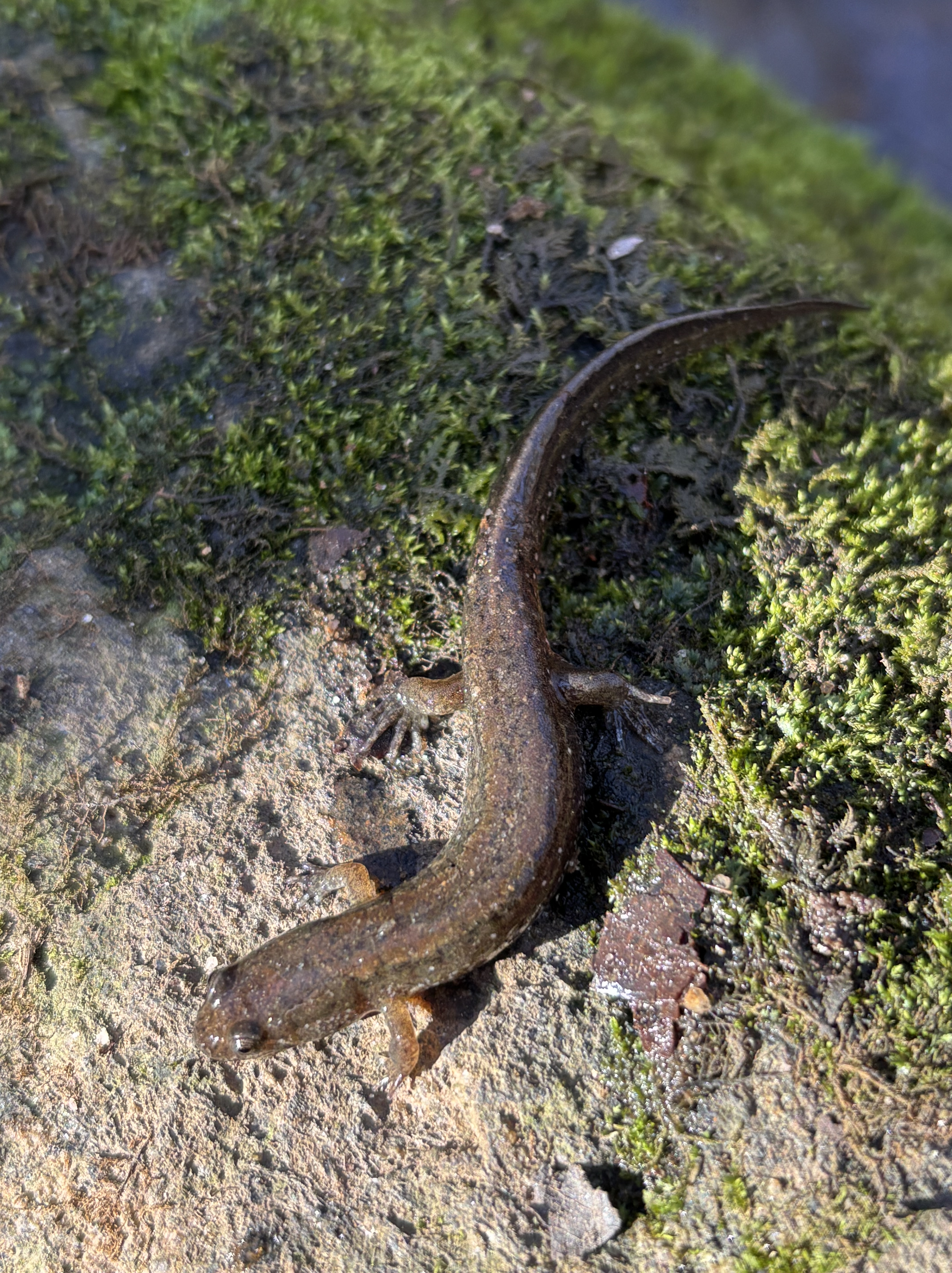
I took the opportunity to carefully pose the salamander on top of a rock for some pictures. My plan was then to hold it for a while to see if the warmth from my hands would gradually get it moving. I looked away for a moment while re-stowing my phone, and to my surprise, when I looked up, it was gone! Somehow a cold-blooded critter living in water just above freezing had mustered up a burst of energy and launched itself off the rock, giving me the slip!
Not to be so easily defeated, I flipped a couple more of the surrounding rocks before relocating the escapee. It was once again motionless, giving no indication of the amazing athletic feat it had just accomplished. I scooped it up and set it down—this time on some leaves a couple feet away from the rocky area. Surely this was a spot where I could watch it move around for a bit, gently redirecting it if it approached a hiding place. When moving quickly, dusky salamanders don’t run as much as pivot forward. Their small legs serve as fulcrums, as they swivel their body in a zig-zag. Their long tails flail back and forth, acting as a counter balance. In describing it, it’s hard to imagine how this motion can be rapid. But before I could act, the little guy covered the distance to the stream, leapt in, and swam, dragon-like, to a crack beneath large rock, disappearing for good.
I was left with my pictures, from which I attempted a sketch. I’m by no means a great artist, and I haven’t captured the correct proportions. but the act of drawing is a powerful way of honing one’s powers of observation. Therefore, I’ll share it here anyway. I learned a lot from the act of sketching, but my biggest takeaway was a confirmation of something I already knew—salamander toes are weird.

 botanicalramblings