June 18, 2025: Botany or a Chase

It’s already my last week before heading back to California for the summer run of the California Ecology and Conservation course. June is a great month to naturalize in the Carolinas, and with time running out, I’m attempting to squeeze in as many outdoor adventures as possible. Therefore, I decided on a super ambitious itinerary for my last solo trip of spring. I left the house at 3:45 AM to make it to the Carolina Sandhills National Wildlife Refuge in northern South Carolina at dawn. I wanted to hike around and botanize in three different parts of the large refuge. Then, the plan was to drive 90 minutes west to Rock Hill, where there is a Scissor-Tailed Flycatcher pair that currently have fledglings. Finally, I would make the long drive back north, arriving before 5:00 pm.

Scissor-Tailed Flycatchers are a beautiful and graceful bird that mostly breeds Texas, Oklahoma, and Kansas. They are also the most common bird in the entire United States that’s not on my birding life list (currently at 617 species), making them a high priority for me to see. Because they perch in the open and would be staying close to the nest—a nest for which I had the exact coordinates—tracking down this out-of-range family would be quite easy.

When planning a trip, I have the tendency to overschedule or pick the more ambitious option. Then, my completionist tendencies make me want to see the plan through, even if I have to rush or it stops being fun. I’ve dubbed the worst cases over the years Timventures. I’ve also maybe become a bit too enamored with adding species to my life or year lists. While it’s really fun to document what I’ve seen, it’d probably be a good idea for me to pump the breaks a bit on obsessively listing. Was it worth it to drive the extra distance to see an amazing new bird, or was I planning a Timventure?

I arrived at the entrance to the sandhills early enough that the nighthawks were still calling. I’ve sung the praises of sandhills in my March 12th post, when I visited Carver’s Creek State Park. The Carolina Sanhills NWR is another amazing example of the habitat. It’s managed as a gameland for things like ducks, turkey, and bobwhite quail. Therefore, in addition to frequently burning the longleaf pine forest, the Fish and Wildlife staff also maintains a series of ponds and wetlands at appropriate water levels and keeps open fields at varying levels of ecological succession. The result is an amazing diversity of plants.

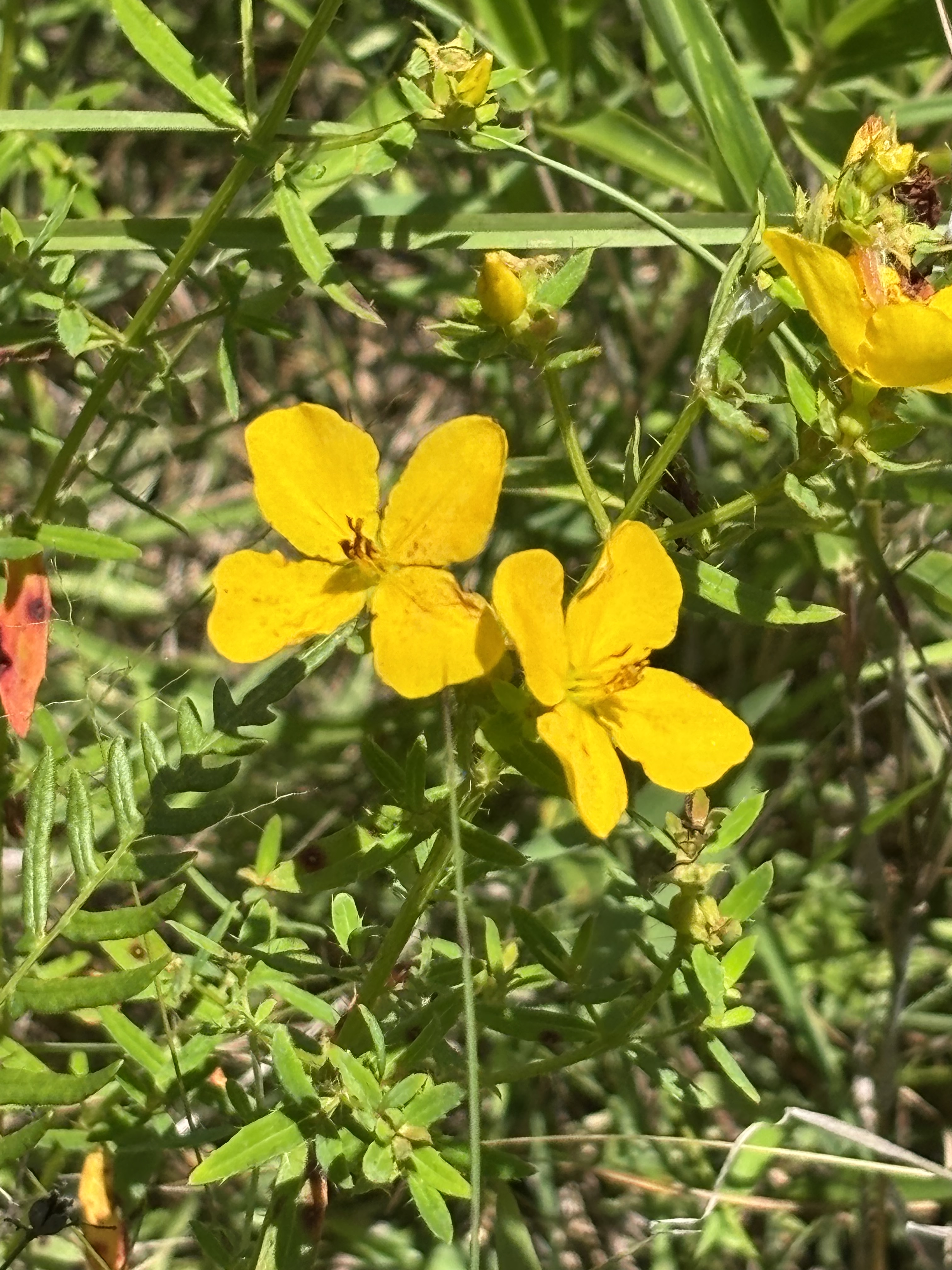
Immediately upon arriving at my first stop, I found large patches of a plant that was new to me—Stylisma patens (sandhill dawn flower).

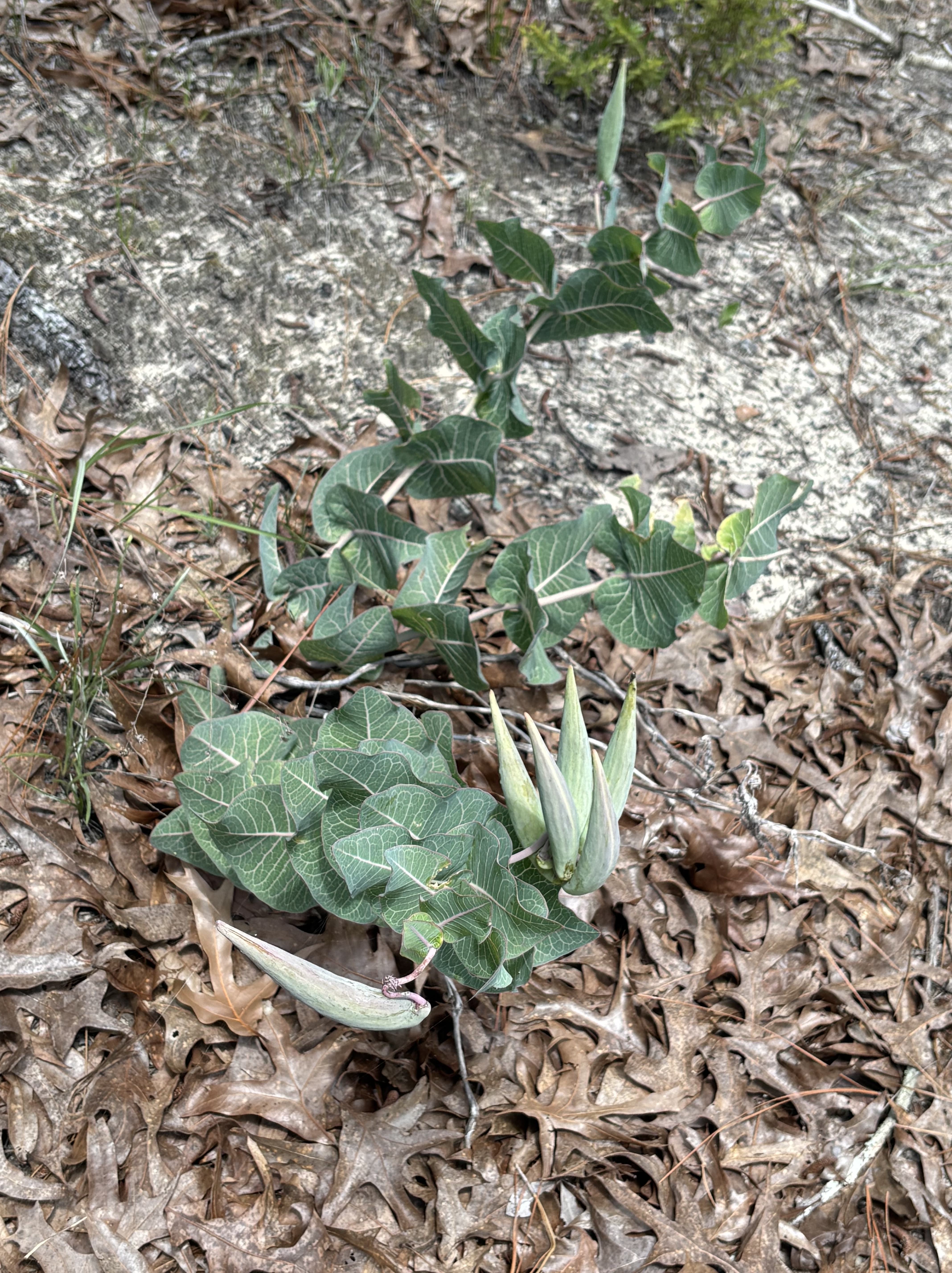
This uncommon little morning glory fits the pattern of many of my favorite finds of the day. It occurs in the sandhills, which run in a narrow strip from south central North Carolina through central Georgia, and also in longleaf pine forests on the coast from Wilmington down through the Florida panhandle. Within that range, it only does well in pristine, fire-managed landscapes. Here are a couple more plants that fit that same profile—Asclepias humistrata (sandhills milkweed) and Penstemon australis (southern beardtongue).
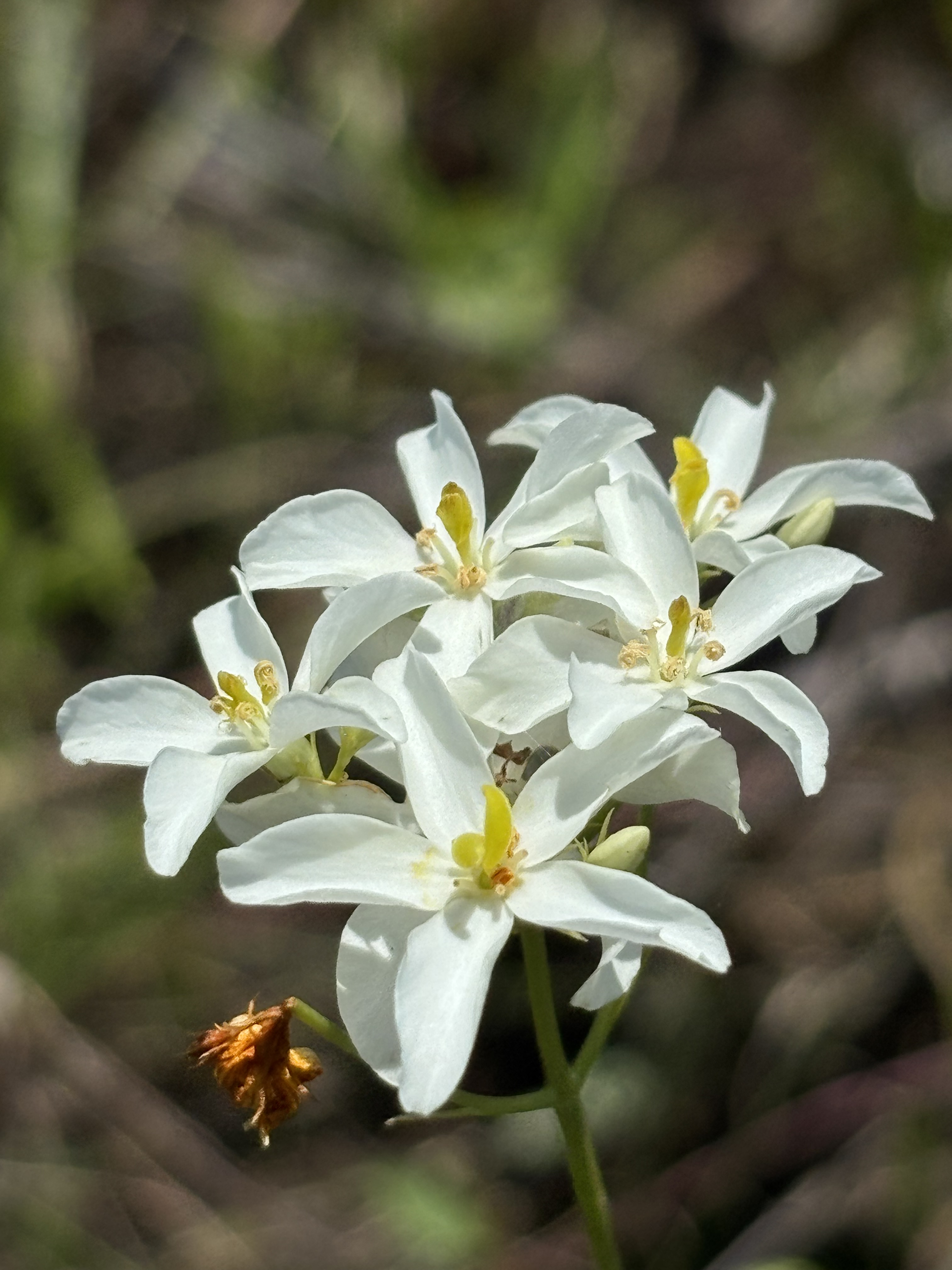
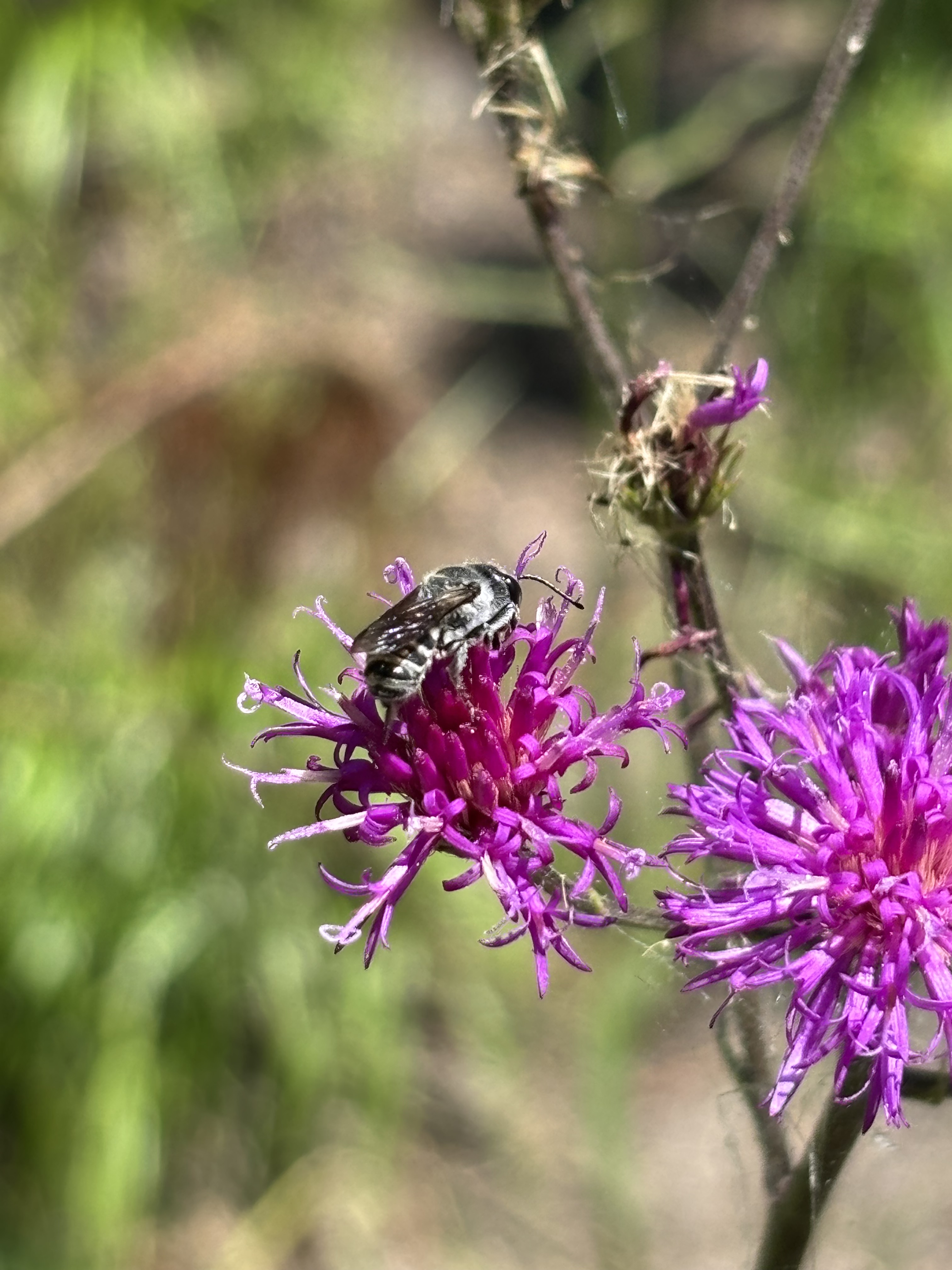
In addition to the cool plants, I was also amazed by the abundance of bees in the area, benefitting from the open ground for nesting and abundance of floral resources. As far as I could tell, they were all native—not a honey bee in sight. Here are three examples of native bees visiting uncommon flowers: Megachile on Vernonia acaulis (stemless ironweed), Lasioglossum on Xyris caroliniana (Carolina yellow-eyed grass), and possibly Halictus on Mononeuria carolinianum (pine barren sandwort).
It was already noon when I made it to my third sandhills stop. I stepped out of the car to se a lush green hillside splotched with bright yellow. These were big patches of Sarracenia flava (yellow pitcher plant)!
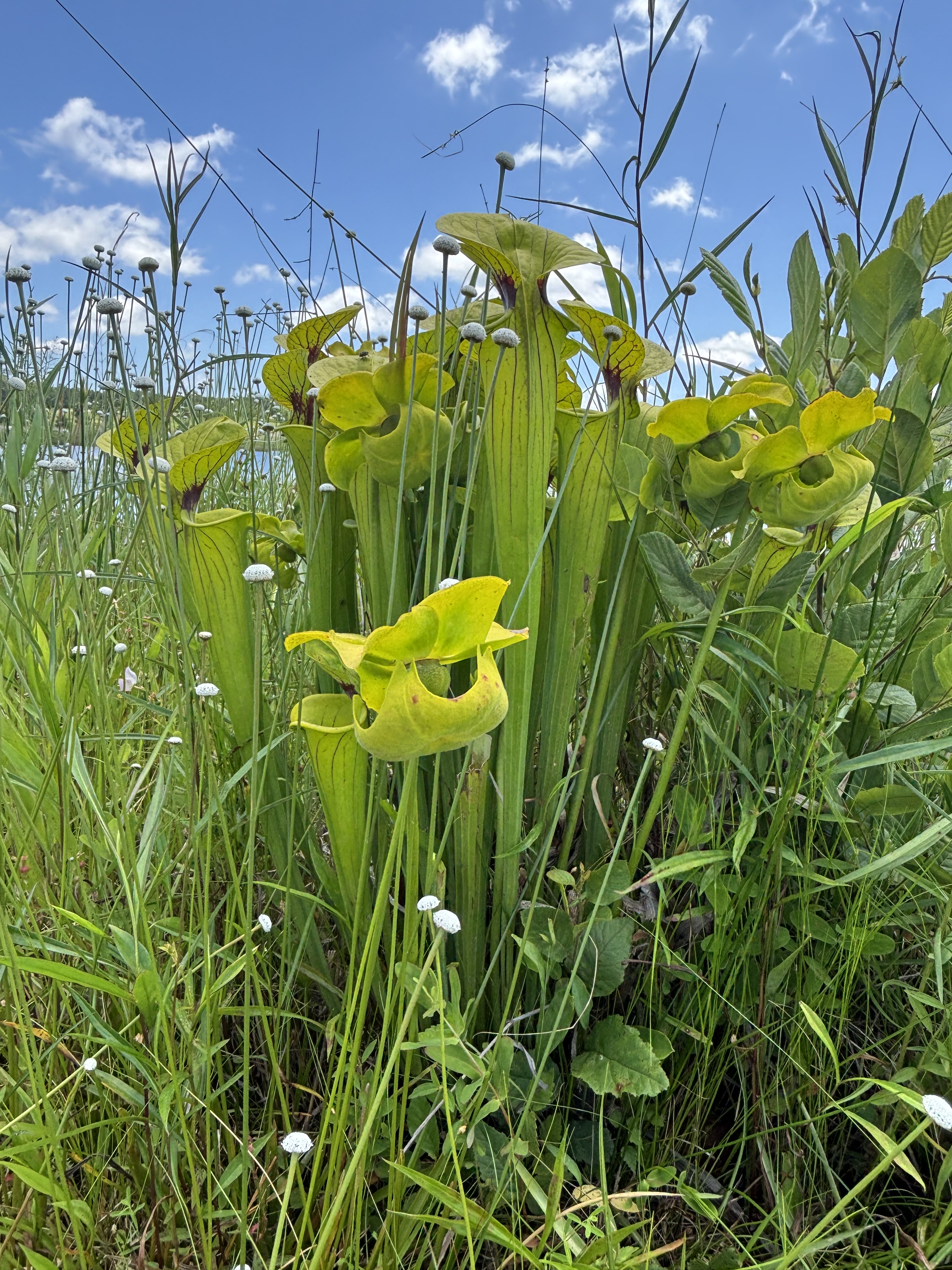
The area was a recently burned seepage slope—a habitat I hadn’t encountered before. I had a choice—take a quick look and hurry over to the flycatchers, or spend some quality time exploring the slope. Uncharacteristically, I chose the latter—I’ll add to my birding life list another day. And I am really happy with my decision. The area had the best botany of the day. Here are my six favorite finds from the seepage slope:

In the future, I’ll have to remember that not rushing to complete a Timventure can be an excellent decision. And it’s not like I missed out on birding entirely—I ended the day with 57 species including the rare Red-Cockaded Woodpecker and Bachman’s Sparrow, the declining Northern Bobwhite and Eastern Meadowlark, and some great observations of Orchard Orioles and Prairie Warblers. It was, all and all, another fantastic day in the sandhills.
April 23th, 2025: In Praise of Black Mustard

Part of being a botanist in California is coming to terms with all the non-native species. Over 1,000 species of plants are naturalized in the state—meaning they have established populations through reproduction outside of cultivation. Some 250 of these are serious invasives that can take over an area and negatively impact natives. In California’s grasslands in particular, almost all of the biomass originated elsewhere. Botanizing here often involves sifting through a lot of trash to find a few native treasures.

However, it’s not the plant’s fault that they’re not from here. I need to remind myself that every species on earth is the product of billions of years of evolution and is worthy of admiration and appreciation. In that spirit, I’ve decided to say ten nice things about black mustard (Brassica nigra), a particularly abundant invasive species here at my current location, Sedgwick Reserve in Santa Barabara county.

1. It’s amazingly adaptable. Black mustard is native to Europe, but has established populations on all six contents that aren’t permanently covered by ice. In North America, it’s found from Southern Canada through Central America, making a living across an amazing range of climatic zones

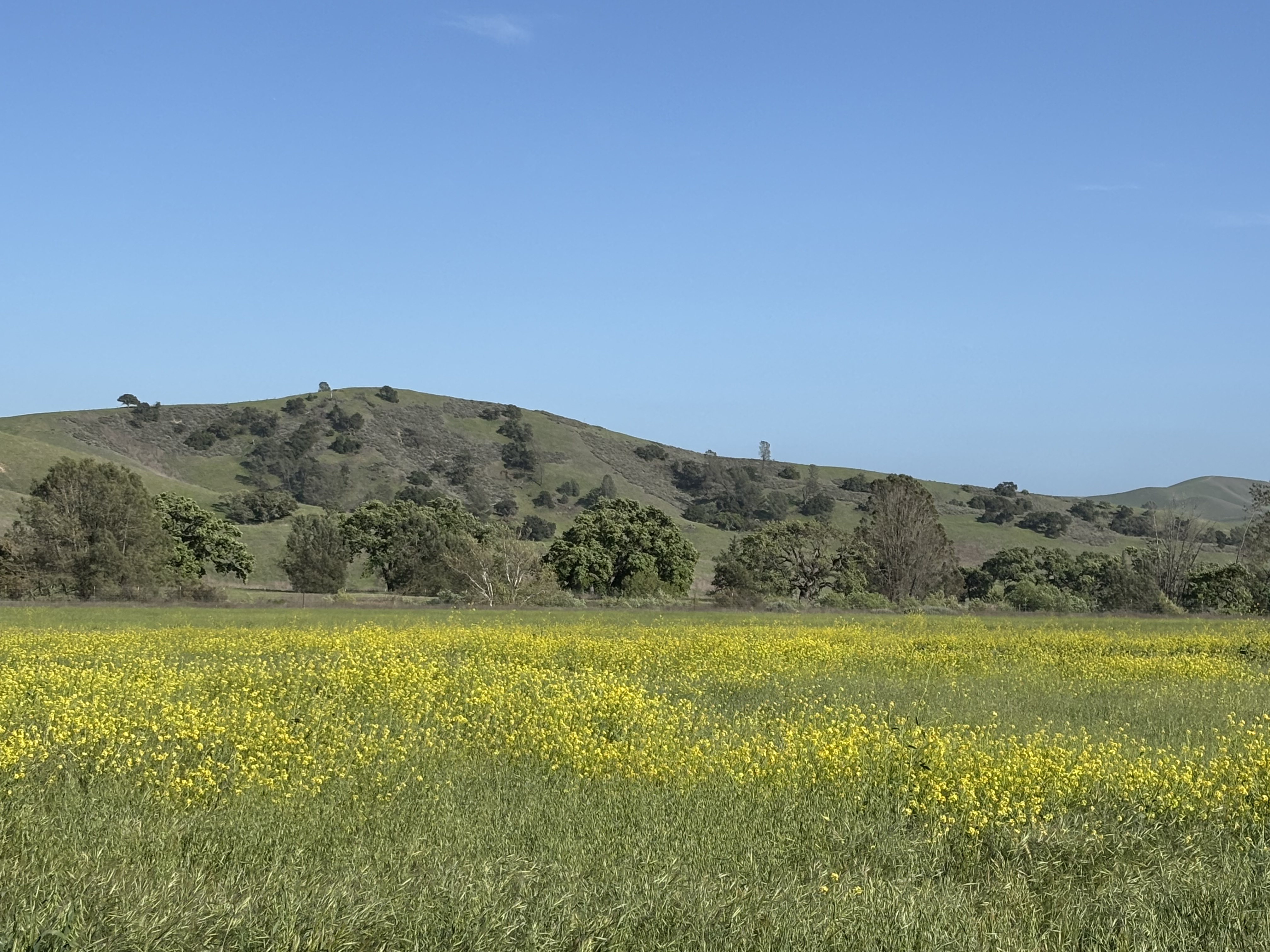
2. It carpets valleys and hillsides and in a beautiful bright yellow. A field of mustard is an objectively spectacular site that can be seen from miles away.

3. It can achieve great heights. Black mustard is a winter annual plant, germinating with the first rains, blooming in spring, and senescing by late summer. In their short life, they regularly grow to six feet tall, and I’ve seen exceptional plants here at Sedgwick that measure at least 10 feet.

4. It has interesting chemistry. Black mustard is in the Brassicaceae family, which is known for making some crazy secondary defense compounds. The production of these compounds, many of which have evolved as defense against herbivores, is carefully controlled by the individual plant. While effective against many species, they are metabolically expensive to make. Therefore, rather than just always making them, mustards upregulate their production as a response to exposure to herbivores like snails or caterpillars. Additionally, these compounds can backfire! Specialist herbivores that only eat mustards can detect small amounts of these compounds in the air, using them to find their target.

5. It wages chemical warfare on its competitors. Black mustard is known to be allelopathic. It produces chemicals in its roots and other tissues (different ones than the herbivory defense compounds) that enter the soil, suppressing the germination and growth of other species of plants. That makes it easier for mustard to completely take over an area, and harder to re-establish native plants even after mustard has been cleared away. It’s annoying as restoration ecologist, but amazing as an adaptation.

6. You can eat it! All parts of mustard are edible, and have been prepared in various ways for at least 2,000 years. The leaves can be pickled, the shoots cooked, the flowers used as a garnish, and the seeds are the spiciest of all mustard species.

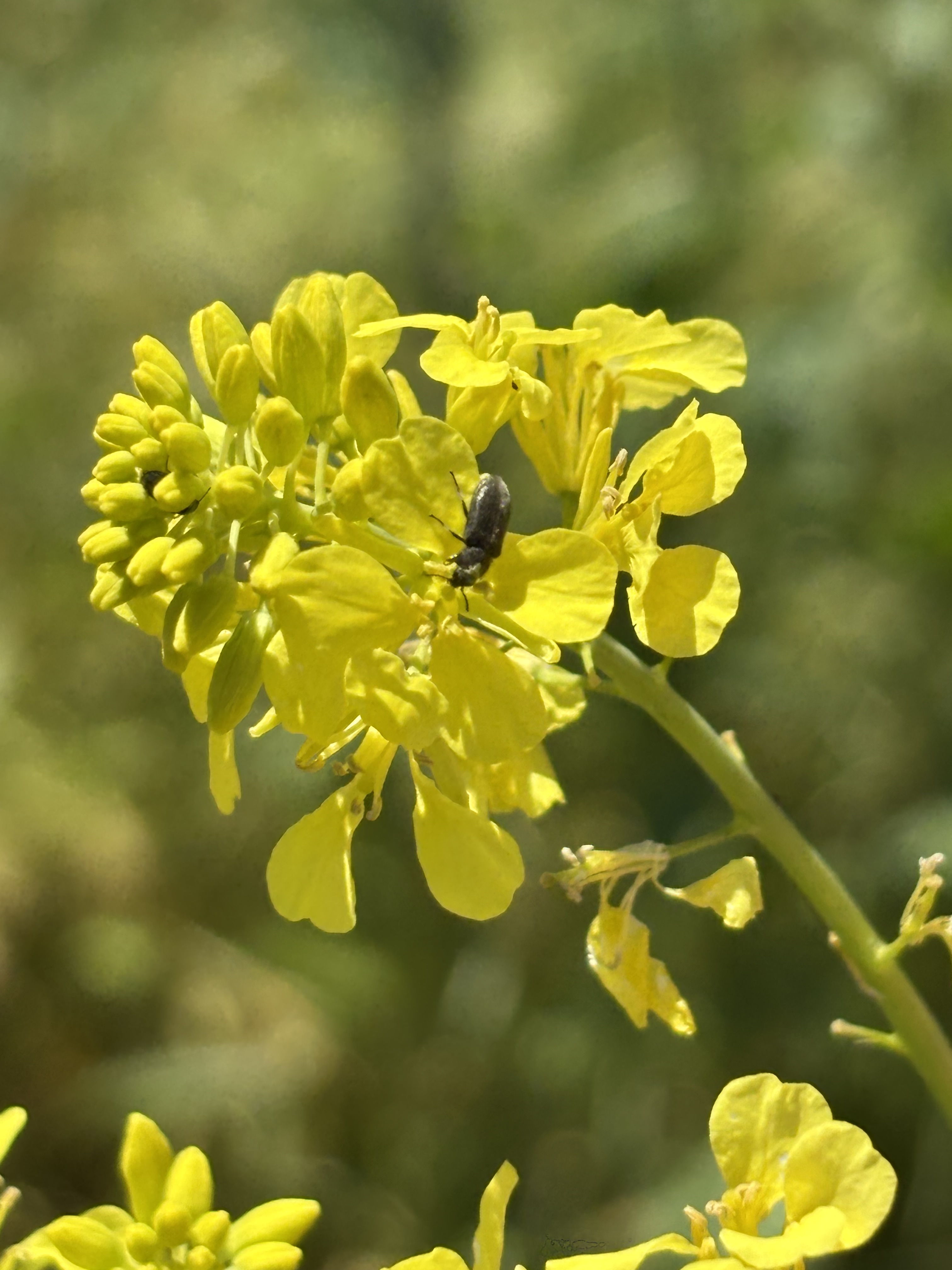
7. Its flowers are intricately arranged. The clawed petals, 4-2 arrangement of anthers and linear yellow sepals are quite lovely. Here’s my stab and illustrating them.

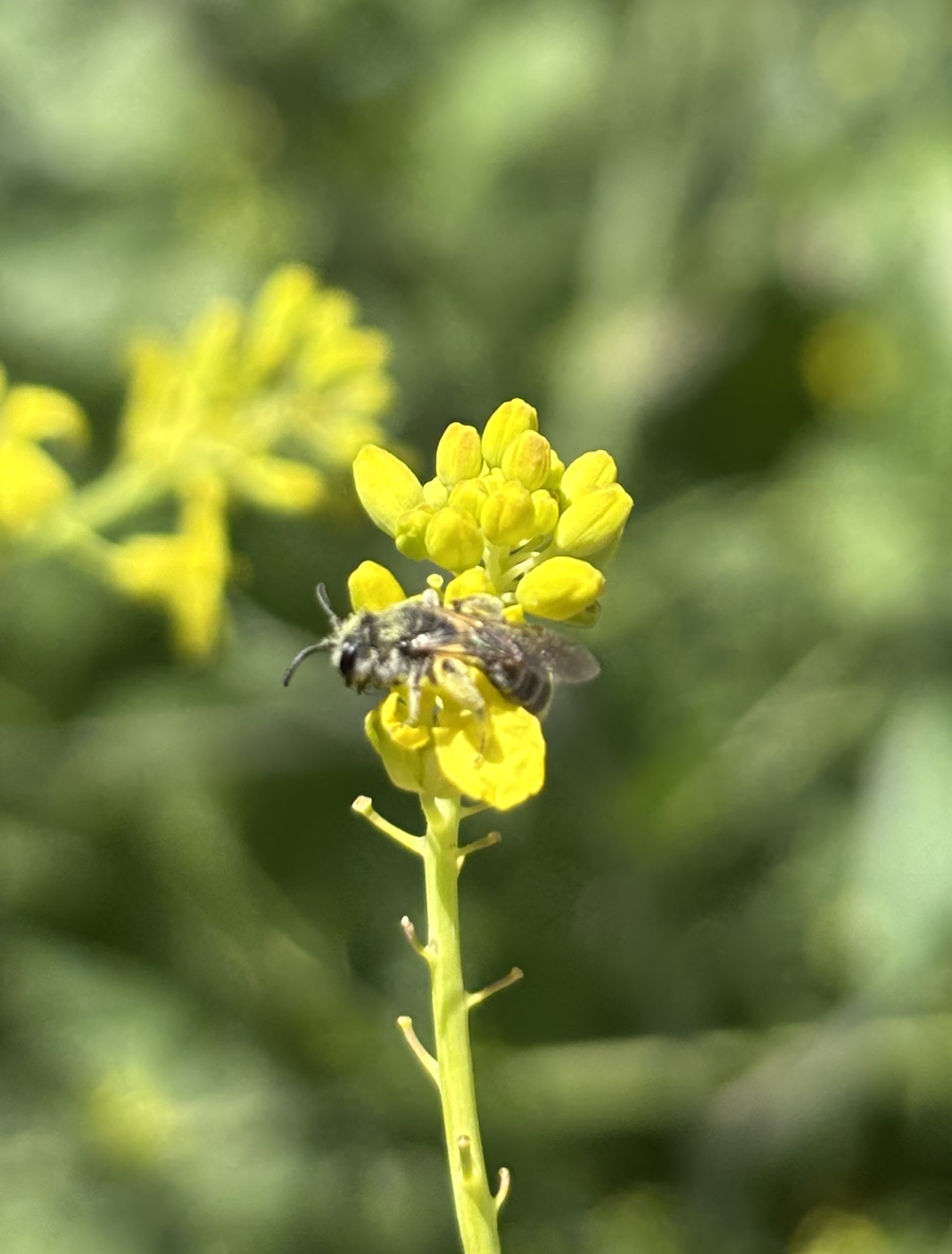
8. It’s great for pollinators. I wandered through a patch this afternoon, and found a number of beetles and solitary bees happily collecting pollen. There are plenty of other flowers blooming here right now, so visiting mustard was an active choice. Sweeping the plant with a net revealed a suite of other insects including flies, aphids, and more beetles.

9. Birds love it. Mustard seeds are eaten by a number of bird species, including the enigmatic Lawerence’s Goldfinch. All those bugs make tasty snacks for additional species, such as the federally threatened Tricolored Blackbird. And the tall stems make a great singing perch for birds like Savannah Sparrows and Lazuli Buntings. I saw all of these interactions this week.

10. It’s not star thistle! Black Mustard is a gnarly invasive plant, but it’s still less detrimental to the ecosystem than some species. For instance, star thistle (Centaurea spp.), takes over a landscape faster than mustard after disturbances, it harder to get rid of once it does, and its sharp spines can make very unpleasant to move though a landscape. I’ll take a field of black mustard over star thistle any day!

Astragalus

My last couple blog entries have been about very “Californian” taxa, with their centers of diversity in the Golden State. With over 2500 species spread across all 6 of the continents worth botanizing, Astragalus is much more cosmopolitan. Still, California has its fair share, with nearly 100 species (and many more varities). I’ve collected photos of 18.

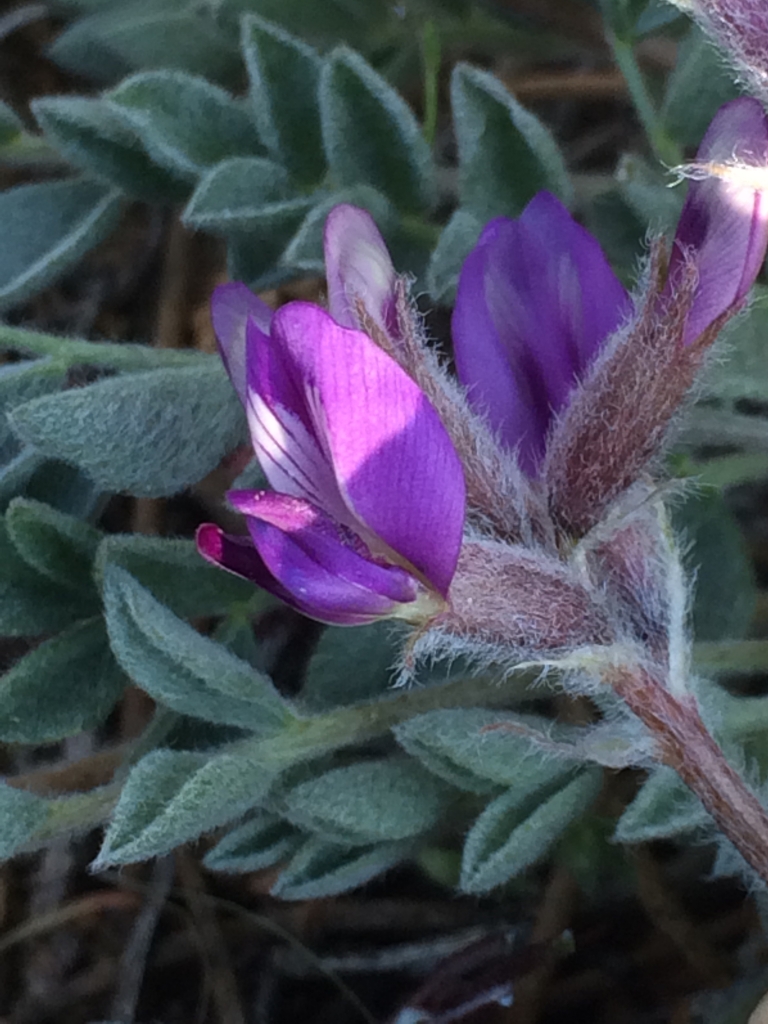
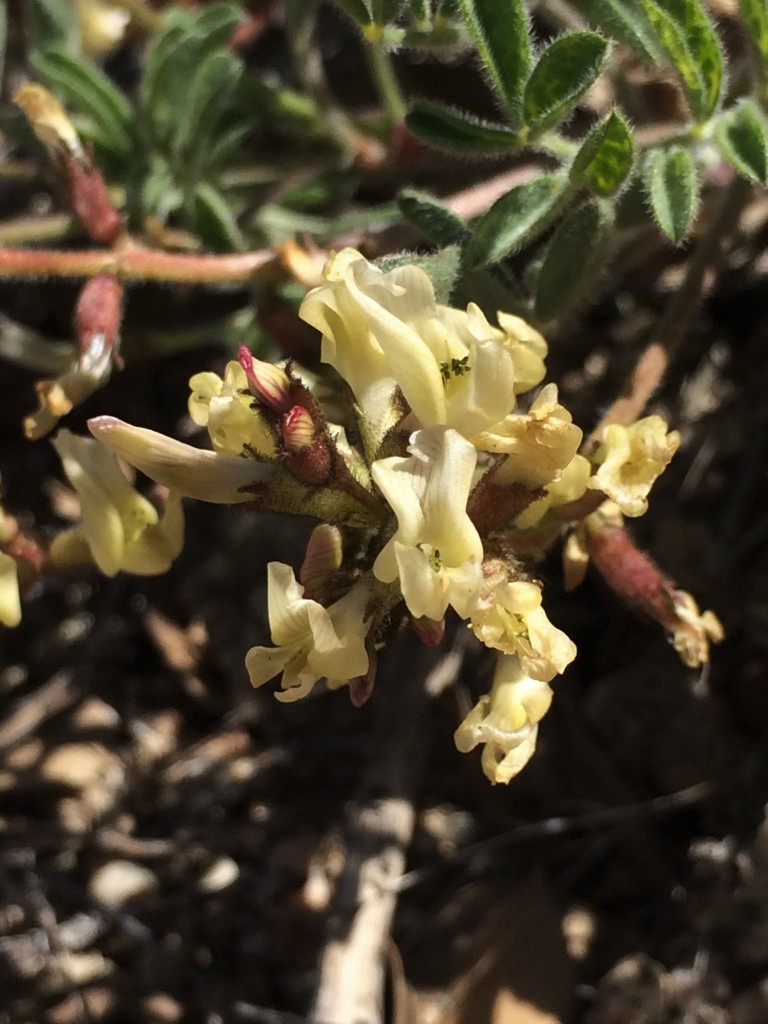
Astragalus is in the Fabaceae, or pea, family, which is one of the most easily recognizable. Flowers (at least in the subfamily Paplionoidae) have a characteristic bilateral shape, with a large banner petal on the top, two wing petals off to the sides, and two bottom petals fused into a shape resembling the keel of a boat. This close up of Astragalus purshii, a common mountain species shows the flowers well.

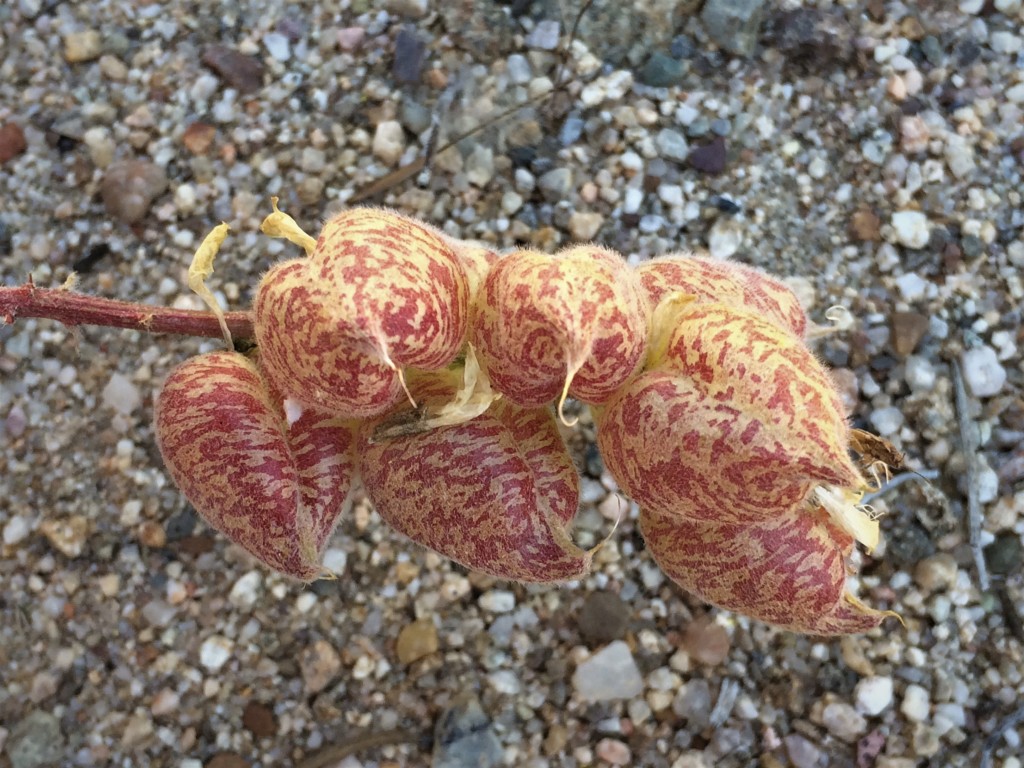
Fabaceae is even more recognizable by their pod-shaped fruits called legumes. In many members of Astragalus, these pods are inflated into fun, pop-able pouches. Here they are in Astragalus lentiginosus–in this species, they also happen to be freckled

Finally, this family tends to have compound leaves–in the case of Astragalus they are pinnately compound with leaflets arranged across from each other along a central axis. Look in the background of this lovely Astragalus lanyeae from the Mohave desert.

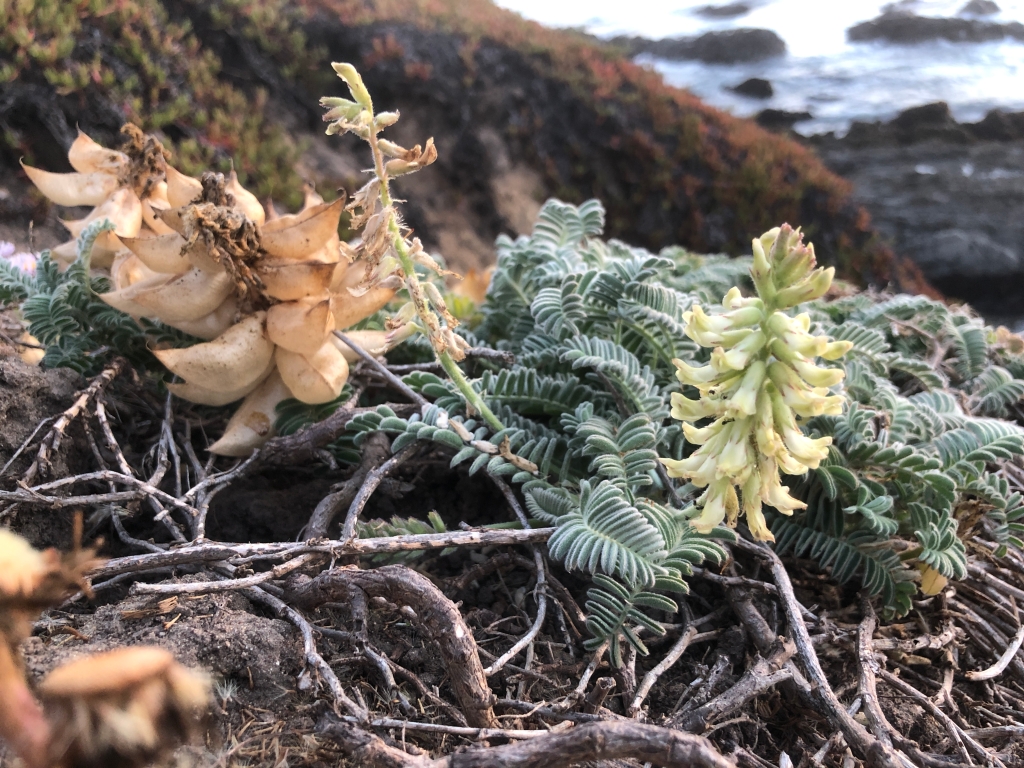
You can refer to plants in this genus by two different common names. The first, milkvetch, works for all species. But a number of species such as the A. lentiginosus shown above and this Astragalus nuttallii from coastal bluffs in along the central coast, produce a toxic compound called swainsonine.

This compound apparently tastes fine to livestock who will preferentially munch on Astragalus plants. If animals eat to much of it, it causes vacuolation and subsequent destruction of neurons. The resulting abnormal behaviors of poisoned livestock were noticed by ranchers in the 1800’s. They dubbed the plants “locoweed”. Unfortunately for the plant, knowledgeable ranchers will remove Astragalus from their pastures threatening the survival of some of the rarer grassland species.

Most Astragalus (and actually Fabacaeous plants in general) are bee pollinated. The stigma and stamens are enclosed in the keel. When a bee lands on the flower, its weight pushes the keel downward exposing the reproductive parts and allowing for pollination. Butterflies and flies just aren’t heavy enough to trip the keel. Here’s Bombus vosnesenskii pollinating Astragalus oxyphysus, one of the aforementioned threatened locoweeds from San Joaquin valley

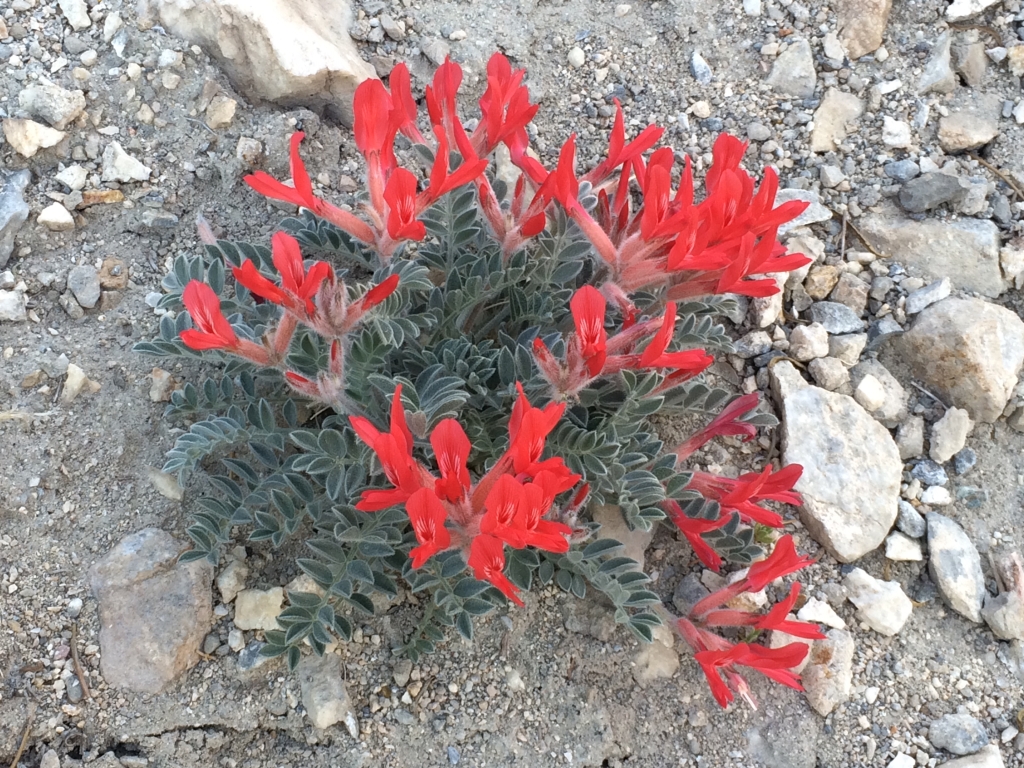
The glorious exception to bee pollination in the genus is Astragalus coccineus, found in pinyon pine woodlands in desert mountains. This species makes use of hummingbirds that presumably press down the keel with their chin.

Even more than most taxa in California, Astragalus is a genus of extreme endemism. Many, many species are restricted to a very specific habitat in a very specific area. Even more widely distributed species, such as the A. lentiginosus and A. purshii are further subdivided geographically into varieties. Wherever you are, there’s likely a rare Astragalus near you. Here are just four of my favorite rare Astragalus:

Astragalus tener, a cute little annual specializing on vernal pools in the Bay delta.

Astragalus pycnostachyus, a stout perennial found in a few coastal saltmarshes in San Mateo, Marin, and Humboldt counties (unlike the east coast, there’s just not very much coastal saltmarsh habitat in California, so the few California endemics that specialize in them tend to be very rare).

Astragalus albens, from only the limestone soils of Cushenbury Canyon in the San Bernardinos. I love the strigose (short, appressed) hairs on the leaves, stem, and sepals of this one.

And finally Astragalus ertterae, found only in a approximately one square mile area just west of Walker Pass in the very southernmost Sierras (you have to hike down the Pacific Crest Trail to see it).

I highly recommend playing around on Calflora.org to find the rare Astragalus near you!