The first day of new year is traditionally about new beginnings. For me, along with many birders, one of the most exiting of these is the annual reset of my birding year list. After seeing 423 species of bird across the United States in 2024, the stroke of midnight on New Year’s Eve rewinds my total the whole way back to zero. Why is this exciting? It means for at least couple of days in January, even the most common sparrow or finch “counts” toward a new total. And that list begins with the first bird identified in the new year. For me in 2025, that bird was a Blue Jay.
As many birders do, I record my bird observations with the amazing website/app eBird. Developed by the Cornell Lab of Ornithology, eBird turns observations from folk’s nerdy hobby into an amazing database that is actively used for avian conservation. According to eBird, I’ve recorded a sighting of a Blue Jay 159 times. That might sound like a lot, but I’ve also submitted 1,559 checklists since I began eBirding on January 1, 2013 (my first bird that year, American Crow).
The Blue Jay is certainly an appropriate first for 2025. They only live east of the Rockies and do quite well in suburban and urban landscapes, nicely representing our recent move from the outskirts of Eugene, Oregon to a neighborhood in Winston Salem, North Carolina. Their noisy calls, mobbing behavior, and love of eating the eggs and chicks of other birds have given the Blue Jay a reputation as a loud, brash, bully. That certainly brings to mind a certain political figure set to take office again this year. Their unarguably stunning plumage represents the painting and decorating Jenny and I have planned for our lovely new home. And their bold and inquisitive nature stands in for the exploring we have planned, beginning with a road trip to Austin, Texas next month.
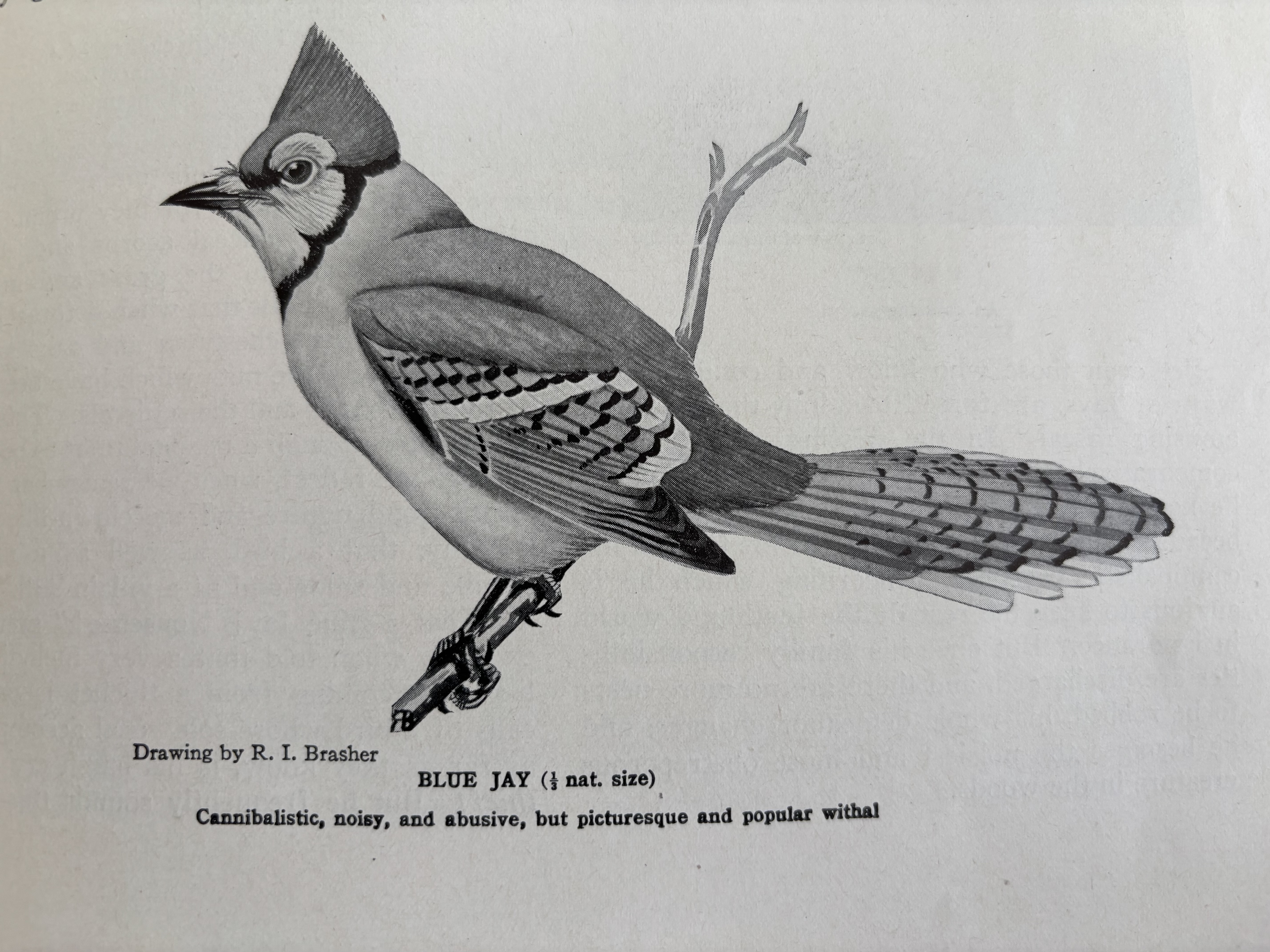
I wanted to look up my first 2025 bird in an amazing tome, Birds of America (1936) edited by T. Gilbert Pearson. Not to be confused with The Birds of America, John James Audubon’s 19th century artistic masterpiece, this book was the first comprehensive review of the subject of US bird identification, occurance, and behavior. In addition to beautiful color plates by Louis Agassiz Fuertes and numerous line drawings and photos, the text is simply amazing. It was a collaboration of some of the finest naturalists of the day. Pearson, himself, is a particularly interesting man. After child and young-adulthood spent collecting bird eggs and egret plumes for those lucrative but destructive markets, Pearson shifted into illustrious career in bird conservation, centered right here in North Carolina.

While current guidebooks (correctly) strive for objectivity and accuracy, they tend to be short on the beautiful prose and playful personification that elevate these old-timey works (another favorite of mine is William Dawson’s The Birds of California). I’ll just share a couple excellent Blue Jay passages from Pearson’s opus here.
“The Blue Jay is the clown and scoffer of bird-land. Furthermore, he is one of the handsomest of American birds; also he is one of the wickedest, and therein exemplifies the literal truth of the saying “Fine feathers don’t make fine birds”…. Eloquent testimony concerning the commission of [his nest-robbing] crimes is furnished by the outcry set up by [smaller and defenseless] birds, whenever they catch a Jay lurking near their nests. But we need not take the birds’ word alone for it, because he has been caught red-handed by man more than once, in the very perpetration of these villainies…. His service [of caching acorns and chestnuts in a way that aids germination], unconscious though it be, ought not to be ignored, even as we reflect…that a bird, as well as a man, may smile and smile and be a villain still.”
What a delightful character assassination! Happy beautiful and terrible 2025, all.
 botanicalramblings