May 18, 2025: Gordon and Blondie

I’m wrapping up the spring run of the California Ecology and Conservation class this week. That means a lot of sitting on the back deck of Blue Oak Ranch Reserve (BORR) barn while I answer questions from students and complete administrative tasks. My ever-present companions are the dozens of California ground squirrels (Otospermophilus beecheyi) that live in an enormous colony next to the barn. By now, I have accidentally accrued hundreds of hours of behavioral observations of these prairie-dog-like mammals. They are endlessly entertaining to watch as they scurry about the important business of eating seeds and chasing neighbors.

              Despite, or maybe because of their abundance, squirrels are under constant threat of being eaten by many species of birds, mammals, and snakes. Several times a day, a squirrel in the colony sounds an alarm. Ground squirrels actually have two types of alarms. The first is a single loud whistle, often given in response to an aerial predator like a hawk, which means “duck and cover”. At the call, squirrels will drop what they’re doing and run into the closest hole. The second type of alarm call is a descending chattering that often morphs into a high, regularly spaced beep. That one must mean “look around”, because when it’s sounded, everyone stands up on their back legs as surveils the field for a bobcat or fox. This time of year, you can only see their little heads poking up above the tall grass. Humans can cause the squirrels to make either type of alarm, especially in colonies far from the barn. When I hike up to the distant areas of the reserve that experience far fewer human intrusions, my presence is heralded with chatters and beeps from a half mile away. On the other hand, strolling directly through the colony by the barn will barely illicit a chirp from the jaded resident squirrels.

Amazingly rattlesnakes generate a different, third predator response in ground squirrels—the tail flag. I’ve watched a squirrel alert to a rattlesnake and then approach it quite aggressively, wagging its tail rapidly back and forth. The snake, apparently relying on a stealthy approach, gave up the hunt and retreated down a hole, despite the squirrel clearly being within striking range. I don’t fully understand why the tail flag works, but it’s a scientifically supported method. Researchers have simulated rattlesnake strikes and found tail-flagging squirrels are better able to leap away. They’ve also found that snakes are more likely to leave the area in response to an approaching flagging squirrel than a non-flagging one.

Despite all the alarming, squirrels get got. A lot. On the reserve. I’ve seen predation by bobcats, coyotes, Red-Tailed Hawks and a Golden Eagle. With all the predators around taking their toll, there’s lots of turnover in the individuals in the squirrel colony. Two notable squirrels that didn’t seem to make it through this past winter were Gordon and Blondie. Gordon was a squirrel particularly acclimated to humans. He developed a preference for dining on the food waste bucket, even scampering into the kitchen to steal treats. His healthy appetite had some serious health consequences—he was the fattest ground squirrel I’ve ever seen. When I showed back up this spring, all the squirrels were slim, trim, and relatively meek. Based on past behavior, by the end of fall, this year’s generation will learn the art of stealing human food and splooting their chonky bodies on the back deck before too long.

Blondie was another squirrel that lived next to the barn who had exceptionally light fur. Ever since I’ve been visiting BORR, a small number of squirrels in the barn colony have been blonde. Their color does blend in quite well once the grass dries out, but they stick out like sore thumbs in the spring when the grass is green and the pups are young and vulnerable. Presumably the genetic mutation in fur color was able to persist in the barn colony because all the human activity results in fewer predators locally. At least until this year. Despite searching for them this spring, I couldn’t find blondie or any other lighter-furred squirrels this spring. This year’s generation of pups are just emerging from their dens now. It will be interesting to see this summer if any of them are Blondie Juniors. I’ll definitely be looking out for them as I resume my squirrel watch five weeks from now.

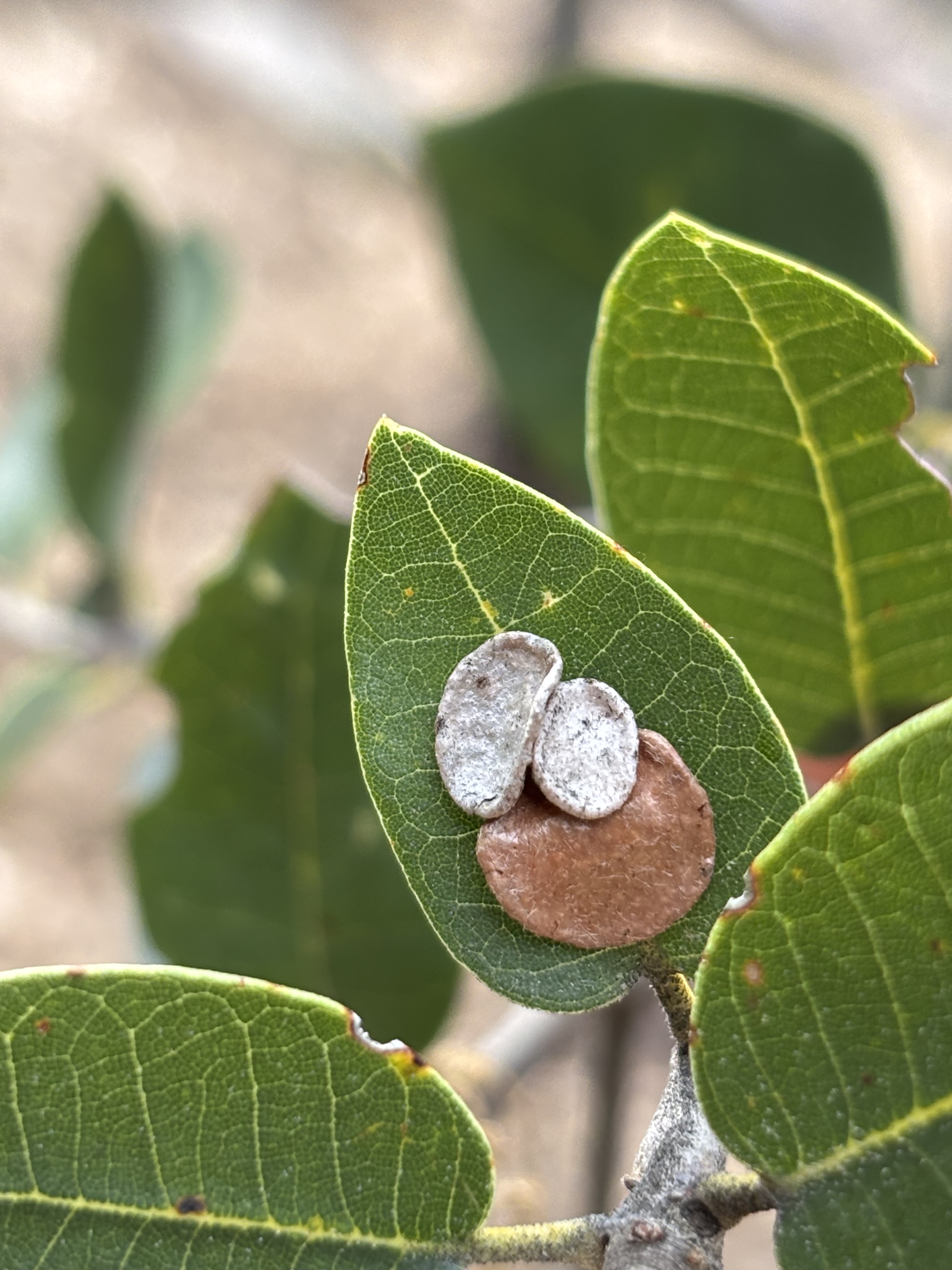
May 8, 2025: In my gall era

Last fall, while at McLaughlin Reserve in Northern California, I started paying more attention to oak wasp galls (tribe Cynipini). A gall is formed when another organism (usually an insect, but it can be a mite, bacteria, fungi, and even another plant), chemically induces its host plant to form an abnormal structure. These interactions tend to be very specialized, with the gall-former only parasitizing one or more closely related plants. With over 150 described species in the state (and probably at least as many undescribed ones) oak wasp galls undisputed champions of gall-forming in California.

California oaks (Quercus) fall into three taxonomic groups–black oaks such as coast live (Q. agrifolia) and interior live oak (Q. wislizeni), white oaks such as blue oak (Q. douglasii) and valley oak (Q. lobata), and intermediate oaks such as canyon live oak (Q. chrysolepis). Most gall wasp species specialize on one of these three groups, and some are only found on a particular oak species. I’ve previously looked for galls on black and white oaks, but not intermediate oaks. James Reserve in the San Jacinto mountains has a large population of Q. chrysolepis, so I was excited to head out to find and photograph some galls. The diversity there did not disappoint.

The tiny adult gall wasps themselves aren’t much to look at. Here’s an individual that’s actually on the showier, side.

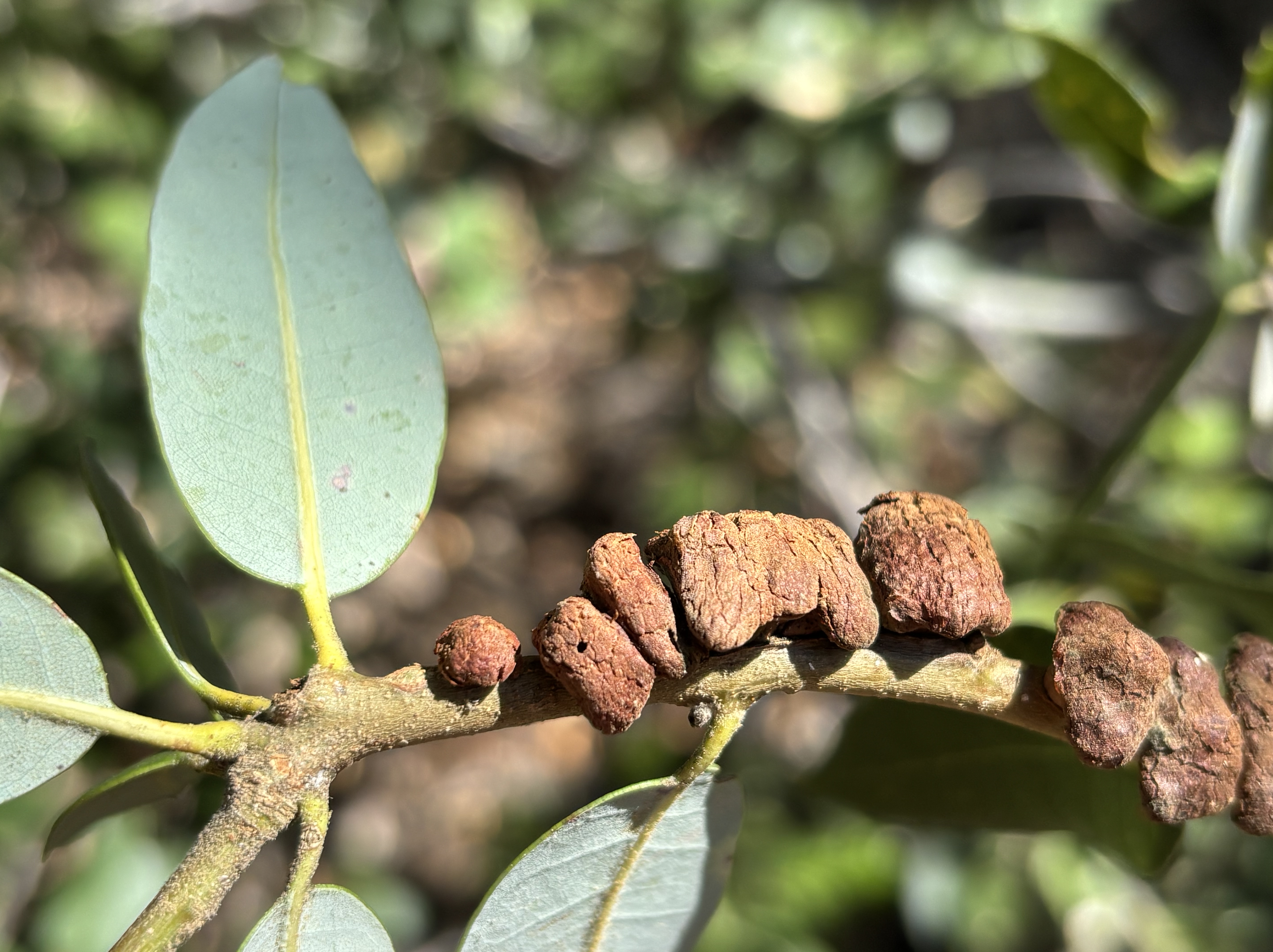
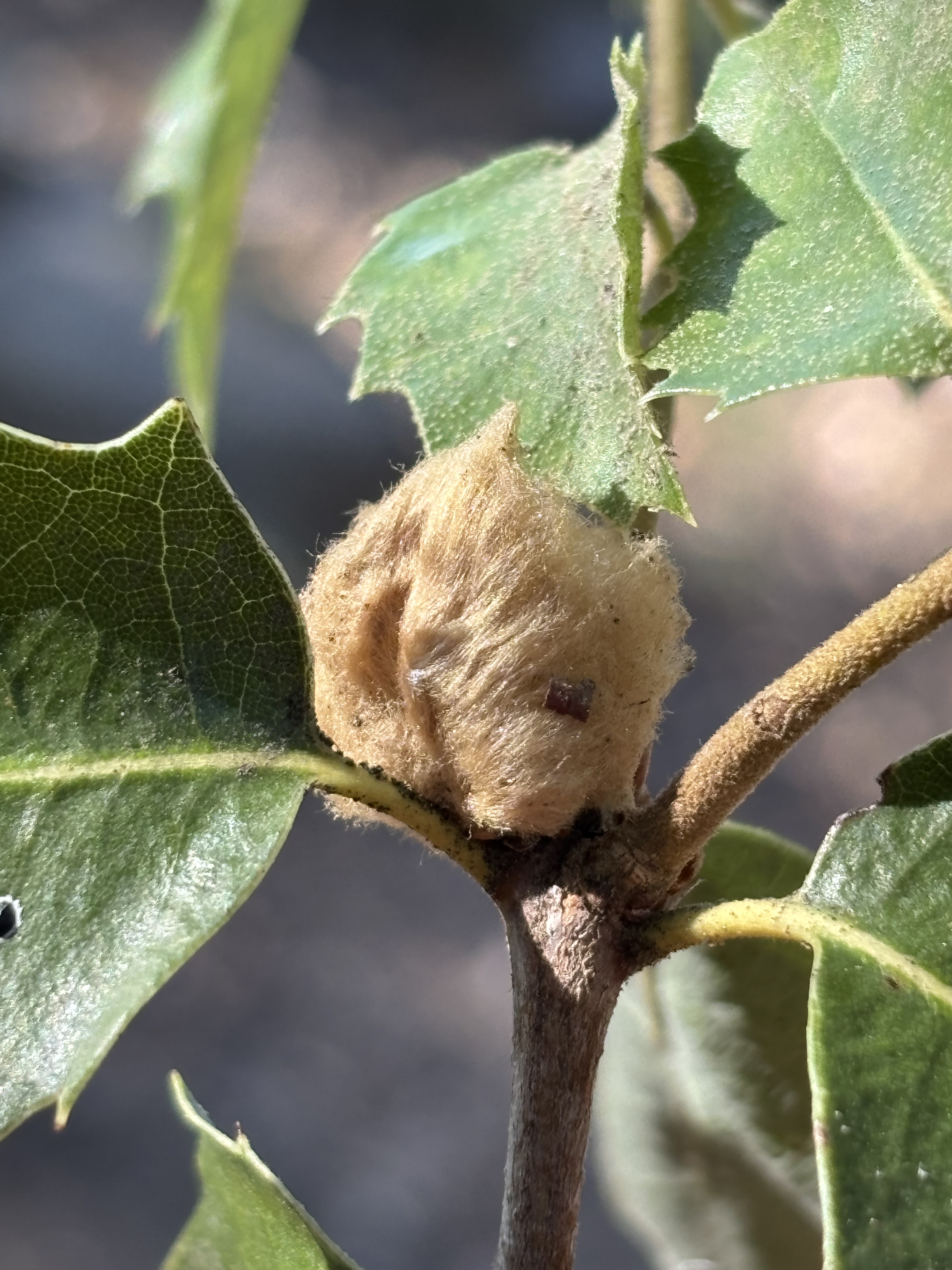
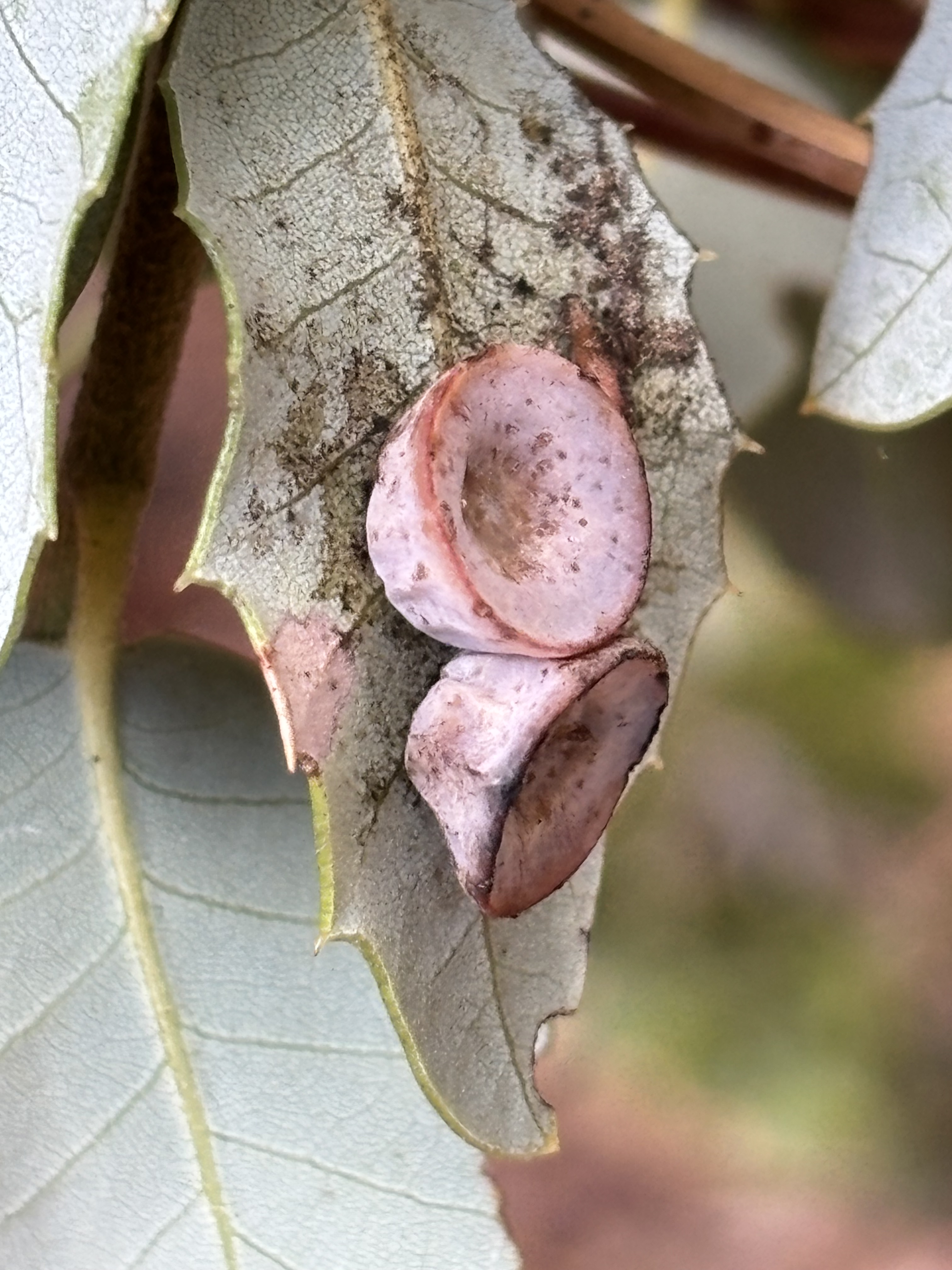
The galls themselves are the main event. Different species specialize on different parts of the plant—everything from the base of the trunk and stems to even the flowers and acorns. The biggest diversity, however occurs on the leaves and small twigs. Here are my favorite finds from the past week.

Andricus perfulvum
Disholandricus lasius
Disholandricus chrysolepidis
Heteroecus dasydactyli
Heteroecus sp (undescribed)
Heteroecus sanctaclarae
Paracraspis patelloides
Paracraspis insolens

The most amazing thing about gall wasps is they have alternation of generations. Only females overwinter, laying eggs of males and females (sexual generation) that form a gall in the spring. This generation then mates, producing only females (asexual generation), which then overwinter, repeating the cycle. The galls produced by the two generations of the same species can look entirely different and form galls on different parts of the plant. Here’s first the sexual and second the sexual generation of Heteroecus pacificus:

Figuring out the identities of these galls is made possible by being able to take decent macro shots of the tiny structures, and comparing them to other folks who have done the same on iNaturalist. I posted enough galls to iNaturalist last year that I was invited to join the Gall Week 2025 Project. From May 3-11, 295 folks from around the globe made 4,800 observations of galls! Additionally, two amazing gall resources help immensely with identification. Plant Galls of the Western United States by Ronald Russo is an excellent field guide, and we recently got the second edition. Also, there’s a really great website, gallformers.org, that has a searchable database of galls and their host plants.

 Even with all these resources, gall identification is still tricky. The club-shaped Heterocus species that I posted is actually a known unknown. It’s a species that’s included in the above references, but no-one has given it a name yet. In order to do that, someone would have to rear the gall through both its generations so it could be formally described.

My interest in galls rubbed off on the class, and one group was interested enough to study them for their final project. They compared gall abundance between Quercus wislizeni and Q. chrysolepis. They found at least 20 different species of gall wasps on the later, more gall-filled oak alone. Included in that total are a couple unknown unknowns—galls that don’t look anything like what we could find in our references!

May 1, 2025: Favorites

What is your favorite UC reserve?” That’s one of the most common questions students in my class ask me. It’s an absolutely fair question, but unfortunately, I still don’t have a solid answer. I’ve been to 24 of the 42 field stations in the University of California’s Natural Reserve System, and they each have something interesting to offer. I love the Granite Mountains in the Mohave Desert because of the amazing scenery. McLaughlin Reserve in Lake Country has weird serpentine soils leading to incredible botany. Rancho Marino on the San Luis Obispo coast has the best tide pooling that I’ve ever experienced. Angelo Reserve is idyllically nestled in a beautiful meadow along the pristine south fork of the Eel River. James has rare frogs, Sagehen has rare fens, and Hastings has a storied history. The point is, I don’t have one favorite reserve, I have many.

              I have trouble with “what’s your favorite…” questions in general, and that’s especially true with natural history type questions. How do you ever pick a favorite bird or flower or mountain? There are just too many options and the field is too crowded. Narrow it down a little and I might have an answer: Favorite duck—Barrow’s Goldeneye, favorite plant in the Borage family—Phacelia nashiana, favorite peak in Colorado—Mount Bellview. But even then, I reserve the right to change my mind or give you multiple answers.

              I think my wanderlust is a separate but related phenomenon. When vacationing or travelling, I tend to prefer going to new spots rather than revisiting favorites. For me, the allure of the new experience trumps the assurance of a trusted spot. It’s one of the reasons I love my job. Each of my twenty runs of the California Ecology and Conservation class has had a unique combination of students, weather, research project topics, and critters. And I’ve never gone to the same reserves in the same order.

But as I close in on three years of my life on course, I have developed some habits. Every time I visit Angelo, I climb Black Mountain to see my favorite hybrid oak tree. At James, I visit the local population granite spiny lizards on the Four Saints Trail. At Rancho Marino, I check specific rocks for the endangered black abalone. And when I return to Blue Oak Ranch Reserve, I’ll say hello to the California tiger salamander larvae in a nearby pond. These habits, combined with the interesting year-to-year comparisons that come with returning to the same places at the same times do have a certain appeal. While I’m nowhere near ready to stop visiting new places, I am becoming more excited about returning to the same ones. And that includes some local spots near my new Winston-Salem home. With my return to North Carolina a couple weeks away, I’m already getting exited to bird, botanize, and herp my new favorite haunts.

April 25th, 2025: Measuring Migration

California spring is very much in full swing, and most of the migratory breeding birds have returned to the state. However, every year it takes me some time to track down all the new arrivals. I thought it would be fun to talk a bit about the migratory species that I found for the first time this year during my stay at Sedgwick Reserve, in Santa Barbara County, California. I’ll order them by how far they’ve come to get here.

Tricolored Blackbirds are a threated species is almost exclusively found in California throughout the year. They are nomadic, moving around the Central Valley in the winter. Many stay there to breed in marshes and croplands, sometimes in colonies of tens of thousands. A few hundred birds breed at Sedgwick, making the short trip every March to a small cattail-filled pond they share with Red-winged Blackbirds. Strangely, the two blackbird species seem to have divided the pond down the middle with very little intraspecies conflict–Trikes to the north, Red-wings to the south

Costa’s Hummingbirds also migrate to Santa Barbara from just a couple counties over. The closest locations that regularly have this species in the winter are the sage scrub covered hills above Los Angeles. In springs when the desert super blooms, most Costa’s will take advantage of all the delicious nectar and spend the spring and early summer there. In these years of bounty they can double or even triple clutch. This year saw extremely low precipitation across the desert. Therefore, more Costa’s may end up wandering west rather than staying east.

Lawrence’s Goldfinchs are another nomadic species. They tend to winter in the deserts of California and Arizona, returning to the oak woodlands that ring the Central Valley in March. However, their numbers at any one place fluctuate wildly from year to year as they follow large blooms of their favorite food–fiddleneck (Amsinckia)seeds. Despite far below average rainfall here, it strangely seems to be a good year for both fiddleneck and finches. As the fiddleneck finishes setting seed, some of them may follow the bloom into Northern California before heading back east for the winter.

Lazuli Buntings have just recently joined us here from the weedy fields and thorn scrub of nearby western Mexico. In southern California, they like brushy hillsides, and seem to do quite well in recently burned areas. Each beautiful turquoise and ochre male sings an individualized three-part song in hopes of attracting an extremely drab-colored female. Once breeding is over, Lazuli Buntings will fly to Southeast Arizona or neighboring Sonora for fall, where they’ll molt while chowing down on the seeds and bugs produced by the summer monsoons there. At the end of fall, they’ll head southwest, completing their unique triangle migration.

A few Bullock’s Orioles winter in coastal southern California, but most likely the ones I’m seeing here arrived a few weeks ago from woodlands in central Mexico. They are already hard at work building their hanging, woven nests. California Lace Lichen seems to be a key component, but one I found by the barn has also integrated some nylon rope and shreds of tarp. Bullock’s Orioles primarily breed in cottonwood trees throughout much of their range, but in California, they also nest in Valley Oaks and Sycamores. The important requirements are big, widely-spaced trees full of lots of tasty caterpillars.

Black-headed Grosbeaks also like foraging in and singing from the tree tops, but a closed canopy forest or suburban garden suits them better than the open savannah here at Sedgwick. The male I saw stopping for a bath at one of the station water-features was probably planning to continue on. The final destination could be as close as the forests just up the road or as far as Southern British Columbia. He was coming from somewhere in central Mexico, where some of his kin are resident, never bothering to take the trip north.

Black-throated Gray Warblers and MacGillivray’s Warblers have similar ranges to the Grosbeak, both in winter as well as summer. Both warblers, like the Grosbeak, are just passing through the area to points north. However, their preferred habitats are quite different. Rather than tall broadleaf trees, Black-throated Grays prefer open pine forests with a brushy understory, and MacGillivray’s like streamside thickets of willows. They also eat different things. A gross (fat) beak is great for crushing fruits and berries, while a tweezer-shaped warbler beak is perfect for finding little spiders and other bugs amongst the leaves.

Western Kingbirds flew in from somewhere from Southern Mexico or Central America a few weeks ago. Here, they joined the closely related Cassin’s Kingbirds who had previously made the much shorter journey from Baja. Despite their aggressive attacks on other members of their species, and even birds of prey, the two species seem to leave each other alone. I’ve never seen a Western go after a Cassin’s or vice versa.

Western Wood-Pewees make among the longest journeys of the songbirds that breed in Southern California. They all winter in forests in northwestern South America, where they possibly spend time with their close relative, the Eastern Wood-Pewee. We actually don’t fully know how much the winter ranges of the two species overlap, because they look extremely similar and tend not to use their distinctive voices while overwintering. It’s also unclear what’s wrong with all the seemingly suitable habitat found throughout central America. The long commute makes them one of the later species to make it to their breeding grounds. The one individual spotted at Sedgwick during my week there was a vanguard of the main force that will arrive in early May.

April 23th, 2025: In Praise of Black Mustard

Part of being a botanist in California is coming to terms with all the non-native species. Over 1,000 species of plants are naturalized in the state—meaning they have established populations through reproduction outside of cultivation. Some 250 of these are serious invasives that can take over an area and negatively impact natives. In California’s grasslands in particular, almost all of the biomass originated elsewhere. Botanizing here often involves sifting through a lot of trash to find a few native treasures.

However, it’s not the plant’s fault that they’re not from here. I need to remind myself that every species on earth is the product of billions of years of evolution and is worthy of admiration and appreciation. In that spirit, I’ve decided to say ten nice things about black mustard (Brassica nigra), a particularly abundant invasive species here at my current location, Sedgwick Reserve in Santa Barabara county.

1. It’s amazingly adaptable. Black mustard is native to Europe, but has established populations on all six contents that aren’t permanently covered by ice. In North America, it’s found from Southern Canada through Central America, making a living across an amazing range of climatic zones

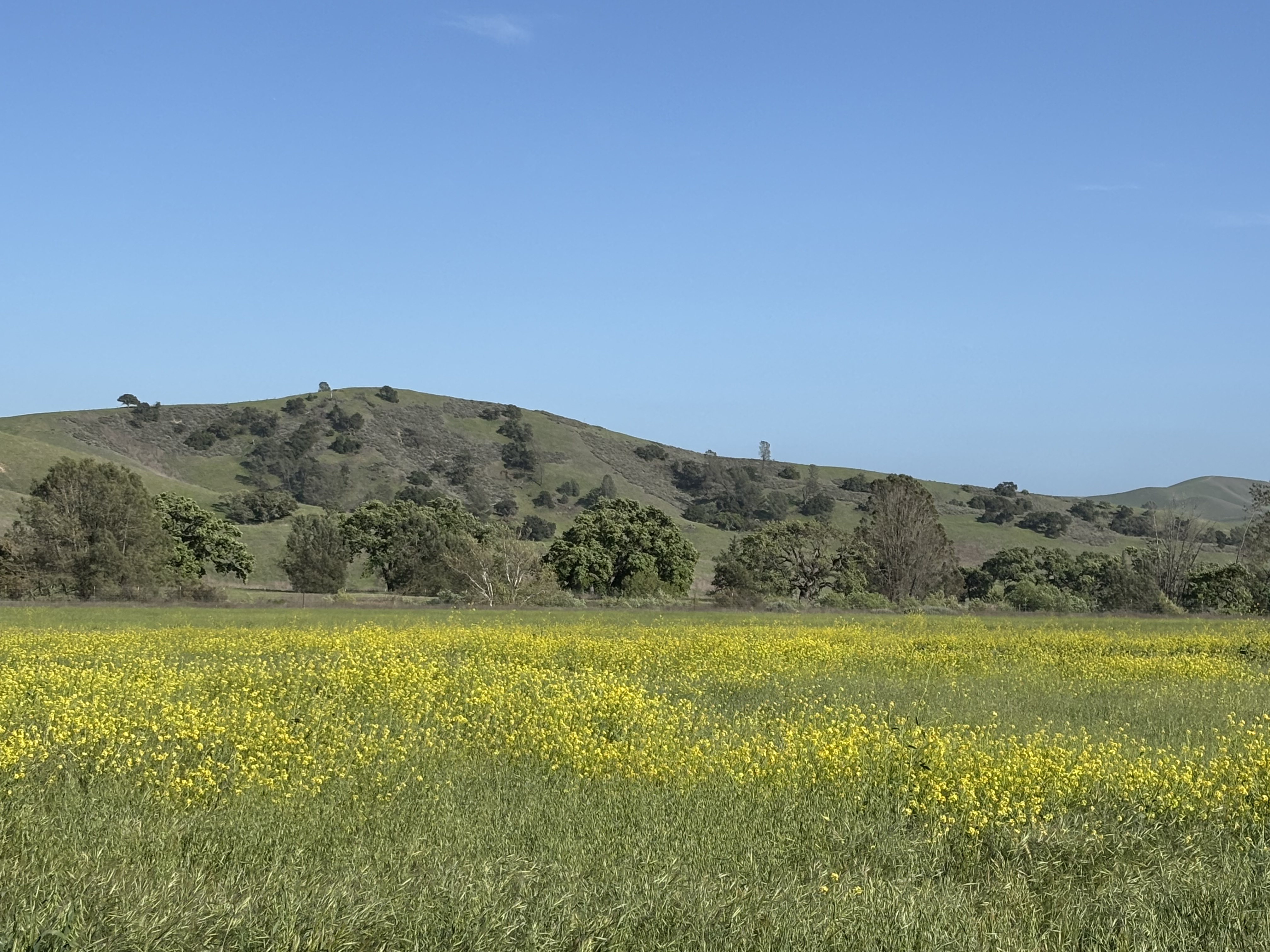
2. It carpets valleys and hillsides and in a beautiful bright yellow. A field of mustard is an objectively spectacular site that can be seen from miles away.
3. It can achieve great heights. Black mustard is a winter annual plant, germinating with the first rains, blooming in spring, and senescing by late summer. In their short life, they regularly grow to six feet tall, and I’ve seen exceptional plants here at Sedgwick that measure at least 10 feet.

4. It has interesting chemistry. Black mustard is in the Brassicaceae family, which is known for making some crazy secondary defense compounds. The production of these compounds, many of which have evolved as defense against herbivores, is carefully controlled by the individual plant. While effective against many species, they are metabolically expensive to make. Therefore, rather than just always making them, mustards upregulate their production as a response to exposure to herbivores like snails or caterpillars. Additionally, these compounds can backfire! Specialist herbivores that only eat mustards can detect small amounts of these compounds in the air, using them to find their target.

5. It wages chemical warfare on its competitors. Black mustard is known to be allelopathic. It produces chemicals in its roots and other tissues (different ones than the herbivory defense compounds) that enter the soil, suppressing the germination and growth of other species of plants. That makes it easier for mustard to completely take over an area, and harder to re-establish native plants even after mustard has been cleared away. It’s annoying as restoration ecologist, but amazing as an adaptation.

6. You can eat it! All parts of mustard are edible, and have been prepared in various ways for at least 2,000 years. The leaves can be pickled, the shoots cooked, the flowers used as a garnish, and the seeds are the spiciest of all mustard species.

7. Its flowers are intricately arranged. The clawed petals, 4-2 arrangement of anthers and linear yellow sepals are quite lovely. Here’s my stab and illustrating them.

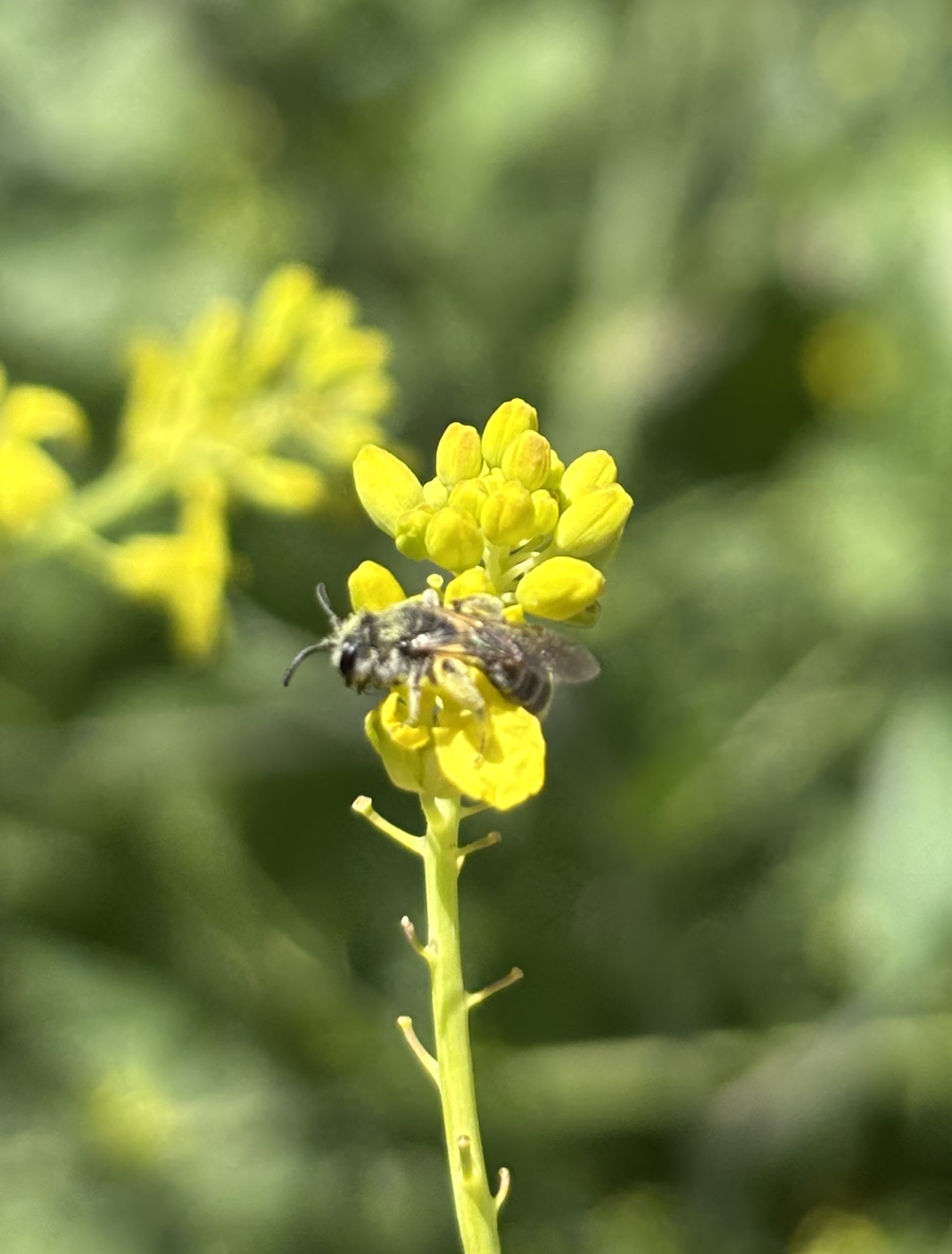
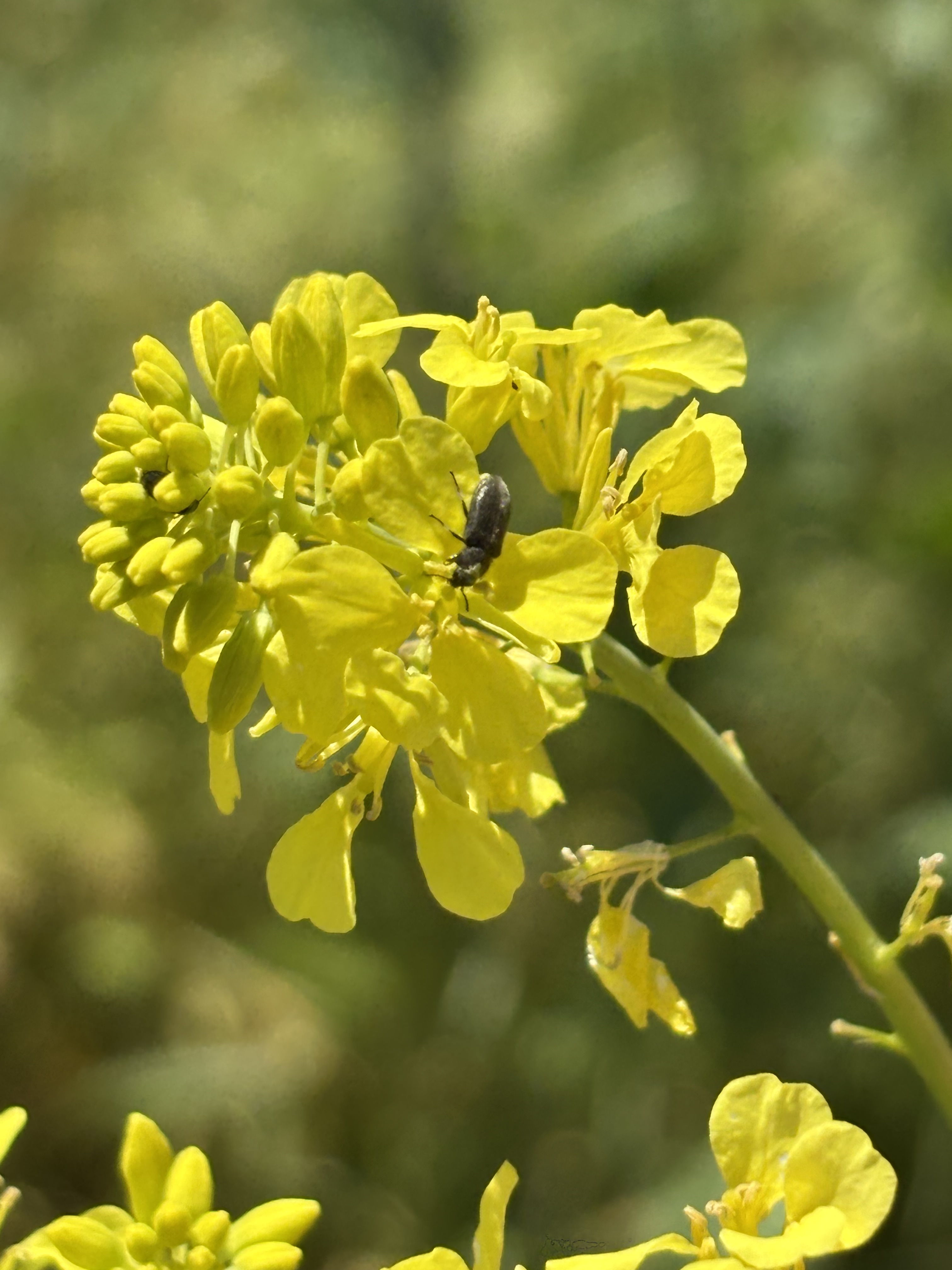
8. It’s great for pollinators. I wandered through a patch this afternoon, and found a number of beetles and solitary bees happily collecting pollen. There are plenty of other flowers blooming here right now, so visiting mustard was an active choice. Sweeping the plant with a net revealed a suite of other insects including flies, aphids, and more beetles.

9. Birds love it. Mustard seeds are eaten by a number of bird species, including the enigmatic Lawerence’s Goldfinch. All those bugs make tasty snacks for additional species, such as the federally threatened Tricolored Blackbird. And the tall stems make a great singing perch for birds like Savannah Sparrows and Lazuli Buntings. I saw all of these interactions this week.

10. It’s not star thistle! Black Mustard is a gnarly invasive plant, but it’s still less detrimental to the ecosystem than some species. For instance, star thistle (Centaurea spp.), takes over a landscape faster than mustard after disturbances, it harder to get rid of once it does, and its sharp spines can make very unpleasant to move though a landscape. I’ll take a field of black mustard over star thistle any day!

March 12, 2025: Floral Reminiscings

The California Ecology and Conservation class I’m teaching has moved south to Rancho Marino Reserve on the coast of San Luis Obispo County. April is my favorite time of year for wildflowers here, and the serpentine hills in the area are a top ten botanical destination in the state. So, with the students busy working on their research projects, I snuck away for a rare plant treasure hunt.

With over 5,000 native plant taxa in the state, despite all my time botanizing here, I’m not going to run out of new flowers to meet any time soon. However, in places like SLO, where I’ve spent a bunch of time, almost all the plants are familiar to me. It takes some research and planning to make first encounters. On this trip, I decided to hike the Reservoir Canyon loop trail, where there were records of two plants that would be new to me—Layia jonesii and Fritillaria ojaiensis.

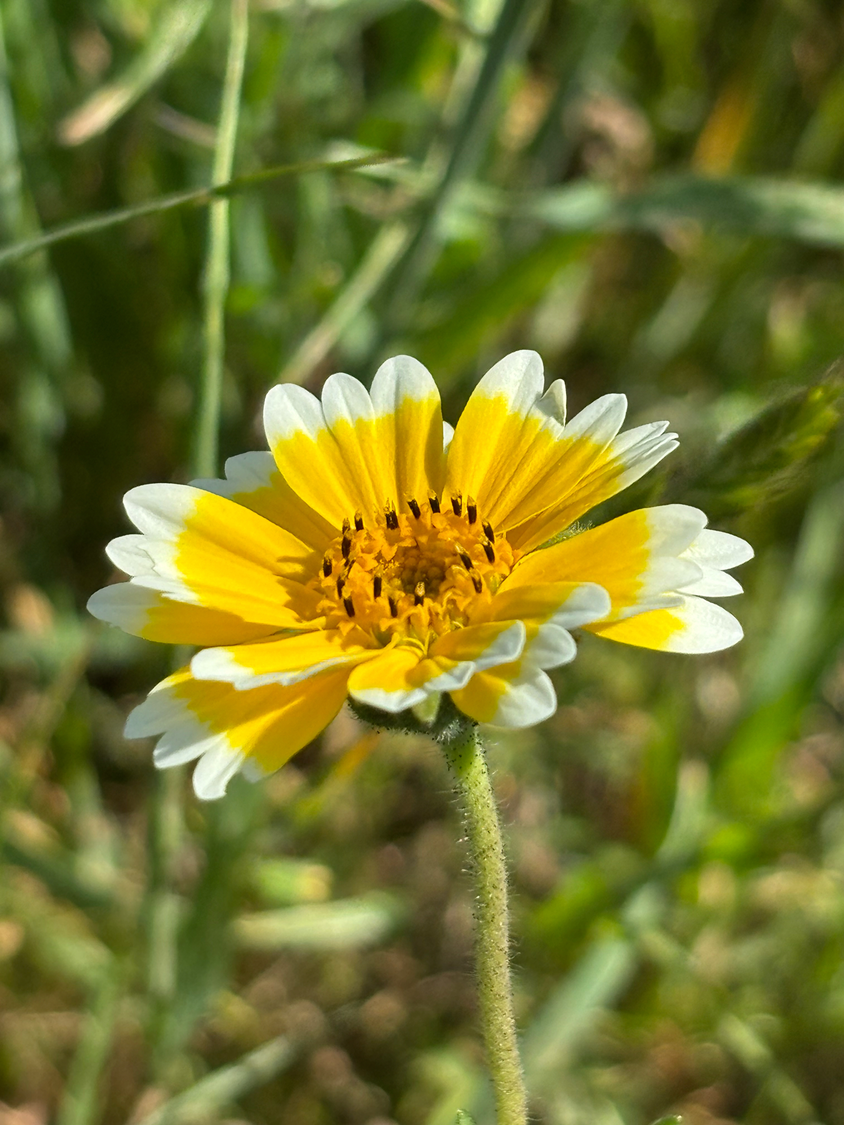
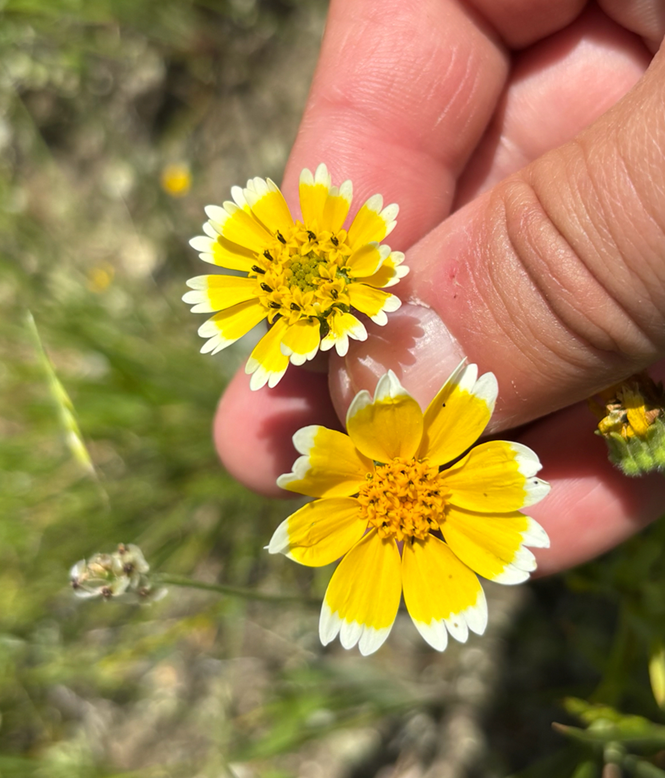
Layia is a genus of 15 species in the Aster family. All of them are found in California and half of them are rare or range restricted. Their common name, Tidy Tips, refers to the neat appearance of the ray flowers, which each have three perfectly even lobes that often appear dipped in white. To me, they are one of the flowers that best emblemize spring in the state. They are low-growing, delicate annuals that love open grasslands and woodlands. Given the right conditions, they can carpet whole areas. My first encounter was with Layia platyglossa, which I saw on a trip to Fort Ord Reserve in coastal Monterrey my first spring in the state. There, huge fields of them carpeted the sandy soil while tons of native bees and butterflies visited. Among many subsequent encounters, I’ve seen L. fremontii ringing the edges of vernal pools in Merced, wondered at L. munzii as a large component of a spectacular superbloom in the Carrizo Plain, and successfully searched for the inconspicuous L. carnosa on coastal dunes.

These past encounters were on my mind as I began my hike, heading toward a location where the rare Layia jonesii had been previously collected. Upon arrival, I immediately found a lovely patch of Layia, and snapped some photos! I was already one for two!

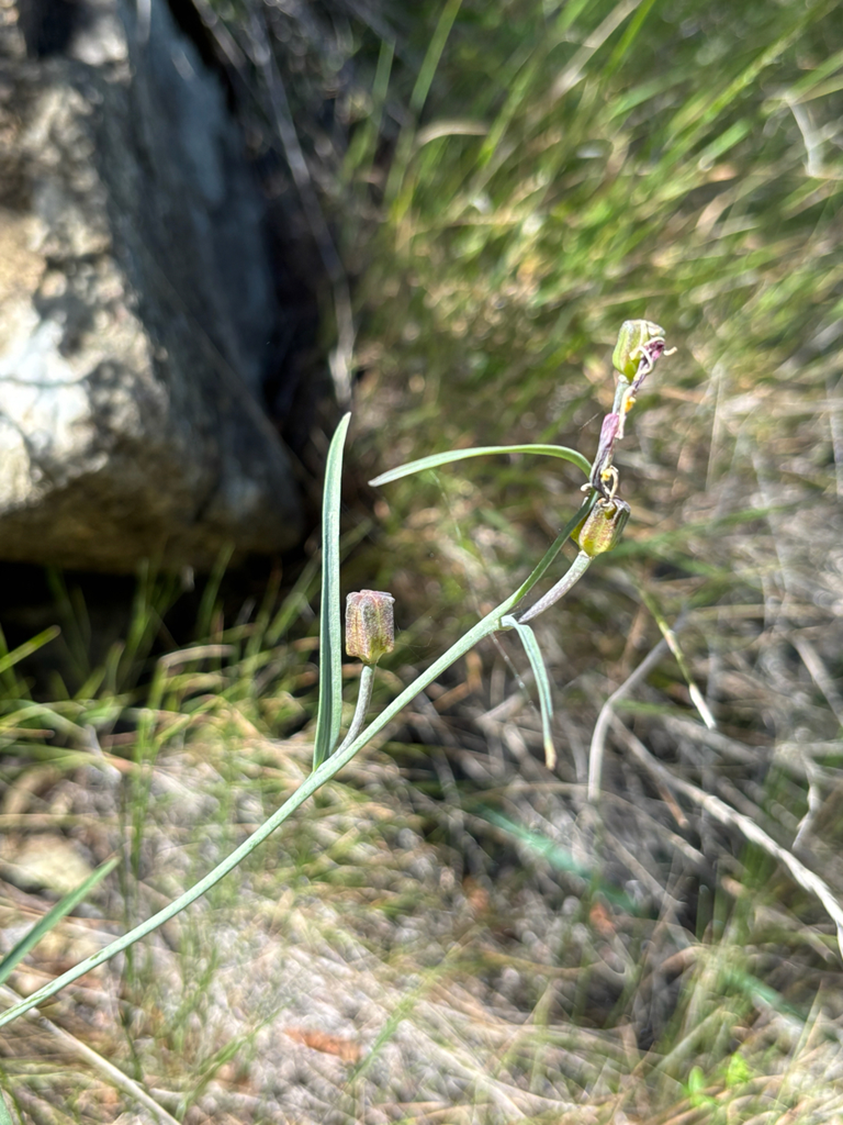
I next headed up the steep side of the mountain to the GPS coordinate where a friend had seen Fritillary ojaiensis just last week. Despite having looked for this species a couple times before without success, I figured this would be a slam dunk! Fritillaria, unlike Layia is not a particularly California genus. Although there are 20 species in the state, there around 100 others distributed across much of Europe and temperate Asia (although, strangely, not in Eastern North America). The name means “dice box” in Latin, which may refer both to the dark spotted petals of some of the species, or to the boxy shape of the fruit. My first Fritillary was a single Fritillaria affinis plant that was in bloom on the path between my office and the classroom where I was teaching on the UC Santa Cruz campus. I quickly fell in love. A couple times a week, I checked on its progress from bud to flower to fruit.

Since then, I’ve logged many hours tracking down most of the Californian species. They can be quite tricky to pin down, often blooming very early in spring, and skipping the bloom in some years by staying as a dormant bulb or a single basal leaf. The beauty, diversity, and weirdness of their flowers is worth the trouble, though. Check out my Fritillary appreciation post, which has photos of the past triumphs. Arriving at the GPS location, I immediately located the plants! However, they had all just finished flowering, or didn’t try to flower this (dry) year.

While the fruits and leaves are cool, I really wanted to see the beautiful maroon and yellow spotted flowers. It was okay. I had a back up spot. I decided to hike the rest of the loop before driving across town to it. I continued up the hill, reaching a beautiful wild-flower filled meadow at the top. There were a bunch more Layia in bloom. They looked exactly like the individuals from the L. jonseii spot, but that species wasn’t supposed to occur up here. Uh, oh. I took the time to carefully identify a plant using a dichotomous key, and it came out to the common Layia platyglossa. The pappus (fuzzy bit on top of the seeds) in L. jonesii was supposed to be lanceolate (wide at the base), but in these plants it was linear.

I looped back to the first location and worked the key there. Also Layia platyglossa. I hadn’t found my target, after all! I continued to search the area now that I knew what trait to focus on (something I should have looked up earlier!), but found patch after patch of L. platyglossa. I was about to give up when I noticed a patch in a depression in the meadow that seemed to be a bit farther along in flowering. I checked the fruits—lanceolate pappus!

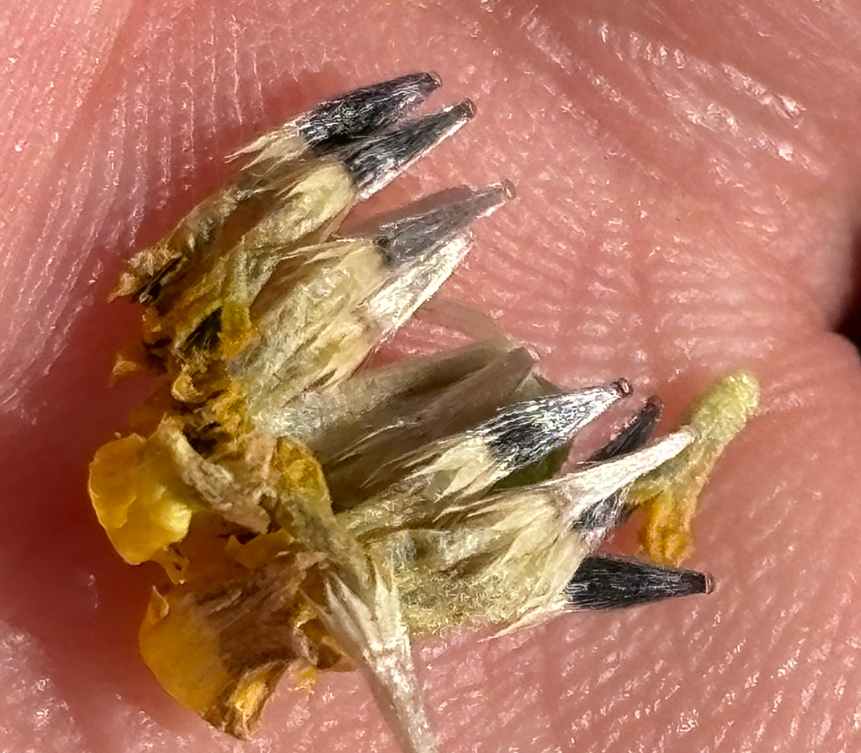
Here’s a shot of the flower of the rare Layia jonesii, known only from about a 20 mile stretch of coastal San Luis Obispo County. Maybe you can forgive my initial poor identification!

I grabbed a nearby L. platyglossa flower for direct comparison, and with the side-by-side, a couple differences do show up. The disk buds are a different color and the phyllaries are a different shape—that’s some real plant nerd content for you.

In the two photos, L. jonesii is top and right, and L. platyglossa is bottom and left.

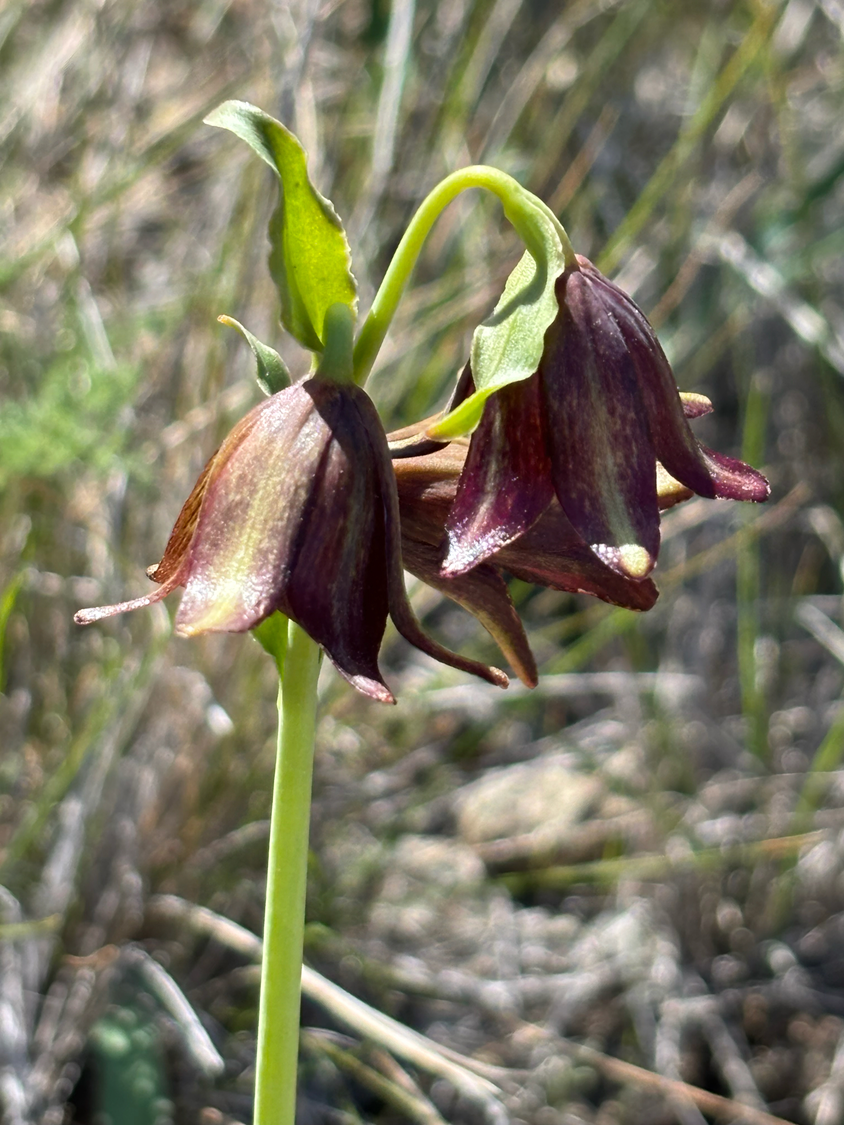
I finished my hike and headed over to the other nearby spot that had Fritillaria ojaiensis records. Despite searching up and down a two mile stretch of canyon for a couple hours, I once again only found plants in fruit and plants that didn’t bloom this year. There was a moment when I got excited over a blooming Fritillaria biflora (Chocolate Lily), but this species is different enough that I didn’t have a repeat of the Layia fiasco!

I’ll have to try again for a F. ojaiensis flower earlier in the season or in a wetter year! But even a botany trip with some missed targets is well worth it. Along the way, I saw so many amazing wildflowers, including some that were quite rare. Many of them brought back magical memories of California spring’s past.

March 30, 2025: A new landscape

I arrived at Blue Oak Ranch Reserve (BORR) today to a landscape completely different from when I last left it in mid-November. Brown hills are now verdant. Green leafed oak canopies are now lichen and mistletoe covered branches devoid of foliage. Dust and hard-packed earth are gone, replaced with puddles and mud. That this transformation happens every year doesn’t make it less remarkable.

I’ve now spent over a year of my life at this University of California property in the hills above San Jose. The fifty-day-long class I teach three times a year, California Ecology and Conservation, begins and ends each run here. Therefore, my six yearly visits are regularly spaced one-week stints. It feels as though I experience BORR as a series of vignettes, each visit a snapshot unique enough that I can name it based on which new flowers are in bloom or which new critters abound: late March (shooting star), mid May (mariposa lily), late June (dragonfly), mid August (tarweed), late September (tarantula), and mid November (tiger salamander). In most years, the most dramatic mid-year change is May to June, when the hills shift from green to golden.

start of a spring class

start of a summer class

end of a fall class

I’ve been visiting BORR regularly since 2018. It’s amazing to think about how much change I’ve seen in even that narrow window. A fire burned half the reserve in 2020. A snow storm in early 2023 caused major damage to many tree limbs. Drought years and wet have shifted the timing of seasons and the levels of the ponds that dot the landscape. Feral pigs have uprooted large areas of meadows in their relentless search for roots and grubs. Invasive star thistle populations have been brought under control, but invasive mustard seems to be taking over the wetlands. The turning of seasons begins to feel like a background beat underpinning a larger song of change.
However large the transformations I’m witness to, they pale in comparison with those that happened 200 years ago. Spaniards first, and then Americans pushing west, hunted out the native elk and pronghorn, replacing them with cows. To feed their bovine investments, they seeded the land with annual Mediterranean grasses and introduced many additional non-native flowers in the process. That most noticeable of annual changes—hills vacillating from tan to green and back—didn’t occur before the 1800’s.

With the perspective of deeper time, the current landscape looks even stranger. When human populations began increasing in the state around 12,000 years ago, they hunted out megafauna and introducing much more frequent fire. Before then, BORR would have been a densely brushy place full of mastodons and ground sloths. Even the climate itself has been in its current form of cool wet winters and hot dry summers for less than 5 million years. Prior to that—a mere blink of the eye in geologic terms, BORR was a cool, wet temperate rainforest. But that long ago the hills themselves weren’t even there. BORR is part of the Diablo Range, which only formed 2 million years ago.

I’m planning on visiting BORR for many years still, and I’m excited and (and a little nervous) to see what changes the future holds. While prolonged droughts and the continuing onslaught of invasive species chip away at native biodiversity, the reserve staff and others are fighting back, planting oak trees and native grasses, and mowing and pulling invasives. All I know for sure is the next time I’m back, things will be different.

March 26, 2025: Spring Feeder Watch

I leave for California at the end of the week and won’t be back until the end of May. Therefore, this week was the last chance for a spring backyard bird watch. It’s still very early in migration in North Carolina, with the peak not happening until the end of April and early May. So far, I’ve only seen a handful migrant species in the area, and all our wintering birds are still present. However, many resident birds have begun establishing their breeding territories, practicing their songs, and I’ve seen some mating and nest building. Therefore, I was expecting a noisier feeder watch than my winter vigil, and was hoping for a migrant or two, as well.

6:45 Begin observation. It’s not even first light yet, but a couple Northern Cardinals and several American Robins are already singing, joined shortly by a Carolina Chickadee.

6:46 A Carolina Wren callsand a Brown Thrasher begins singing. In the past week our backyard thrasher has begun putting on virtuoso performances where he mimics many of the local birds. My favorite today was an excellent impression of the “potato-chip” flight call of an American Goldfinch.

6:48 An American Crow calls while flying by. A Song sparrow begins singing.

6:50 A Tufted Titmouse calls, then sings. Chickadees begin foraging in the oak trees overhead.

6:52 An Eastern Towhee calls

6:55 An Eastern Bluebird calls and gives a couple songs

6:56 A Yellow-bellied Sapsucker calls. This is our only migratory woodpecker—the pair that’s been wintering in our yard will be heading north in a couple weeks. The American Robins that have been singing and calling continuously begin chasing each other through the yard.

6:58 Two Blue Jays fly into our magnolia—the first bird this morning I saw before hearing.

6:59 Northern Cardinals visit both the bark butter and the bird feeder. A European Starling flies by. A White-Throated Sparrow calls.

7:02 A Downy Woodpecker calls

7:04 White-Throated Sparrows and a Carolina Wren visit the bark butter

7:09 Several European Starlings fly into our large oak tree, and one does a Killdeer impression that fools my Merlin bird sound identification app.

7:10 A Yellow-rumped Warbler calls from the trees. A few Dark-eyed Juncos attack the bark butter. A Ruby-crowned Kinglet begins to sing. It’s loud out here!

7:12 The Brown Thrasher takes a break from singing to visit the feeder. It’s awkward to watch—he’s too big to sit comfortably on the lip, but he makes it work. The feeder has much less action than when I did this watch in winter, likely because emerging insects are now an alternative food source.

7:16 Sunrise.

7:17 A House Finch comes to the feeder.

7:24 A female Brown-headed Cowbird visits our neighbor’s feeder before two males spot her and begin a chase.

7:26 A Mourning Dove flies by, followed by a Common Grackle. A large flock of grackles descended on our street about a month ago and seemingly hasn’t left since.

7:29A White-breasted Nuthatch begins foraging on the branches of our large oak

7:33 A Northern Flicker calls loudly

7:34 I spot a Blue-headed Vireo foraging slowly through the newly emerging leaves of our neighbor’s oak.

7:35 An Eastern Phoebe calls.

7:39 A Fish Crow calls, the final new species of the day.

7:45 End observation.

Total: 27 species.

Most notable: Definitely the Blue-headed Vireo. This was a new yard bird (# 53)! In North Carolina, Blue-headed vireos winter on the coastal plain and breed in the Appalachians, but they are only seen as spring and fall migrants on the Piedmont. There’s only one other record in eBird for Forsyth County so far this year, so I’m pretty excited about this one.

Strangest misses: Northern Mockingbird and Red-bellied Woodpecker. After fiercely defending the feeder all winter, Marty the Mockingbird has been very subdued recently. I’m wondering if the aggressive starlings and grackles that have shown up in numbers in recent weeks have caused Marty to tactfully retreat. I did see our resident male Red-bellied Woodpecker at the feeder 10 minutes after I ended the count. He has also been affected by the starlings. A month ago, Jenny and I noticed him beginning to excavate a nest cavity in a dead branch of our front yard maple tree. After several days of pretty much continuous labor, his work was complete. The craftsmanship must have been high quality, because after an inspection, a female decided to move in. Unfortunately, several starlings were also impressed with the work and wanted to take over. A weeks-long war ensued for control of the nest, with battles won and lost by both sides. Now it seems the startlings have emerged victorious, and the original builder is left without a home. I don’t like starlings.

Comparisons: 15 species overlapped with my January 11th watch, and 12 were new. I only didn’t see three species that were on the winter watch—Golden-crowned kinglet, American Goldfinch, and Northern Mockingbird.

March 21, 2025: A salamander mystery

This Friday I decided to take a hike in Boone’s Cave near Lexington, North Carolina. I was mainly searching for the spring woodland wildflowers that are currently blooming in profusion. We’re now in the narrow golden window after temperatures have warmed but before most trees have leafed out, cloaking the forest floor in shade. Here are some photos of my favorite botanical finds of the day:

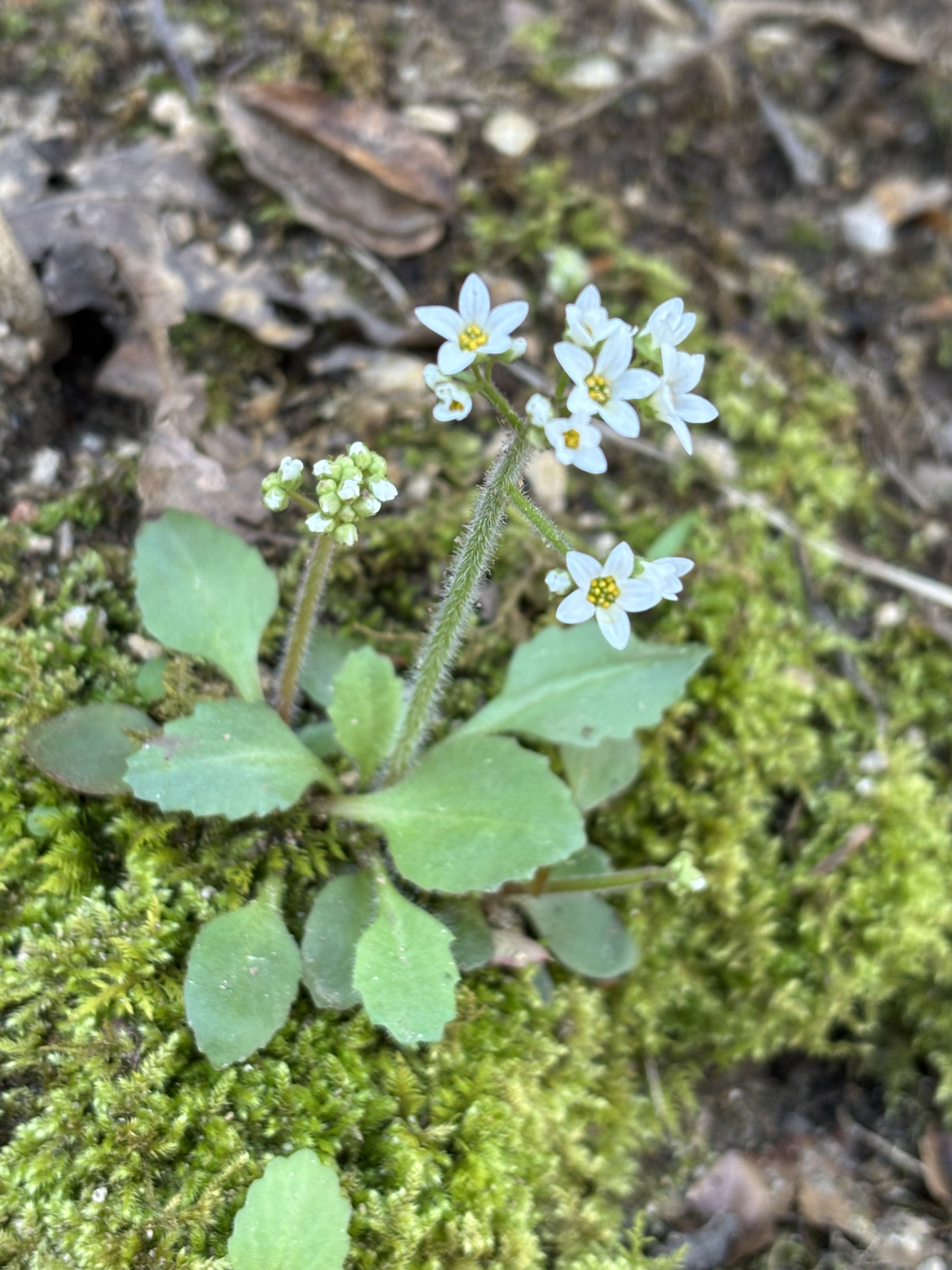
In order, that was bloodroot (Sanguinaria canadensis), yellow corydalis (Corydalis flavula), heartleaf foamflower (Tiarella cordifolia) and Virginia Saxifrage (Micranthes virginiensis)

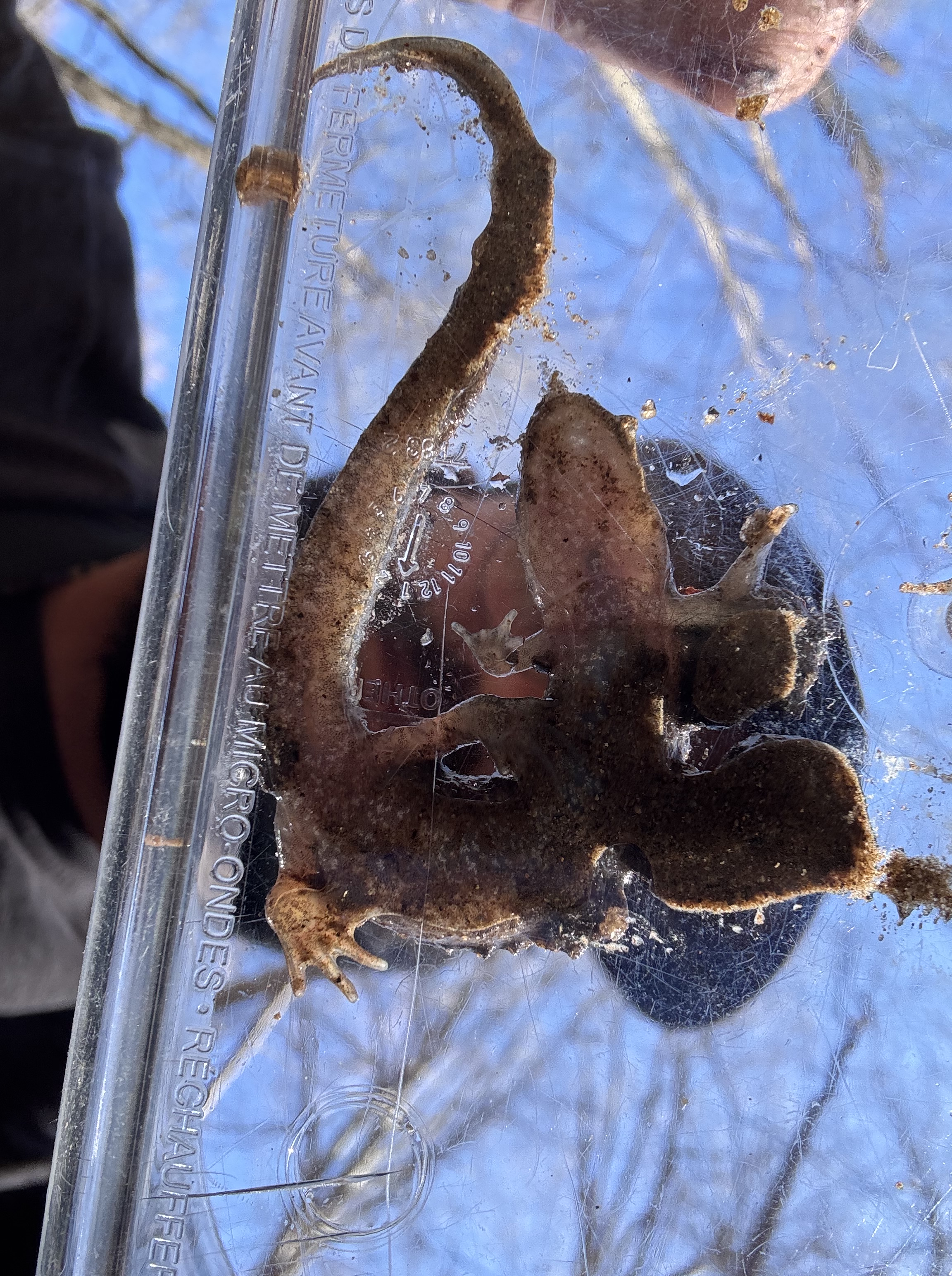
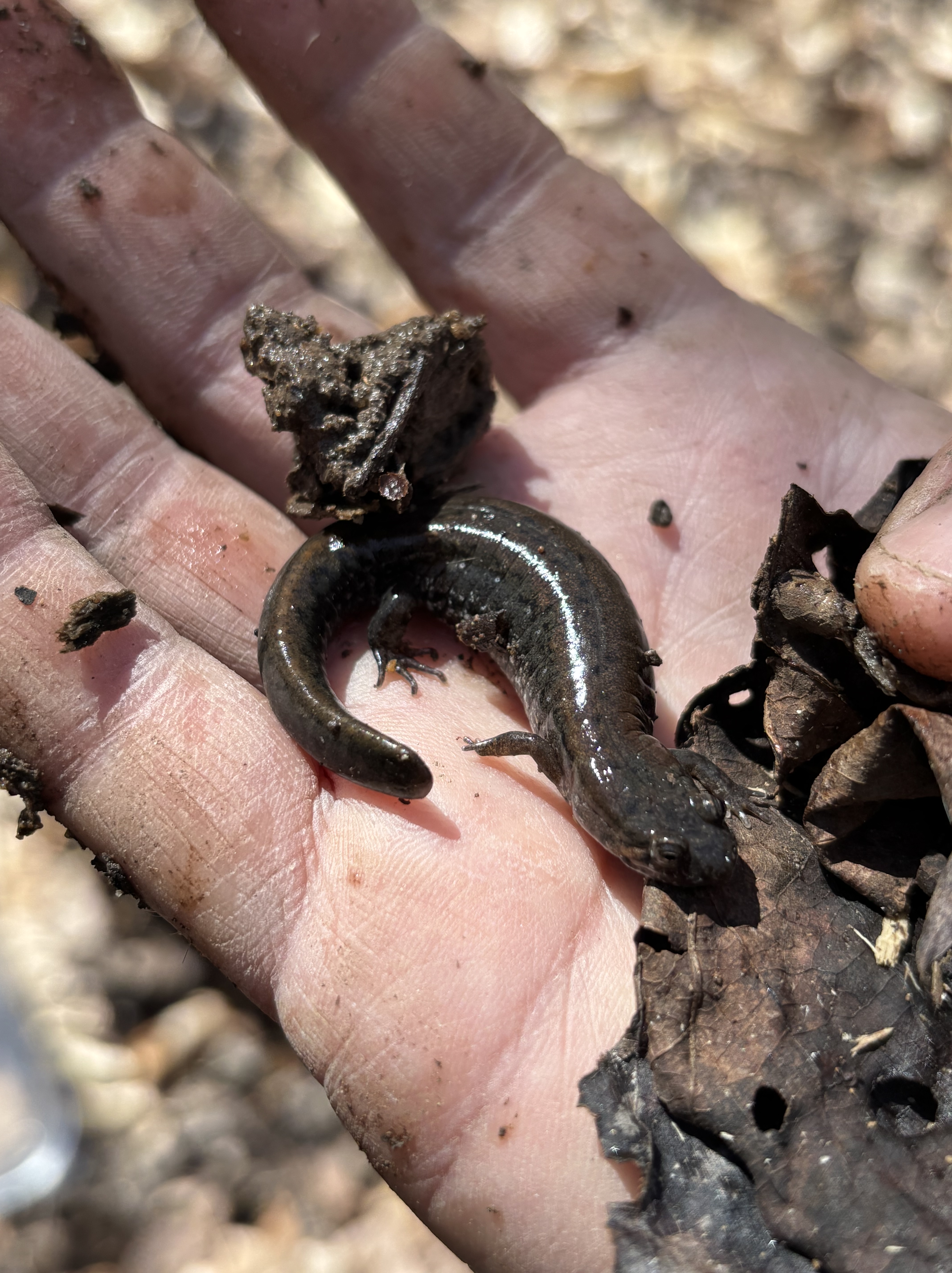
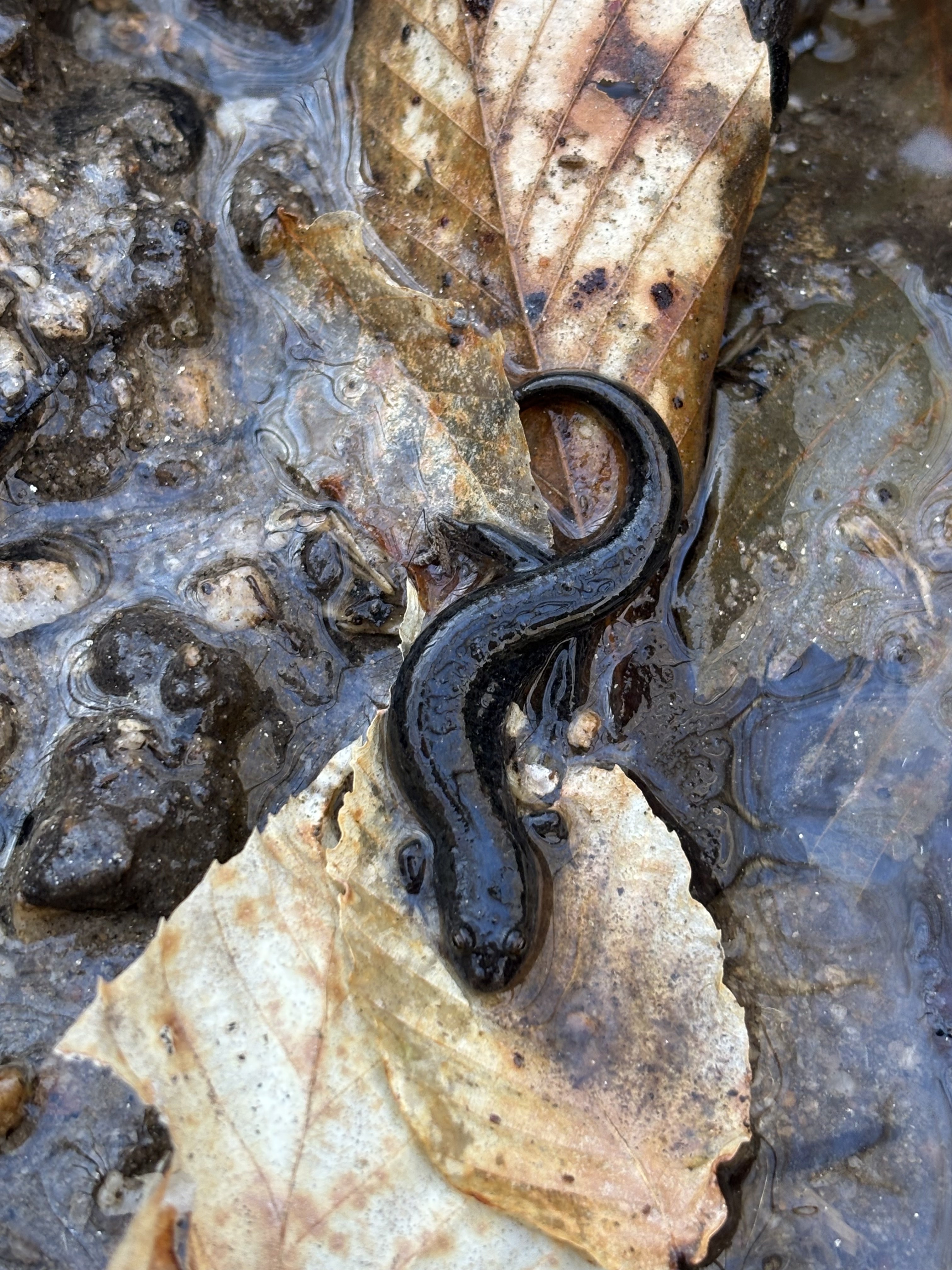
While botanizing, I couldn’t help but flip rocks and logs among the small streams and seeps that cut through the hillsides, looking for salamanders. While I found a few southern two-lineds (Eurycea cirrigera) and one tiny slimy (Plethodon cylindraceus), most of my encounters were with duskies (Desmognathus). This diverse genus has about 40 species, with a center of diversity at mid-elevations in the southern Appalachians. Here as many as six species can co-occur partitioning up the habitat along a moisture gradient. The smallest species spend their lives away from flowing water. They have round tails and direct development, which means that instead of an aquatic, gilled larval stage, the young hatch from the eggs looking like miniature adults. Another group of species spends their lives in the middle of permanent streams. They are larger, with paddle-shaped tails, and have a larval stage that lasts for a couple years before they make the transformation to adult form. A third group lives the edges of streams and in muddy seeps and springs. These species have moderately keeled tails, moderate sizes, and a short larval phase (< 1 year).

Moving away from the southern Appalachians, Desmognathus diversity rapidly declines, and the species tend to have the intermediate, stream edge morphology. That pattern holds true in the Piedmont of North Carolina. Here, the only species used to be the northern dusky salamander (Desmognathus fuscus). However, two years ago, a paper came out that revealed, based on molecular and morphological evidence, D. fuscus was a complex of multiple species. In the northern and western parts of the NC piedmont, we now have the wolf dusky salamander (D. lycos), and the piedmont dusky (D. bairdi) lives further to the east and south. The new species are supposedly parapatric, meaning their ranges abut without overlapping. No one has found a location where the two species co-occur.

It turns out Boone’s Cave is right on the range boundary between the two species. And interestingly, the ten or so dusky salamanders I saw there seemed to have two relatively distinct forms.

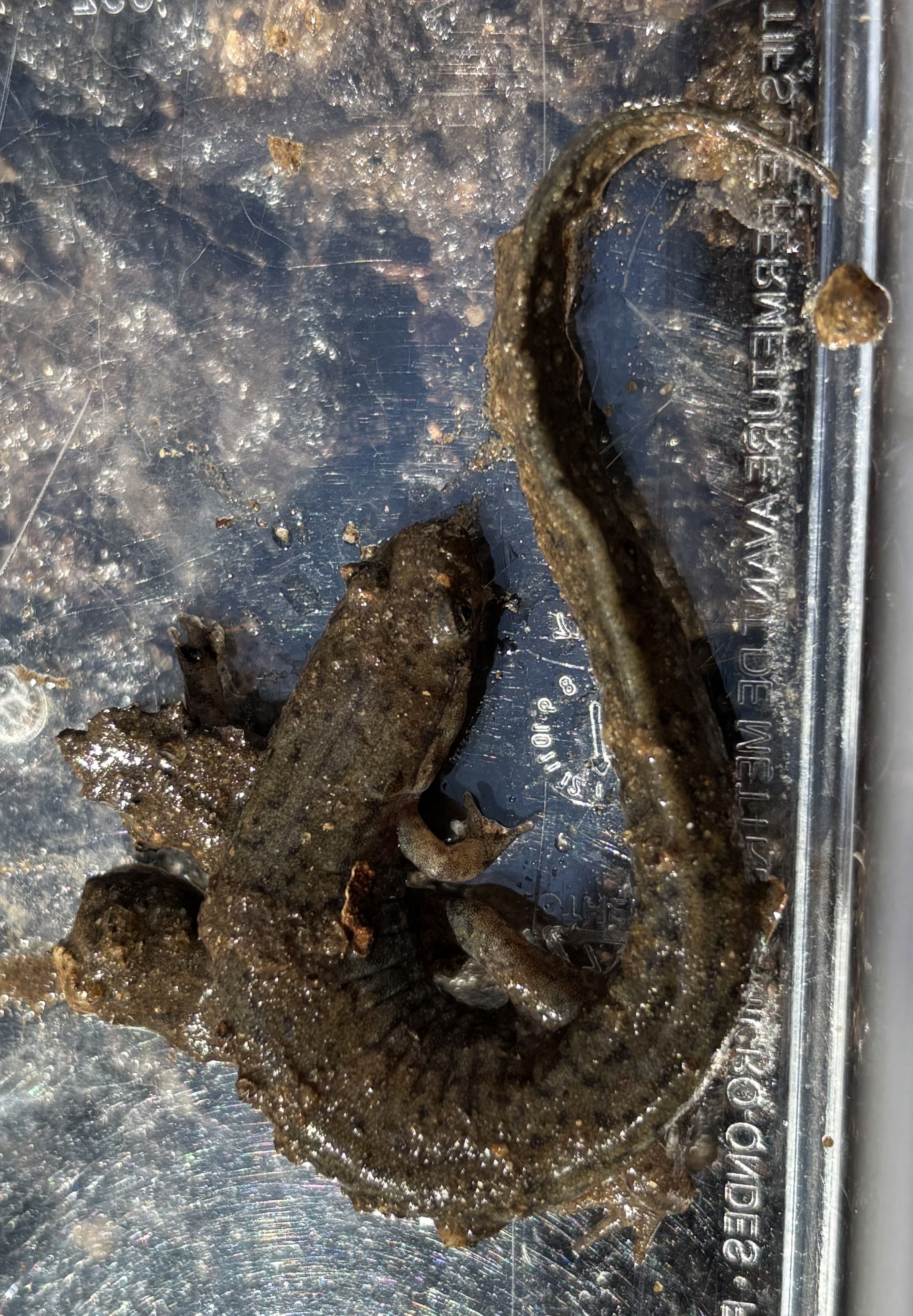
Here are a few photos of the first form:

They tended to be chunkier and reached slightly larger sizes. Their backs were gray with some dark mottling. Their sides had some white specks, but those weren’t arranged neatly in a line. Their bellies were light gray whiter specks. And finally, they had a fairly keeled paddle-shaped tail.

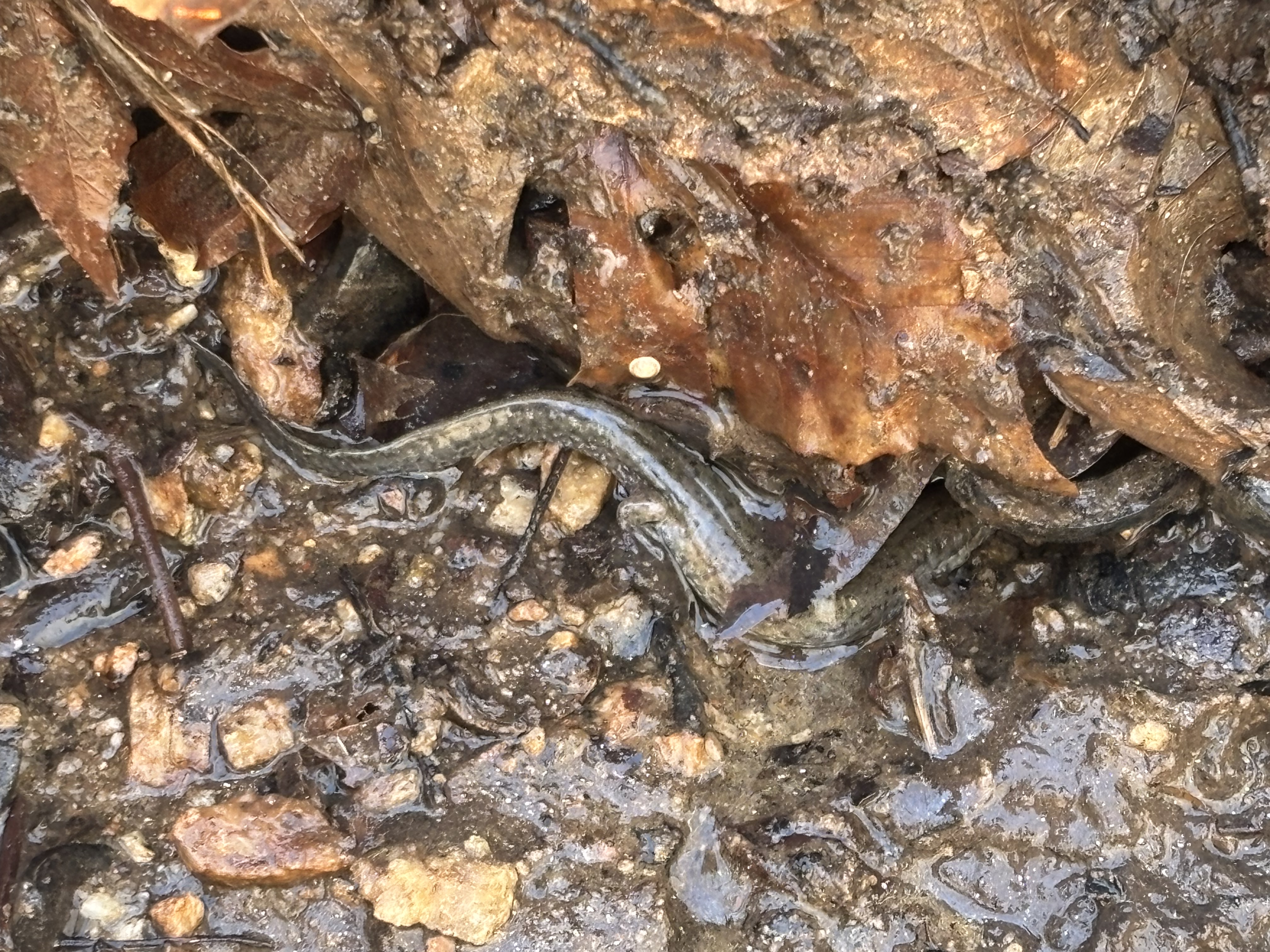
Here is the other type:

They were less robust (although that’s tough to tell from these photos). Their backs were darker, and they often had a fain reddish stripe running down them. Their sides had clear lines of white specks. Their bellies were a much darker gray base color, and their tail wasn’t nearly as keeled.

Based on the scant information that exists about morphological differences between the two species, I’d argue that the first form could be D. lycos and the second D. bairdi. Adding further to the intrigue, the two morphs seemed to show habitat partitioning! I only found first in seeps and muddy depressions and the second form in or at the edges of the little streams. Both species occur across all these habitats at other locations. Here, if I did actually see two species, they may be divvying up the landscape at Boones Cave like those duskies in the mountains do! This type of habitat partitioning, through evolution, canresult in both species having more extreme traits in places where ranges overlap than in locations where they are the only one. It’s a common enough phenomenon that ecologists have given it a name—character displacement.

Now for some caveats. Salamanders in general andspecies of Desmognathus in particular are super variable in color and form within individual species. Additionally, ten or so salamanders isn’t a very big sample from which to draw conclusions. Finally, I was by no means surveying systematically. But in any case, the dusky salamanders of Boone Cave deserve further investigation. It’s possible this is the first known co-occurrence of these two “new” species, which would be really exciting!

March 12, 2025: Old-School Naturalizing in the Sandhills

Today I headed to Carvers Creek State Park for some early spring naturalizing. The park, north of Fayetteville, preserves some pristine longleaf pine (Pinus palustris) woodlands. This beautiful and diverse habitat, threatened by habitat development and fire suppression, is fast becoming one of my favorites in the state.

Normally when I’m in nature, I’m on my phone a lot. I keep a running eBird list, and have a trail map downloaded, which I check frequently. Additionally, if I have service (most places these days) I’ll take pictures of unknown lifeforms and upload them to iNaturalist, using the algorithm to generate a tentative identification. This time I wanted to try naturalizing completely offline. I printed out the map, packed a couple field guides, and hit the trail.

Amazingly, the very first bird I saw upon exiting the car, was a rare Red-Cockaded Woodpecker (Dryobates borealis). An obligate dweller of frequently burned pine-forests, this was only the third time I had ever seen one! I instinctively reached for my phone to start an eBird checklist before I remembered my brief. Instead, I opened my notebook, wrote down the four-letter of birding code RCWO and put a small dot next to it. Before everyone had an electronic recording device in their pocket, ornithologists developed a shorthand for recording their lists. Each bird has a unique 4-letter code that’s some combination of the first letters of words in the English species name. Additionally, rather than tick marks, birders often use the dot and line tally method, where you build boxes that eventually total ten individuals. This method is easier to read and harder to miscount. By the end of the day, I had a hand-written list of 28 birds and their counts. I must say, I think my totals were more accurate than my normal eBird accounting.

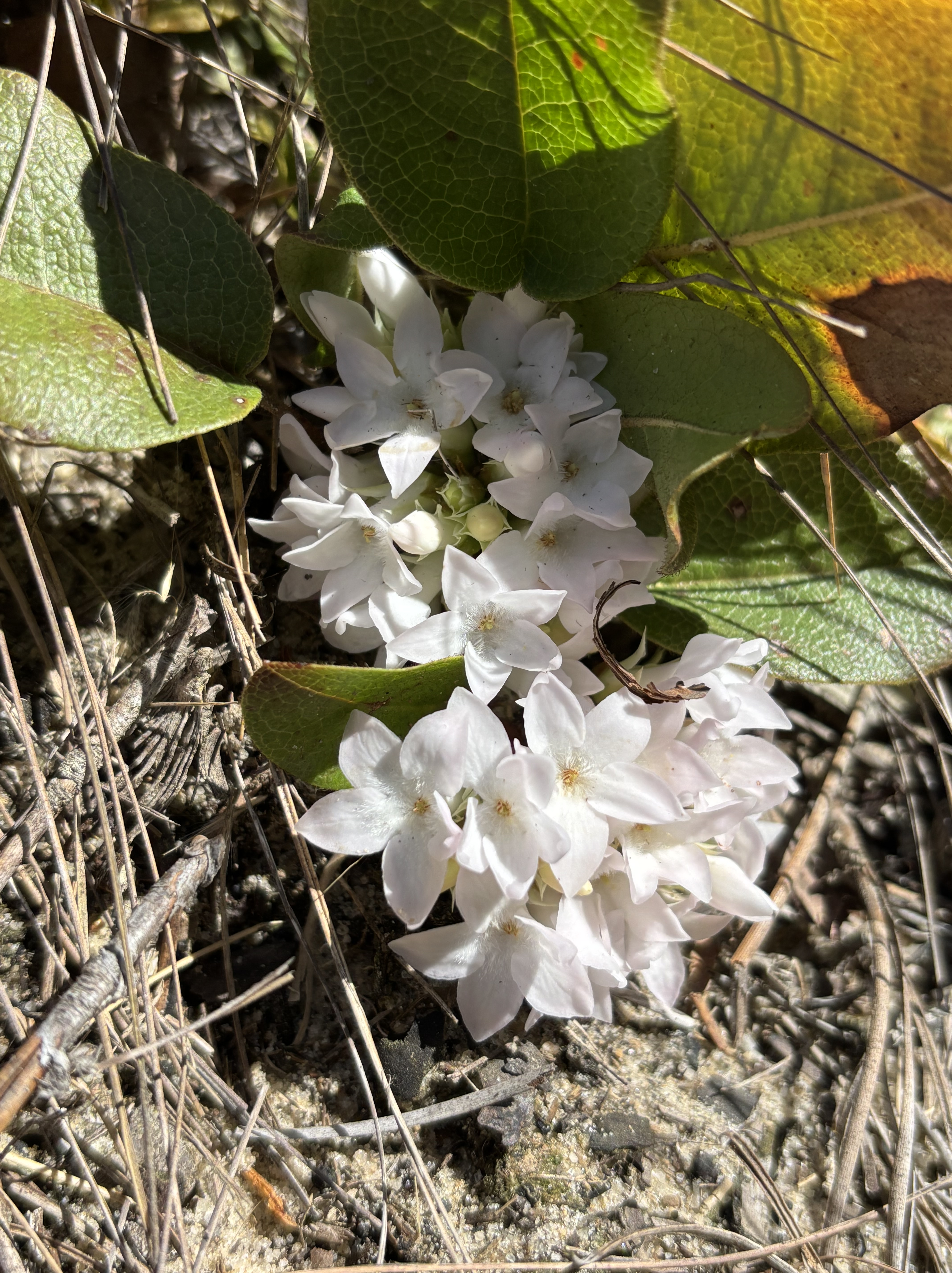
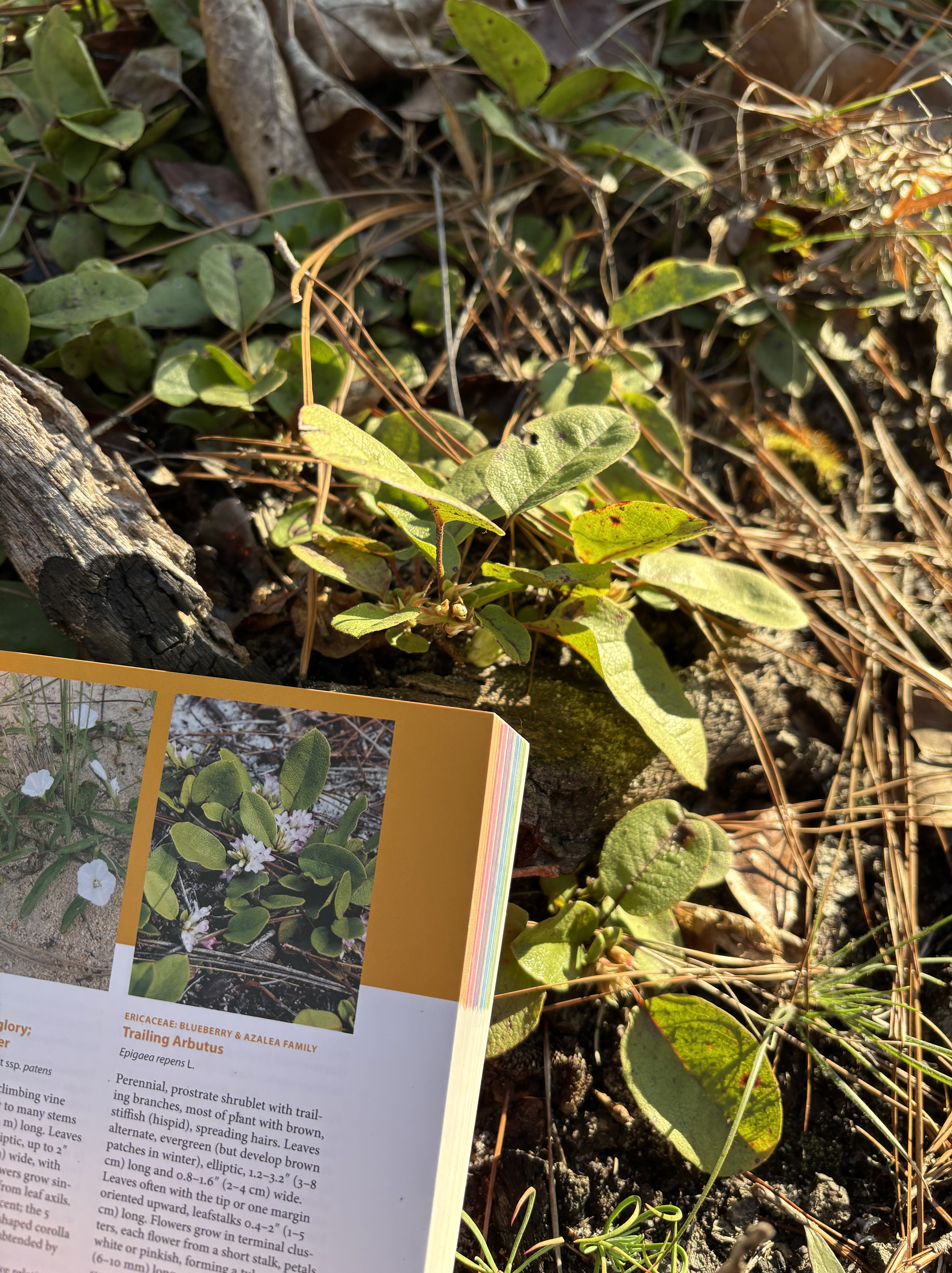
A few minutes down the trail from the woodpecker, I found a low-growing plant with lovely, fuzzy-centered white flowers.

I brought my copy of Wildflowers of the Sandhills Region by Bruce A. Sorrie for just this moment. Flipping to the appropriate section, I quickly identified it as Trailing Arbutus (Epigaea repens).

The description in the book mentioned a nice fragrance, so I lowered my nose to ground level to get a whiff. What a treat! They had a lovely smell of a less-cloying jasmine. Here was definitely a win for field-guide usage—I never would have thought to sniff if I had just used iNaturalist.

The only other plant blooming this early was my main target of the whole trip, the sandhills pixiemoss (Pyxidanthera brevifolia). Only found in six Carolina counties, this is one of the rarest plants in the region. It’s an absolutely adorable cushion-plant, densely covered with delicate flowers.

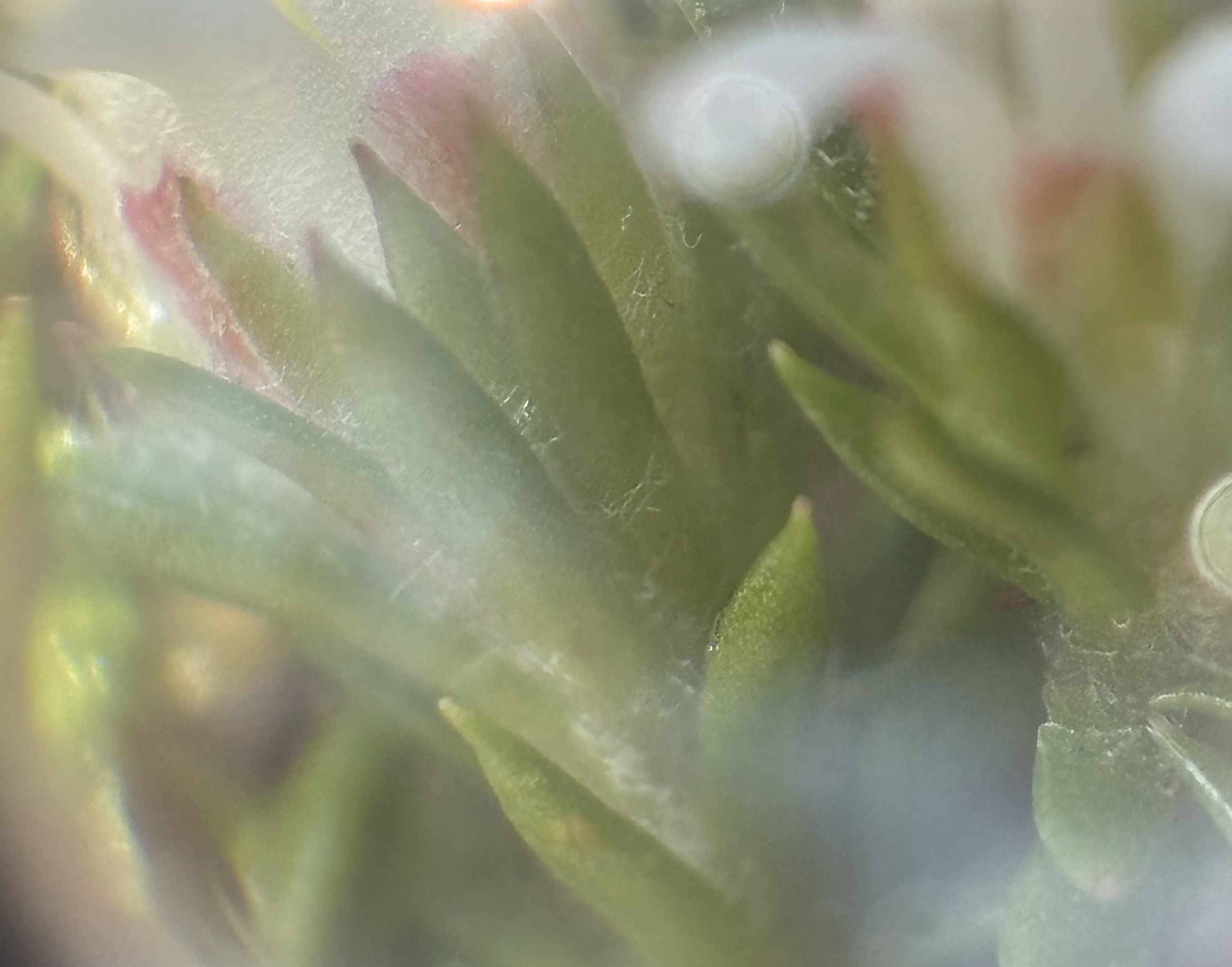
Even here, in excellent habitat, it is uncommon—I only saw one plant across eight miles of trail! I used the description in field guide to make sure I wasn’t confusing it the only other species in the genus. Using a hand lens, I saw hairs covering the leaves, which among other traits, clinched the ID.

In addition to the birds and flowers, I had an excellent day for herps, totaling nine species (no snakes though). While flipping some small logs around the edge of a pond, I found this tiny salamander!

Based on shape, I knew it was in the genus Eurycea (amazingly it’s a congener of the cave salamander I had just seen in Texas!). But I had no idea which one. Time to turn to my other old school resource—the Peterson Field Guide to Reptiles and Amphibians of Eastern and Central North America. Comparing the species that could be found in the area, I locked in on a couple important characteristics. Four (not five) toes on the back legs.

A yellow belly with an even paler throat and chin (compared to a darker gray).

I had just found the uncommon and recently described Chamerlain’s Dwarf Salamander (Eurycea chamberlaini)!

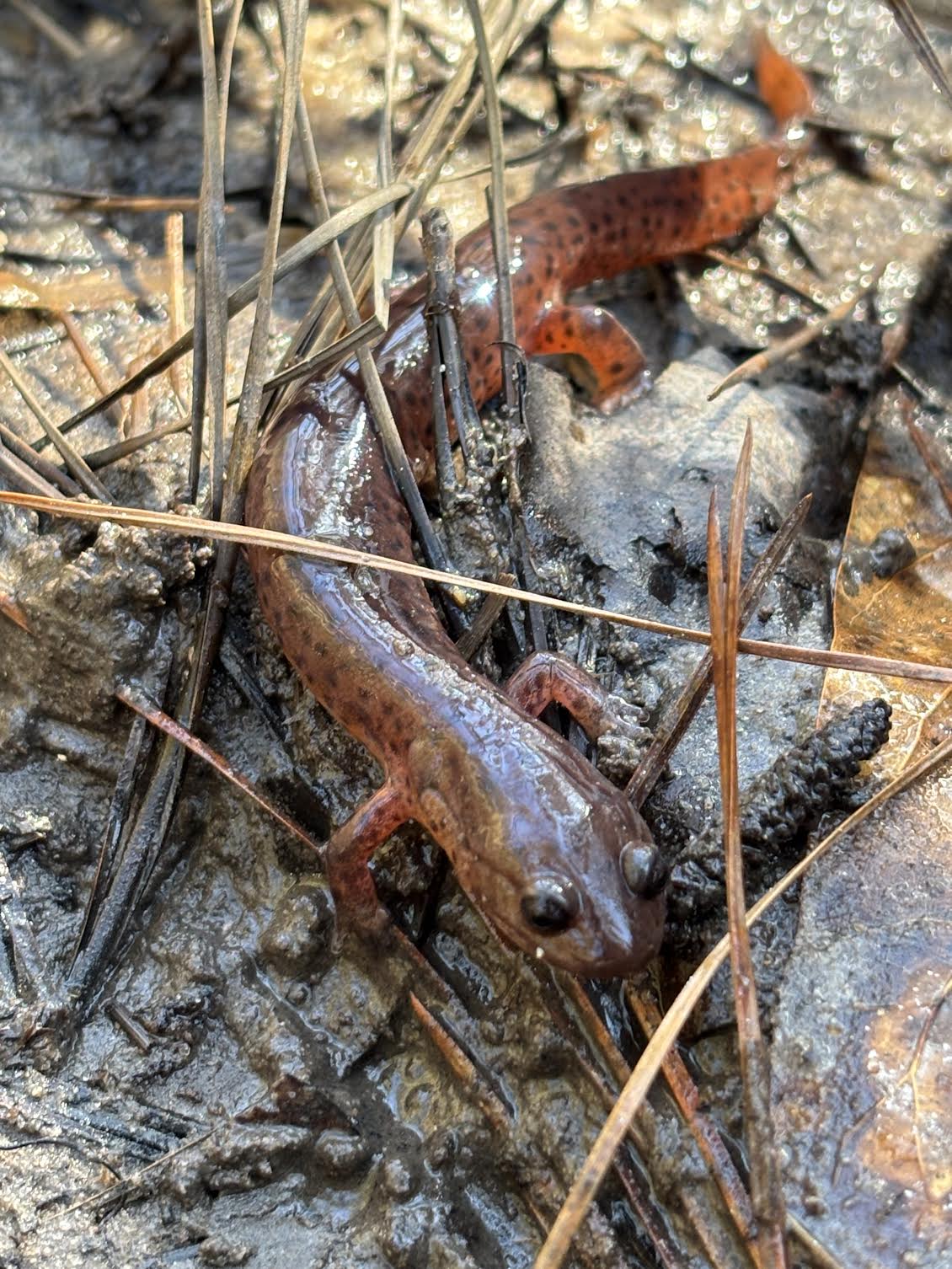
Other herp highlights included this chonky mud salamander (Pseudotriton montanus),

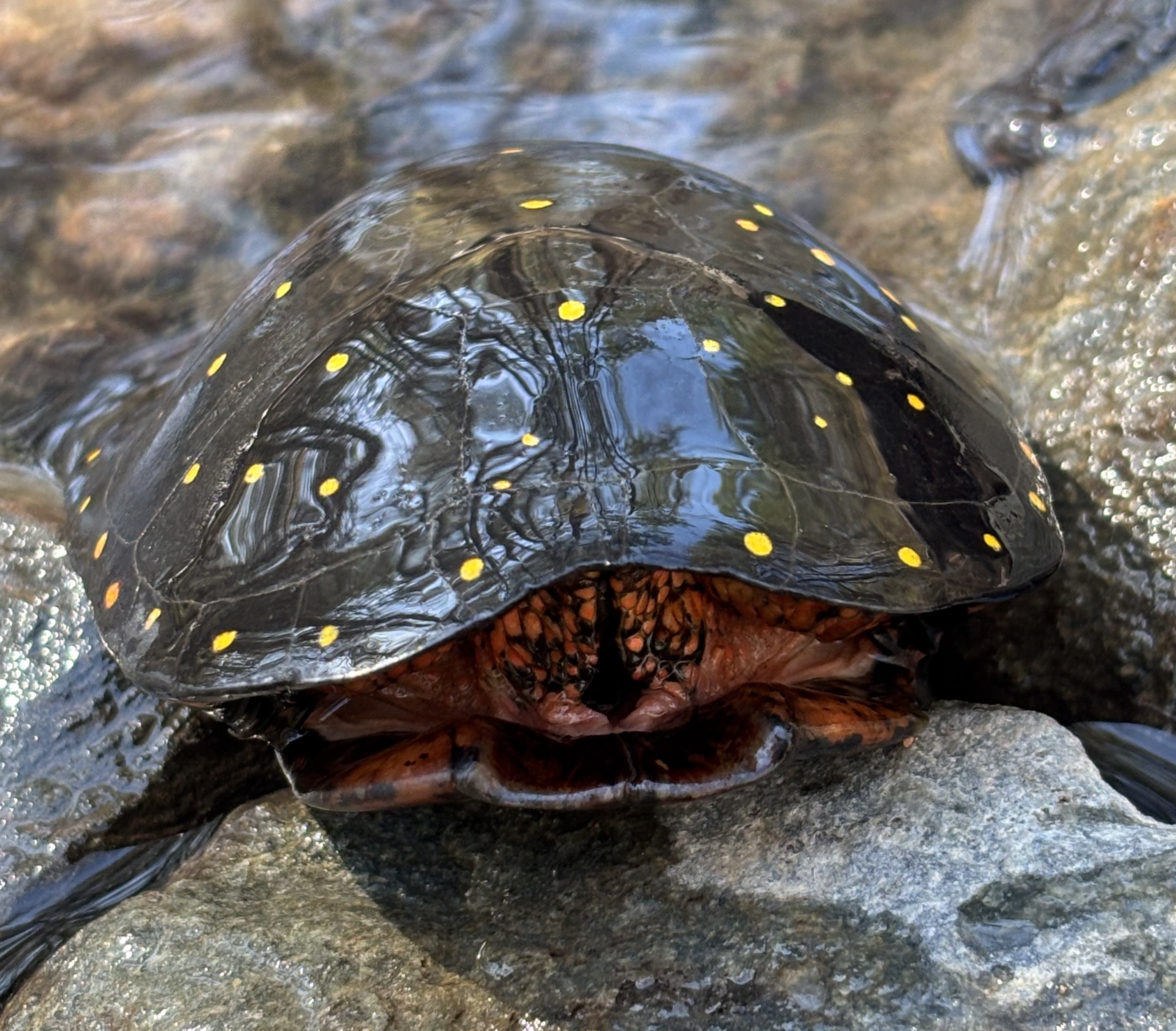
and this stunning spotted turtle (Clemmys guttata).

No field guides were needed for either of these two (In case you’re curious, I swear this is the front end of the turtle—their head is tucked is tucked behind those weird orange and black neck folds!).

Overall, I did enjoy eschewing my phone. Hiking with a notebook in my pocket encouraged me to jot down observations as I walked. For instance, based on my notes, I could figure out that a butterfly I saw flutter by was a sleepy orange (Abaeis nicippe). However, I found it somewhat annoying to transcribe my bird list when I returned. Additionally, it seems unnecessarily handicapping to not use the identification algorithms of iNaturalist when I have a perfectly good photograph and the internet. On my next hike, I’ll definitely keep that notebook in my pocket and take the time to use a field guide, if I brought the right one. But I will go back to my phone-y ways.