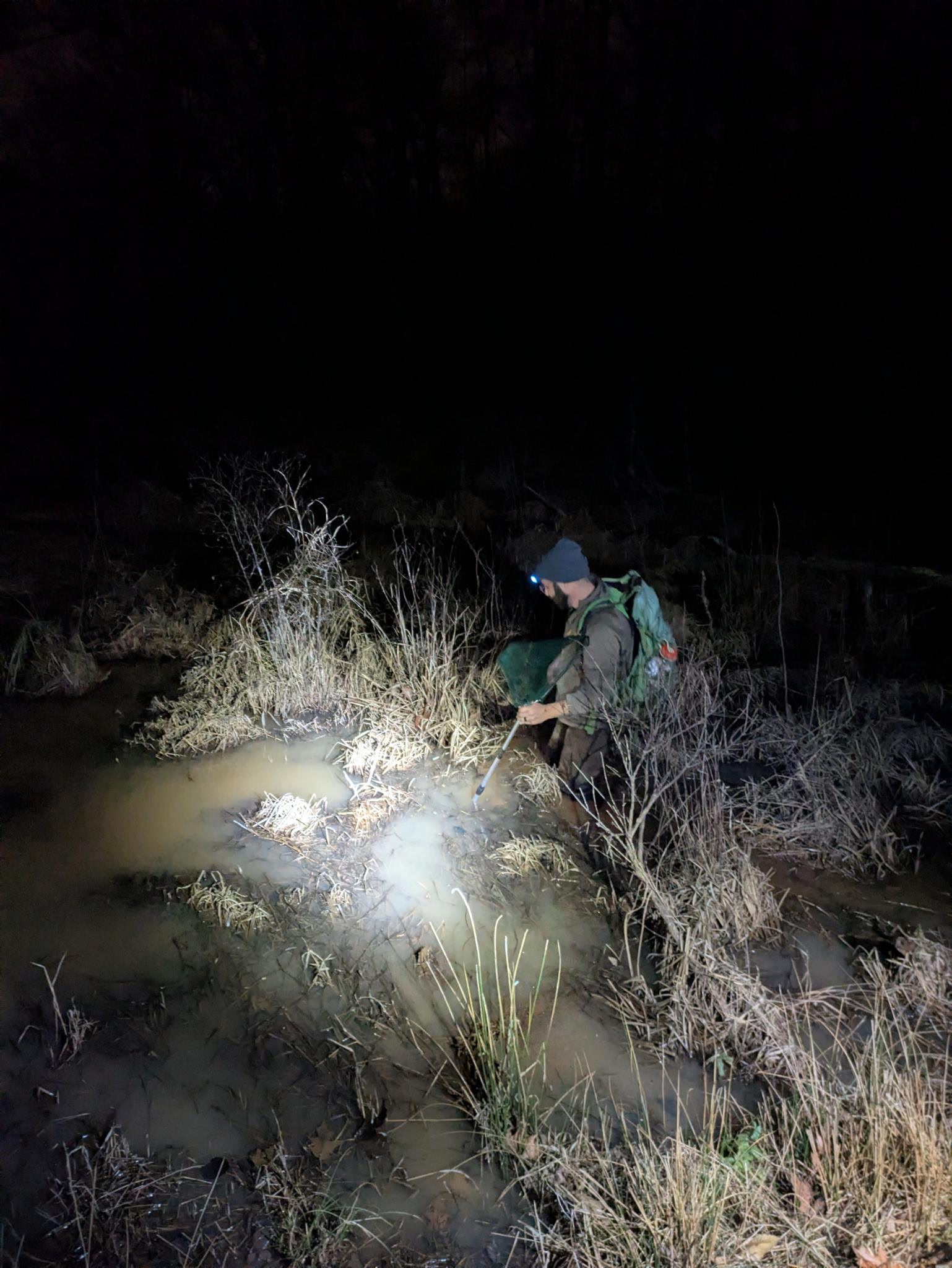
North Carolina has an amazing number of amphibians. We’re at the center of world salamander diversity and there are at least 46 species of the slimy little slitherers in the state. But the anurans (frogs and toads) of North Carolina hold their own. There are 29 native species here—more than in all of California. This Wednesday we had a large storm system come through, with temperatures staying relatively warm into the evening. Despite a bit of wind, the conditions were pretty good for some night herping! I set out with some friends in the hopes of seeing some nocturnal amphibians.
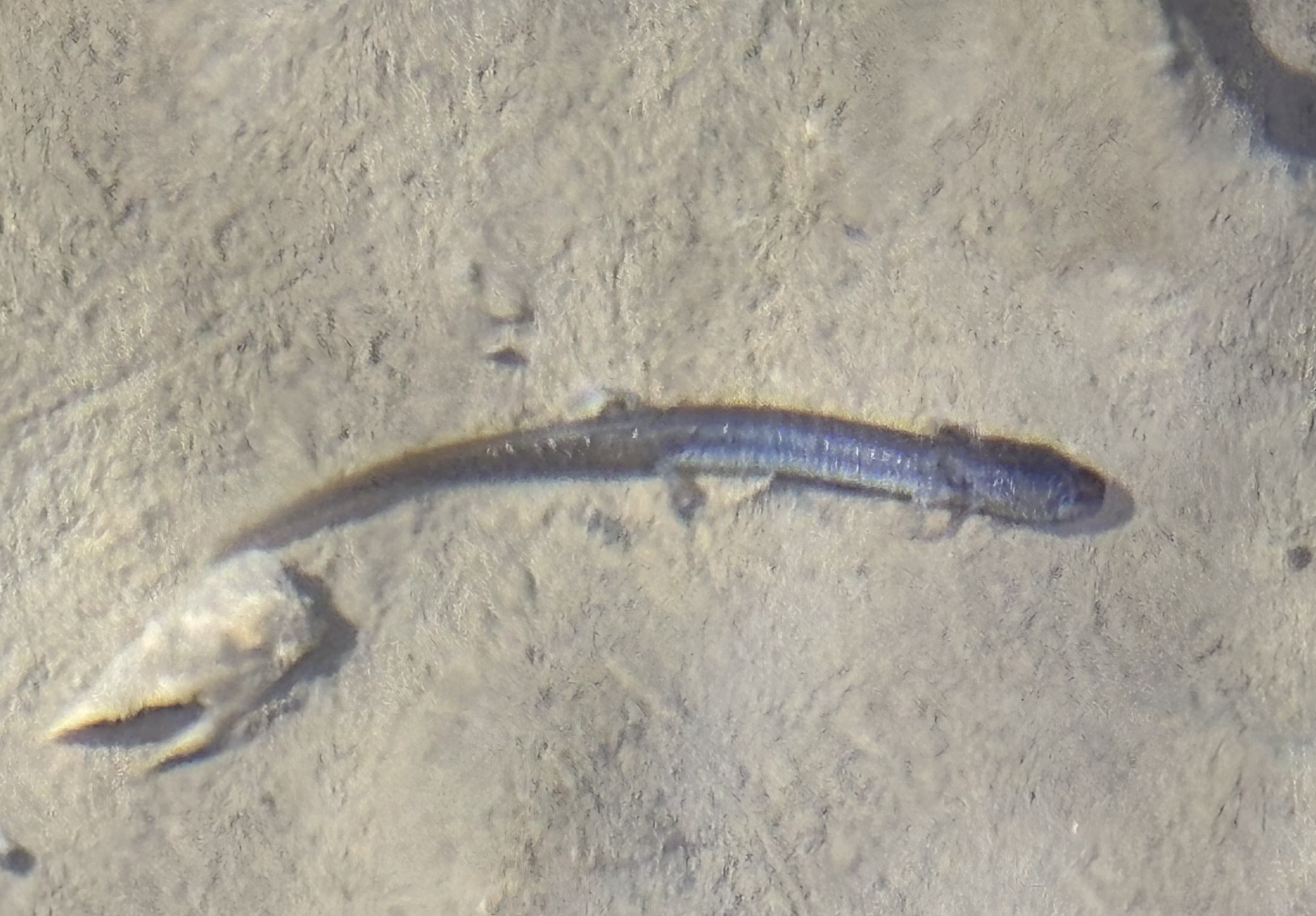
The hope was that salamanders would be moving across the trail, but unfortunately the ground had dried since the morning rain. We put in a valid attempt, but we only were able to find one chunky southern two-lined salamander (Eurycea cirrigea). She was extremely gravid, and we could actually see her eggs through her somewhat translucent belly.
Photos: Jenny Mohn
While our sally count was…low, there were many very active frogs. Finding frogs has some pros and cons relative to searching for salamanders. on the cons side, frogs are much harder to catch. Their cryptic coloration, tendency to hang out in middle of ponds, general skittishness, and notorious jumping ability all combine make it very hard to get satisfying looks. On the pros side, you can hear them from (sometimes literally) miles away! Most frogs and toads all have unique mating calls that the males use to attract mates. They are different enough that it’s possible to identify them confidently without seeing them. In fact, in some cases it’s the only way to differentiate species! For instance, Cope’s and gray treefrogs (Hyla chrysoscelis and H. versicolor) look identical, but the former trills more rapidly and harshly than the later.
On our hike, we were able to track down and catch a spring peeper (Pseudacris crucifer).
Photo: Katherine Tombs
It only took wading into knee-deep muck, and a carefully timed swing of a net!
Photo: Katherine Tombs
The scientific name, crucifer, refers to the cross-shaped dark mark on their back, but their common name references their distinctive call—a high whistled “peeeeep”. Hundreds of them were calling from their breeding pond, creating an impressively loud symphony of sound.
We also heard many upland chorus frogs (Pseudacris feriarum). Despite being in the same genus as the peepers, their call is entirely different. They say a slow “crrrreeek” that sounds like fingers dragging over the teeth of a comb. They are extremely common here in the piedmont of North Carolina, but despite searching I still have yet to lay my eyes on one!
In a previous post I described keeping a birding life list. I am also nerdy enough to keep a list of all the reptiles and amphibians I’ve encountered in the US. It currently stands at 210 species, 43 of which are frogs. Upland chorus frog is on the list because I’ve definitely knowingly been within a few feet of one, but the entry gets the qualifying addendum of “heard only”. This is a term borrowed from birding—I’ve heard but not seen nine birds in the United States. Besides upland chorus frog, two additional heard only frogs make my list. While exploring the wetlands of Northern Minnesota, the knocking-on-wood sound of a mink frog (Lithobates septentrionalis) emanated from some nearby but inaccessible reeds. And just last week in the Savannah National Wildlife Refuge, SC, a pig frog (Lithobates grylio) called from the water’s edge next to an alligator haul-out spot. It really did sound like a pig grunting. I didn’t know what it was at the time, but I recorded the sound on my phone and uploaded it to iNaturalist. Within a few hours another herper was able to put a face to the sound.
Aural encounters are great, but as a member of a visual-centric species, I’d love the chance to “convert” these heard onlys into the spotted column. Goals like this will keep me adventuring on warm, rainy nights for decades to come.
This weekend, Jenny and I went to Hilton Head Island, South Carolina, to meet up with our friends, Charlotte and Eric. One of the highlights was a dolphin-watching trip through the saltmarsh inlets that surround the island. The dolphins here are a newly described species, the Tamanend’s bottlenose dolphin (Tursiops erebennus), which was recently split from the common bottlenose dolphin (Tursiops truncatus). While the former averages smaller, the two species more or less look the same. However, their behavior and genetics are quite different. The Tamanend’s are an inshore species that’s resident year-round from New York City south to Miami. The common’s are generally an offshore species found across the globe.
Before we left the harbor, Captain Sebastian told us if we noticed anything that might be a dolphin, regardless of our confidence level, we should let him know. He told us of trips where customers mentioned they thought they had seen dolphins when they were back on shore and it was far too late. While obeying the slogan “If you see something, say something!” in a dystopian totalitarian regime might make you a collaborator, it was sage advice from our captain. Having a fast trigger on the phrase “What’s that?” should be a rule whenever two or more naturalists are gathered.
While the concept is easy in theory, people are surprisingly bad at calling things out while still uncertain. The simple psychological truth is that people don’t like to be wrong. I get it. It can feel embarrassing when you think something is going to be cool, you make a big deal about it, and it turns out to be…not that thing. In order to get over that fear, I play a game while naturalizing called Stick or Snake.
Pronounced “sticker snake”, the goal of the game is to be the first to correctly guess whether the object in front of you is a stick or a snake. You win by determining something is a snake and it is! There are two ways to lose. Occasionally, you might claim something is a stick, but it’s actually a snake. Assuming you didn’t run it over in your car or get bitten by it, losing this way isn’t the end of the world. However, it does mean you should start searching much more carefully—you’re probably missing lots of cool snakes. Far more often, you will think something is a snake but it’s actually a stick. Especially if you’re a newcomer to the game, you should lose this way A LOT. And each time you do, you should proudly declare “I lost stick or snake.” If you’re not losing often, you’re not playing hard enough.
Stick or Snake has lots of variants. Leaf or Lizard. Log or Croc. Plastic Bag or Snowy Owl (that one’s really hard). The version we played at Hilton Head could be called Dolphin or Nothin’. The wonderful thing about these games is how quickly folks improve. Visual pattern recognition is one of the greatest skills of our species possesses. Students on my course are often amazed by how quickly they learn the search image for their study organism, and how they accidentally continue to find them long after their study is complete. But, in order to train our brain to recognize what something looks like, we also need negative data. What doesn’t it look like? Playing these games gives us a better training set on which to hone our detection abilities.
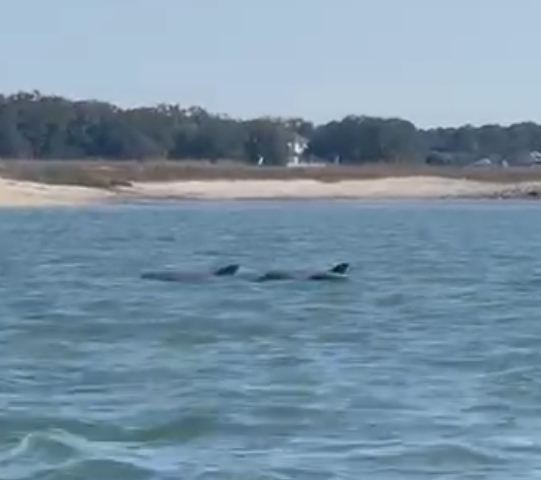
On our boat trip, it turned out Dolphin or Nothin’ was pretty easy to win. A boat ahead of us had already spotted a pod of Tamanend’s Dolphins. We watched in wonder as they foraged and tail slapped in the bay, sometimes even swimming directly under the boat. On the way back to shore, we even had time to play another game—Wood Stork or Another Tall White Bird that Isn’t as Cool as a Wood Stork. I lost a lot.
Ten days ago, I looked at the long-range weather forecast, and saw days with temperatures in the high 60’s and days with snow!
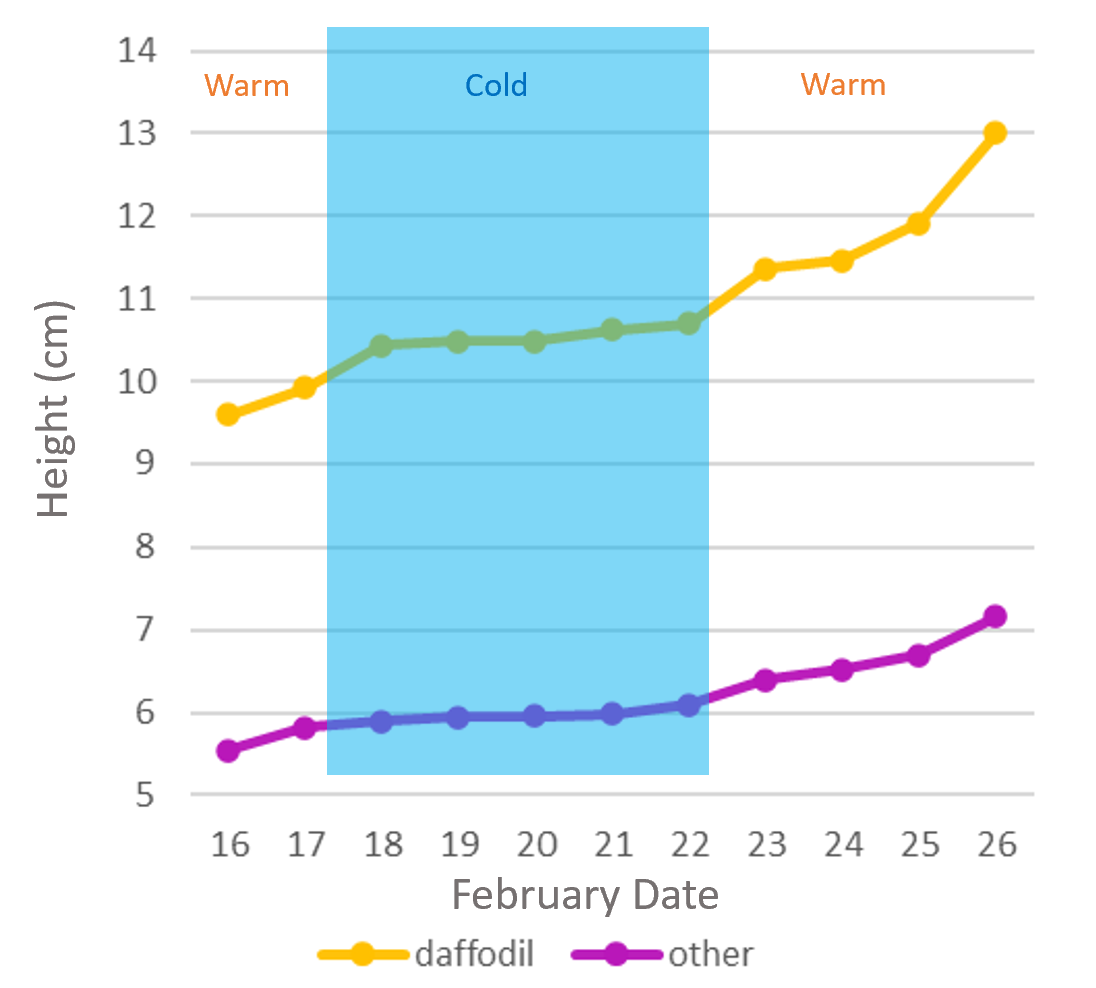
Early spring is maybe the time of year most noted for wild swings in weather. Over the last ten days, we’ve had temperatures as high as 69 and as low as 19. It’s also, amazingly, a time when the ground begins to show pops of green as long dormant spring flowers unfurl their leaves. In our backyard, daffodils, crocuses, tulips, and other bulbs are rapidly racing towards flowering. But do these plants continue to grow when the weather turns wintry? What matters more to a growing plant, warmth or sunlight? From February 16-26, I tracked the growth of ten leaves (5 daffodils and 5 various other plants). To do so, I marked focal leaves with a sharpie and measured their length with a ruler every day around noon. Then I charted their growth in relation to the weather.
This stretch began mild, but quickly turned frosty. I ended up having to brush away snow on the 20th. However, by the end of the ten days, spring had definitely sprung. The graph below clearly shows the plants responding to the weather. Most plants showed some growth on the first couple days before shutting it down during the cold stretch. As the weather warmed again, growth happened even faster than before. The record was daffodil #3, who grew 1.6 cm in a 24-hour period.
Doing a little study like this often unlocks more questions than it provides answers. Unfortunately, during these ten days, there weren’t really days that were cold and sunny or warm and cloudy. Therefore, I couldn’t disentangle the effects of warmth and sunlight on plant growth. On a couple days, it seems like the daffodils grew but not the other plants. Are the daffodils responding to different environmental cues than other spring flowers? Also, I didn’t control for things like shade and soil type which varied a lot even in the small confines of our back yard.
If studying back-yard plant growth was something that seriously interested me, I could use the information I collected as pilot data to help me design the next iteration of my data collection. As a scientist in general, and an ecologist especially, you’re never going to design the perfect study right out of the gate. There are simply too many unknowns going into a new study system. Without a bit of preliminary data collection, you’re not going to know the best ways to measure the things you do care about and to control for the things you don’t. For instance, I measured the height of the leaves from flush with the soil surface. However, I noticed that ground height shifted around some plants due to the freeze-thaw cycle. Therefore, if I was doing the study again, I might mark a location at the base of the focal leaf from which to start my measurement every time.
While finding that plants grow when it’s sunny isn’t going to win me the Tyler Prize for Environmental Achievement (there’s no Nobel in this field), it was nice to get back into data collection mode. In a month I’ll be helping students collect their own pilot data and I need to make sure I’m not rusty!
Across most of the United States, February is a boring month for birders. We’ve been stuck with the same species all winter, with no hope of reinforcements in the form of migrants until the end of March. As I wait for spring, and it’s associated turnover of species I decided to do a bit of housekeeping of my birding life list.
I’ve mentioned this before, but eBird is an absolutely amazing website for birders. It’s great for finding places to look for birds, checking recent submissions for any nearby rare or unusual birds, and linking to pictures and descriptions to help with identification. But most of all, eBird amazing at keeping lists. Listing birds is like other collecting hobby, in that more is better, complete sets or rarities are particularly fun, and conversations about which ones you have is extremely tedious to anyone who doesn’t collect. I think the difference between baseball cards or coins and birds, though, is that each item on my life list has at least one amazing memory attached to it. I’ll occasionally peruse my list and reflect on the time I saw a Great Grey Owl hunting voles in the evening light or watched a Great Curassow stride through Mayan Ruins.
Since I began using eBird in 2013, I’ve encountered (seen or heard) and logged 976 species of birds globally, 601 in the United States, and 412 in California. The problem is that I’ve seen some birds before 2013 and not since. I know for sure I’ve actually met 612 kinds in the US and 419 in California. A few of these “extra” birds are quite rare in the region, and I’ll be unlikely to ever see them there again. Therefore, in order to preserve my memories, I keep an excel spreadsheet with my USA and CA life lists. It’s easy to do in theory, but in practice, my “count” keeps changing!
Other than seeing new birds, the numbers on my list can change for two reasons. One is taxonomic change—lumping and splitting species. Based on the most recent literature, sometimes two or more species are grouped into just one. A recent example is that Common and Hoary Redpolls were found to freely interbreed, and therefore lumped into “Redpoll”. More frequently, what was formerly considered geographic variation within a species is deemed enough to elevate populations into to two or more separate species. For instance, last year Cory’s and Scopoli’s Shearwaters were split, and, as I had seen both, I got to add one to my count—an armchair tick! Numbers can also change based on which non-native species are considered “countable”. The American Birding Association (ABA, aka the birding police) keeps track of wild, but introduced populations of birds in the US and Canada, determining when they are “naturalized”—that is self-sustaining through reproduction in the wild—and thus countable. The chicken you watched crossing the road after escaping its coop doesn’t count, but the European Starling at your backyard feeder definitely does. The flock of Egyptian Geese that Jenny and I saw along the Colorado River in Austin last week? The ABA needs to make a ruling (it’s on my list, but it’s technically still a provisional species!). Finally, adding to the confusion are name changes and taxonomic revisions that alter the order birds appear of the list.
All this to say, a couple days ago I redownloaded the most recent ABA checklist, and spend a couple hours updating my excel sheet. I made adjustments to the taxonomy and additionally added the ABA rarity codes to my list. Here’s how those work:
There are 1109 species of extant (not-extinct or locally extirpated) bird species that can be counted the US, of which I’ve only seen 55%. However, 362 of those are rarities—codes 3, 4, or 5. Of those, I’ve only seen 19 (5%, including my one code 5 lifer, a White-chinned Petrel that hung out with me on a boat trip in Monterey Bay). I’ve seen about 45% of the 257 code 2 birds. Many of my code two misses would either require trips to Alaska, Hawaii, or South Texas (places I’ve never been), or are naturalized species locally found in cities (places I don’t particularly enjoy birding). That leaves the 489 code 1 birds. Of those, I’m only missing 15 (3%)! Those elusive few make a great list to search for on future adventures! Hopefully I can find a few more lifers once winter turns to spring.
Jenny just completed our road trip to Texas and back. I challenged myself to make a natural history observation on each of the 12 days. I’ll present those below along with an interesting fact that I did not know before doing some research.
Day 1, Montgomery, Alabama: Much to my surprise, White-Winged Doves (Zenaida asiatica), and not Mourning Doves were the most common dove in the city, their raspy songs echoing across the National Memorial for Peace and Justice. I think of White-Winged Doves as a desert species, seen soaring over saguaro or perching on mesquite. But their numbers have been dramatically increasing in the suburbs and cities of the Southeast, where they spend the winter. White-winged doves perform elaborate courtship displays, involving bowing, bill slapping, tail fanning, and spiraling display flights.
Day 2, Red Hills, Alabama: A red hills salamander (Phaeognathus hubrichti) poked its head out of its burrow before turning around and slithering, dragon-like, deeper underground. Jenny and I camped in the Red Hills specifically to look for this salamander that’s endemic to the area. It’s a super unique critter in appearance (it’s extremely long and skinny), behavior (it spends most of its life in narrow burrows on the sides of mossy ravines, waiting for invertebrate prey to wander by), and taxonomy (it’s the only species in its genus). It also wasn’t known to science until 1960, when it was accidentally discovered during a snail survey! In 2000, A third grade class successfully petitioned the Alabama state legislature to name it the state amphibian. Most populations were on private land (and thus imperiled) until state, federal, and private organizations collaborated to purchase a bunch of prime habitat for conservation. It’s heartening to know these types of conservation efforts are possible in the deep, rural south.
Day 3, Lafayette, Louisiana: Hundreds of galls formed by the wool-bearing gall wasp (Druon quercuslanigerum) galls covered many southern live oak (Quercus virginiana) trees in downtown Moncus Park.
I’ve recently become a bit obsessed with gall wasps, and these were the coolest species of the trip. Crazily this wasp has a life cycle with alternation of generations. I found the asexual leaf galls, where all the emerging adults will be clones of mom. In the spring, the species produces a sexual generation (males and females) on the flowers of the oak.
Day 4, Atchafalaya Basin, Louisiana: A northern cottonmouth (Agkistrodon piscivorus) reared back its head, revealing its namesake white maw, while rapidly shaking its tail against the dry leaves.
The display was very effective, as I quickly jumped back from this very venomous snake. Unlike Crotalus and Sistrurus rattlesnakes, this genus of pit vipers, which includes copperheads, doesn’t have a tail tip made up of hollow, loosely connected scales. Therefore, it was interesting that it produced a warning vibrating sound anyway. Cottonmouths are swamp dwellers, very at home in the water where they eat mostly fish and frogs. They are one of the few snakes that can live in salt water, and are even capable of swimming out to barrier islands.
Day 5, Galvaston Island, Texas: A small mixed flock of Snowy Plovers (Anarhynchus nivosus) and Piping Plovers (Charadrius melodus) foraged in the surf near a larger group of Sanderling (Calidris alba). The movements of the two species were very similar, as they stopped and started, picking small invertebrates from the wet sand. Both the plovers are small shorebirds that nest on beaches, with snowies breeding along the pacific and gulf coasts and pipers along the Atlantic. Both are threatened by habitat loss and have very active conservation programs to protect them. Beaches along the Gulf of Mexico in winter are the only place to observe such a mixed flock. Because they seem so similar in looks and behavior, I had assumed they were closely related. It turns out they are on entirely different branches of the plover tree. Piping Plovers are more closely related to the ubiquitous Killdeer, while Snowy Plovers are allied with the oddball Mountain Plover, among others. Many of their similarities, it seems, are the result of convergent evolution—the two species hitting on similar strategies in the face of similar selective pressures.
Day 6, Aransas Peninsula, Texas: A Whooping Crane (Grus americana) family struts around a recently burned savannah, looking for grub (maybe literally). The attentive parents seemed to keep the buffy-headed youngster was under constant watch.
Whooping Cranes are the tallest and one of the most endangered birds in North America. There are only about 700 in the wild, but that’s far more than their nadir of only 15 birds in 1938. The cranes were our whole reason for a detour to the gulf coast, and watching them was well worth the trip. The population that winters at Aransas breeds in Wood Buffalo National Park in northern Canada. The juvenile we saw flew south with its parents and will remain with them through the long northern migration this spring. Then it will join up with a flock of other young birds until it finds the perfect life partner through the magic of dance at age 2 or 3. Pairs usually take a couple of years before starting a family. They often don’t successfully hatch an egg before their 5th birthday.
Day 7, Austin, Texas: Large numbers of ball moss (Tillandsia recurvata) plants grew on deciduous trees in the downtown. It was fun to see such a tropical-looking plant growing on trees that had lost their leaves for winter.
One of the most northern members of the bromeliad family, these hardy beings must be amazingly pollution tolerant to make a living constantly exposed to the polluted city air. Despite a reputation of being harmful to the tree, ball moss doesn’t steal any water or nutrients and doesn’t increase the chances of limb breakage. In fact, they host a nitrogen-fixing bacteria in their tissues that converts atmospheric nitrogen into forms that can be used by the plant. Therefore, when they fall to the ground at the end of their short life, they enrich the soil with extra nutrients, benefitting their host plant.
Day 8, Austin Texas: An impressively large Monk Parakeet (Myiopsitta monachus) nest rests on the side of a telephone pole.
Monk Parakeets are the only parrots that nest colonially and the only ones to make an entirely stick nest. This unique adaptation likely makes them successful at maintaining feral populations in surprisingly temperate cities—there’s warmth in colonial living. Originally from Argentina, Monk Parakeets can now be heard loudly squawking in Santiago, Mexico City, Madrid, Rome, Athens, Tel Aviv, Singapore, New York, and, incredibly, Chicago. Clearly sophisticates, outside their native range, these birds don’t do suburbs.
Day 9, Cascade Caverns, Texas: Several Cascade Caverns salamanders (Eurycea latitans) of varying shades from nearly white to dark gray-brown moved slowly through cave pools.
The Edwards Plateau in central Texas has porous limestone bedrock, which is prone to forming caves. This holey habitat, while dark, has plenty of water and a constant temperature, making it a great place to live if you’re a spider or isopod. With food to be had, salamanders moved in to occupy the top of the food chain. Central Texas is home to around 11 species of salamanders in the genus Eurycea. Elsewhere, species in this genus have an aquatic larval form that lives in streams before emerging as skinny, yellowish adults. However, the Texan, cave-dwelling troglophiles often never metamorphose, becoming sexually mature while still retaining gills. The denizens of the deepest caves often don’t have pigmentation or even eyes. The species we saw is more variable than most. Some individuals have tiny, non-functional eyes and a pale color, while other, usually darker individuals can see. In fact, some individuals in some populations will actually metamorphose. When we shined a light on them, some definitely reacted more strongly than others.
Day 10, Austin, Texas: Small, reddish Texas fox squirrels (Sciurus niger limitis) chased each other in the back yard of our Airbnb. Small is relative here—fox squirrels are the largest tree squirrel in North America. Nevertheless, Austin squirrels were decidedly more dainty than those I’ve seen (non-natively) in California cities or (natively) in the Midwest. They also have an extremely different color pattern than those found in North Carolina and other Southeastern states. Northern and Western squirrels are reddish on their face and belly with gray backs. Those I’ve seen in the North Carolina pine woods have pale bellies, black shoulders and faces, and have a white patch of fur above their nose. They look like an entirely different species. The story of fox squirrel coat color goes back to the last glacial maxima. As glaciers advanced, fox squirrels were driven into refugia in Florida and Southeastern Texas. It turns out coat color in this species evolves very quickly, and these two populations evolved different patterns in isolation before quickly expanding their range back across most of eastern North America. Those that moved onto the Edwards Plateau in central Texas evolved a smaller body size due to the hot dry climate—a common pattern seen across many animal species. Despite the dramatic differences in appearance, all fox squirrel populations are genetically quite similar and can freely interbreed. Hence, they are all considered the same species.
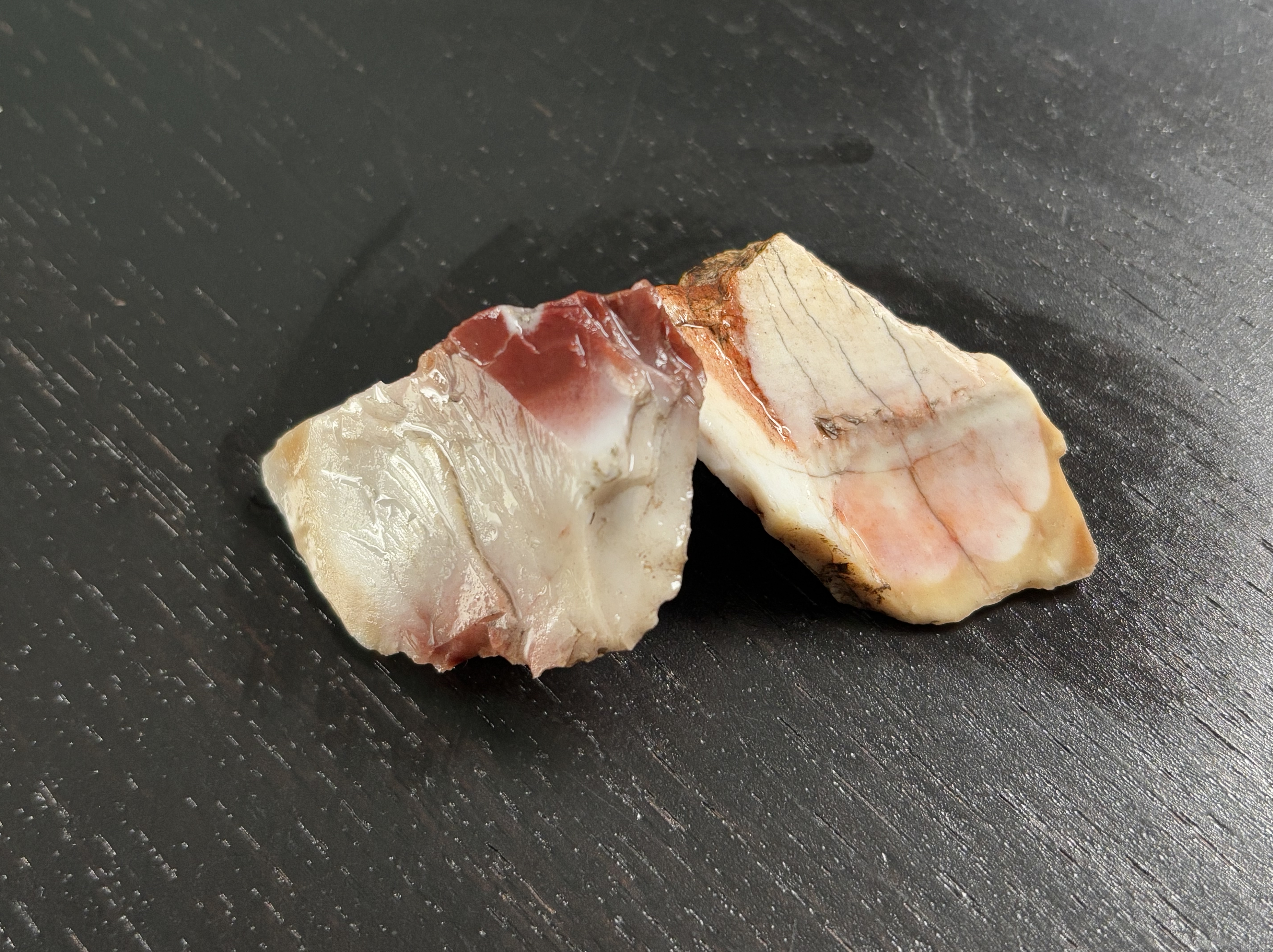
Day 11, Hot Springs, Arkansas: Chunks of beautiful Arkansas Novaculite were scattered across a recently-burned hillside on a trail in Hot Springs National Park.
Novaculite is a form of chert—a hard, fine-grained rock that’s comprised mostly of quartz (silicon dioxide). The colors in it are traces of iron, aluminum, and other metals. It formed as tiny particles of marine animals like sponges and zooplankton were deposited when Arkansas was deep underwater during the middle of the Paleozoic (~450-350 million years ago). As water became land and the Ouachita Mountains rose up to around 10,000 feet, the deposits were lightly metamorphosed (pressure cooked) giving them that slightly shiny look. This uplift occurred ~300 mya—still pre-dinosaur era when pretty much all land was in the super-continent Pangea. Since then, the Arkansas Novaculite has just been sitting around, resisting erosion as best it can (which is still going well, especially relative to the shale and sandstone around it!). It’s a fairly rare rock—only found here, the Middle East, and Japan. In all three places, novaculite has been mined since prehistoric times for arrow and spear points, and, more uniquely, sharpening stones. Apparently its 3–5-micron quartz particle size is perfect for putting the final edge on a metal blade. You can buy a novaculite “Arkansas Stone” for sharpening your high-end knives online right now!
Day 12, Ozone Falls, Tennessee: Beautiful ice formations festooned the rocks, moss, trees, and ground near one of the most impressive waterfalls I’ve seen in the East. Vast expanses of needle ice carpeted the bare dirt, reaching several centimeters in length.
Needle ice is an amazing demonstration of the high capillarity of water. It forms when the ground is above freezing and the air is below freezing, as can occur on a cold night after a relatively warm day. Capillary action pulls unfrozen ground water to the surface through narrow channels between soil particles. There it freezes. As more water moves in to take its place, the frozen bits are pushed up in long, skinny columns. This process occurs where there is flowing ground water, ensuring a constant source of building material. It also requires and a high amount of silt and organic content in the soil, which produces the medium-sized spaces where capillary action works best. Stream banks often have the right combination of these ingredients. Once you’re done admiring its beauty, one of life’s simple pleasures is to stomp on it. The crunch is so satisfying!
The falls were our last stop before making it home. It definitely added a fun element to the trip to make a natural observation even on days that were more focused on interesting culture and tasty food!
Jenny and I are about to embark on a two-week road trip to Austin, Texas. While a big motivation for the trip is to explore the food and culture, we have some nature-oriented goals, as well. For this post, I wanted to briefly describe what goes into preparing for a successful naturalizing expedition.
Identifying targets. A few months ago, when we settled on a drive to Austin, I began looking up interesting critters along the route. I plan my trips by using some amazing advanced search functions on specific websites. My three favorites are Calflora, eBird, and iNaturalist. With all of these sites, you can choose a geographic area and search for records that match specific parameters. For example, on iNaturalist I searched for February records of amphibians listed as threated within 100 miles of Montgomery. On eBird, I searched for birds found in Texas in winter that I had never seen before (based on my submitted checklists). After fiddling around like this for a couple hours (and consulting Jenny), I settled on three targets: the red hills salamander in Alabama, Whooping Crane on the Gulf Coast of Texas, and cave salamanders near Austin. I love having targets, because even if I don’t find them (for instance, the red hills salamander is a long shot) I end up visiting amazing places. That’s because unique species tend to hang out in unique habitats!
Researching. For each target species, I use the same websites as to determine accessible locations where folks have seen them. Then I plan my specific route. I like to have a main spot and a couple back-ups. I look up as much as I can about the organisms in field guides (both online and print). Specifically knowing the microhabitat requirements and behaviors of a species really helps me focus my search. Finally, I scout out what other critters might be in the area. Sometimes this “bycatch” ends up being the trip highlight!
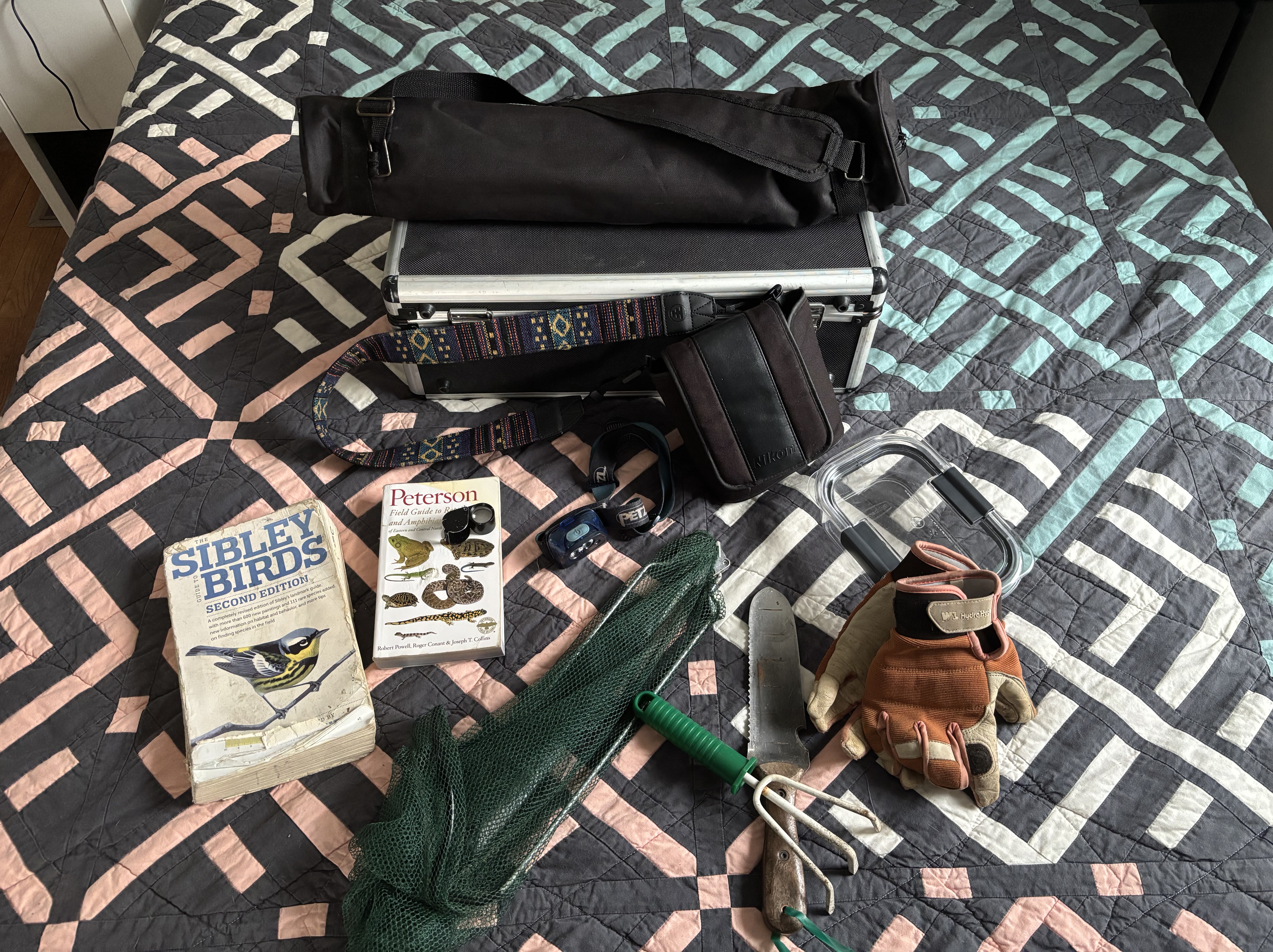
Packing. Bringing the right equipment is also super important to a successful trip to Here’s a list of naturalist-related gear that I’m bringing to Austin:
binoculars, spotting scope, work gloves (for flipping rocks and logs), spade and hand rake (for sifting though dirt and leaf litter), hand lens, headlamp, aquatic net, clear container (for close-up photography), field guides
Despite all the planning, success often involves being flexible enough to adapt the plan due to weather, road closures, or unforeseen opportunities. I’m definitely looking forward to this adventure!
January is a tough time to be an entomologist in North Carolina. Cold weather and lack of available food prevent arthropods (insects, spiders, slugs, etc) from making a living during the winter months. But with few notable exceptions—looking at you, monarchs—bugs are too small to migrate. That means most species need to find a protected place to hunker down and wait for warmer temperatures. They don’t truly hibernate; that’s a warm-blooded animal thing. But many do a similar thing called seasonal diapause, where they slow their metabolism and activity to almost nothing. Common overwintering locations include underground, in rotting wood, and at the bottom of streams and ponds.
Many bugs have annual life cycles, timing their life history stages with the seasons. Therefore, in addition to location, bugs vary in their overwintering life history stage. Some spend the winter as eggs (e.g. praying mantises) some as larvae (dragonflies), some as pupae (the majority of butterflies and moths) and some as adults (centipedes, lady bugs, and bumble bees). Overwintering strategies can vary dramatically even among closely related species. Because of challenges in finding them in the first place and then identifying them when you do (for example, identifying a larval or pupal stage insect requires first rearing it to an adult in a lab), we actually just don’t know where or how many species overwinter!
This week I went out to a local nature preserve to look for some bugs! I knew I could find some by flipping over logs and rocks, but I wanted to try a different strategy. Ecologically conscious gardeners know that leaving dead flower stalks standing though the winter is a great way to increase the abundance of beneficial insects such as bees. That’s because the hollow stalks are a great place to settle in for the winter. Supposedly. I’d never looked before! So armed with a pair of clippers and my fleece-lined pants (the high was 28 degrees), I set out to peer inside some plants.
The rules: stalks had to be 1) at least two feet off the ground 2) from about pencil to quarter thickness and 3) broken off or with holes or other potential entry points. Conditions of victory: find bugs in all four life history stages (egg, larva, pupa, adult).
Stunning success struck on second stem I split open! I found this adorable jumping spider in the genus Phidippus tucked into her silken hammock.
Jumping spiders don’t make webs to catch prey, but they do make little bivouacs when they settle in for the night or for a long winter’s rest. A couple centimeters further up the stem was a second web filled with little light-orange orbs.
This was her egg case, and the reason I know the spider is female—spiders generally do maternal care. After two stems, I already had found two of the four life history stages!
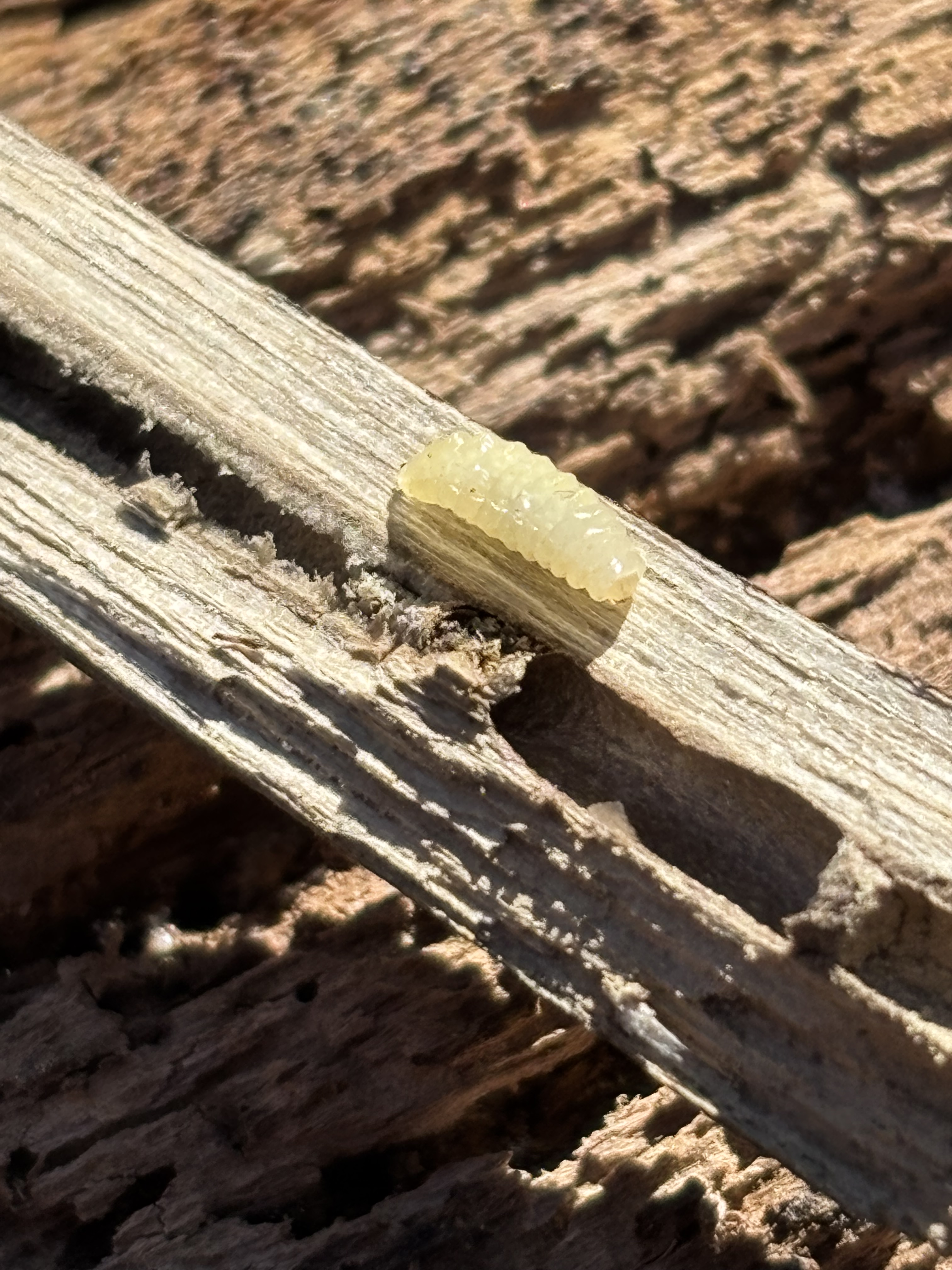
I continued down the trail, stopping to cut open a stem every 50 feet or so. Amazingly, the majority of stems I checked either had a bug currently, or showed evidence of former occupancy (insect poop (aka frass), boring holes, hollowed out cavities, etc.). I was expecting to find a lot of pupae, but instead, larvae were the most common life history stage. A few examples: 1) a beetle larva, showing some frass by its head. Beetle larvae have three pairs of legs near the head, but don’t have prolegs (additional sets of leg-like protrusions) like caterpillars do.
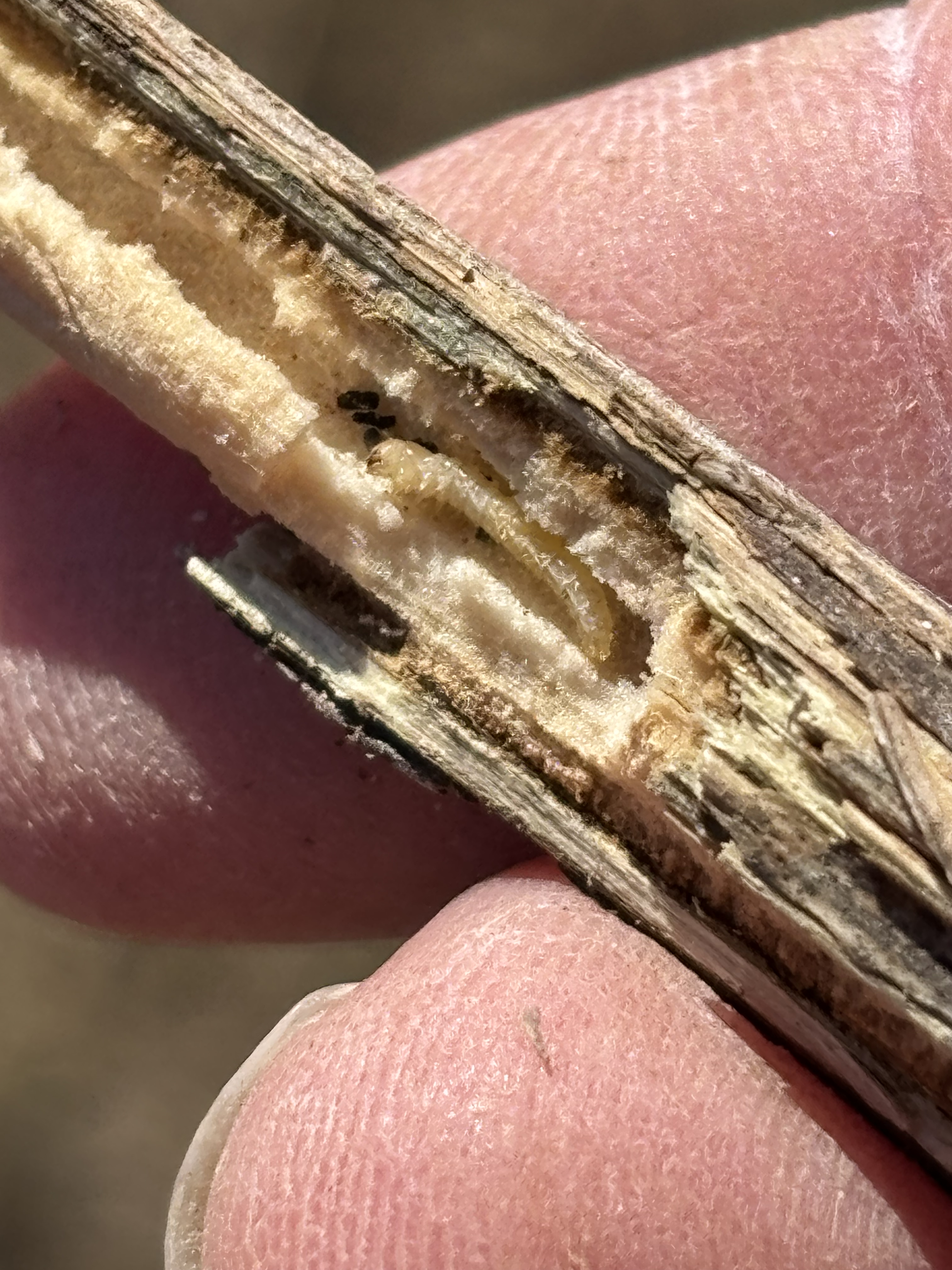
2) A bee larva, next to its chamber that was created by mom. Bee larvae don’t have any legs, just a fat, segmented body and a small, but distinct head.
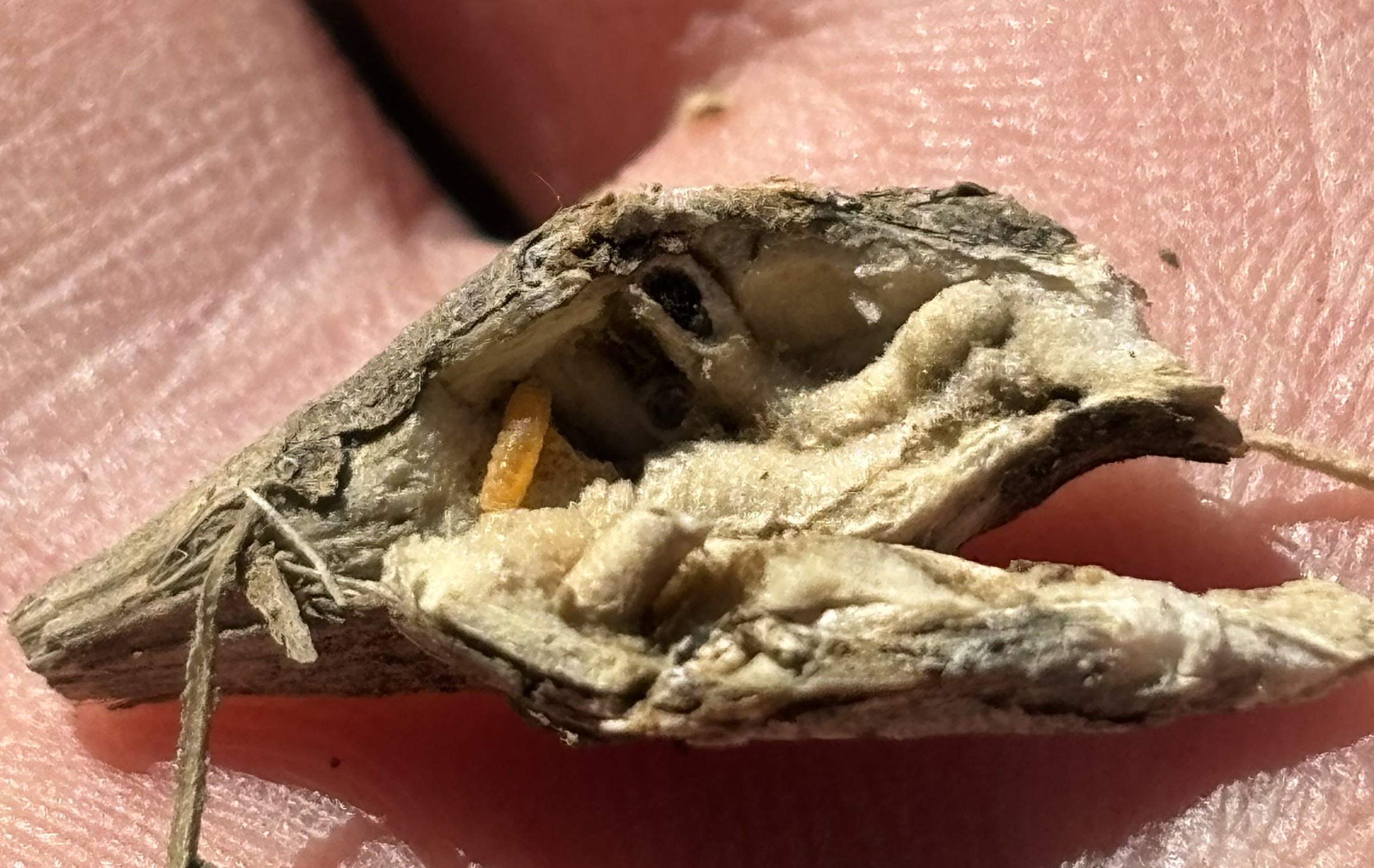
3) A fly larva that had formed a really strange gall. I have no idea what species this is, but check out the crazy tubes the larva created in the wood! Terrestrial fly larvae are skinnier than bee larvae, and don’t have a distinct head—think maggot.
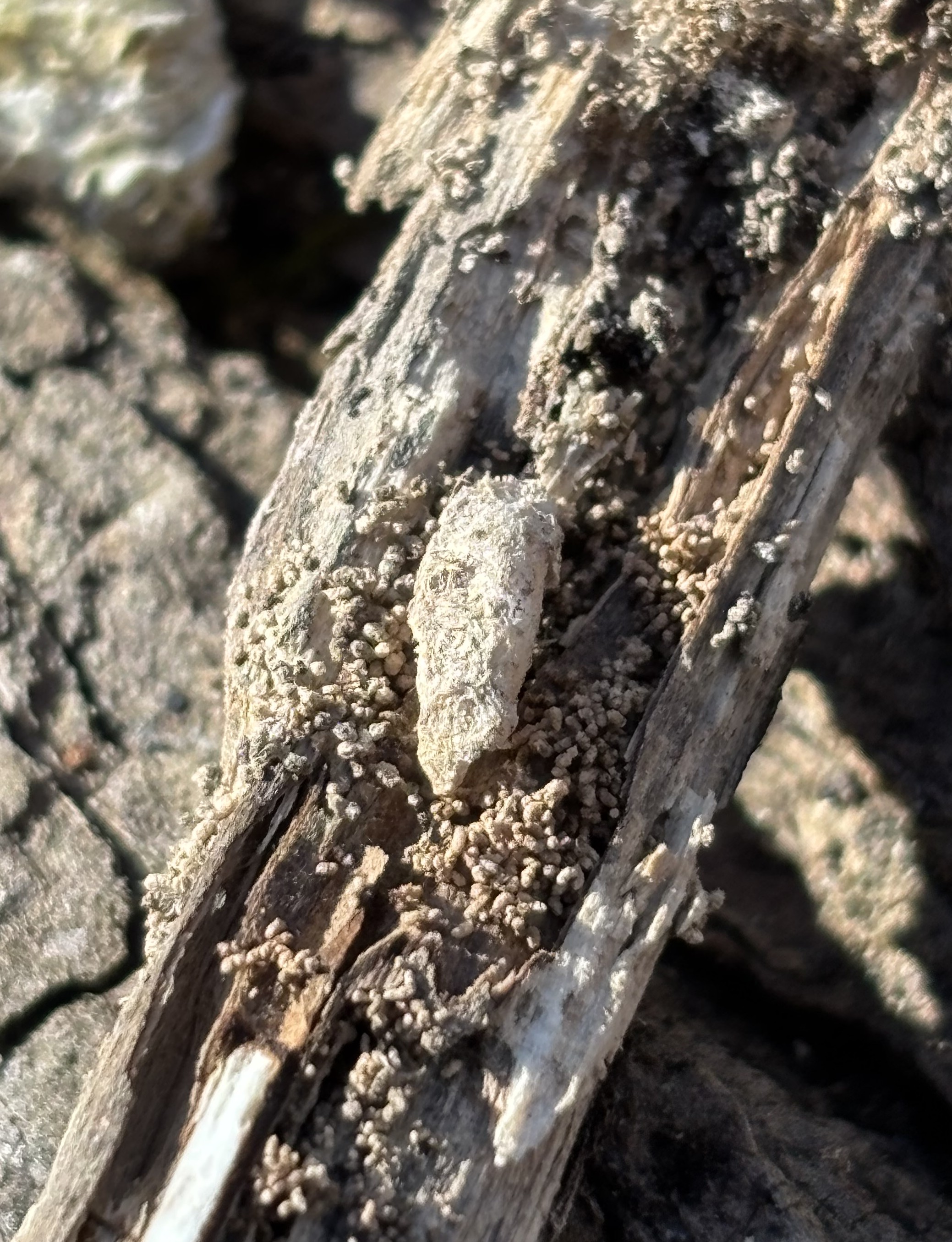
After about 25 stems, I was beginning to worry that despite the amazing bug diversity I was finding, I would end my hike pupa-less. Finally, in a rotting stick sticking out of some mud, I found a dusty gray moth cocoon. It’s not pretty, but it assured me victory!
My favorite find of the day was this entire colony of ants in the genus Temnothorax hanging out in a dead, hollow branch. Their common name is the acorn ant, presumably because in addition to using stalks, they can set up shop in hollow acorns. I had no idea these tiny stripey guys existed!
It’s always a great day when I meet a new species. All in all, I’d call the expedition a huge success and it gave me a newfound appreciation for the importance of dead stalks!
A big winter storm hit Winston-Salem on the night of January 10, dumping a few inches of snow onto our yard. The next morning was forecast to be sunny and calm—perfect snow day conditions! I decided to wake up early and do an hour-long bird feeder watch, beginning just before first light. Here is my log from that watch:
7:00 am: Begin observation
7:07 First bird—Marty the Northern Mockingbird perches on the lip of our raised flower bed
7:14 Northern Cardinal calls
7:16 Marty snacks on some bark butter I had smeared on a tree trunk
7:17 Yellow-Bellied Sapsucker calls
7:19 White-Throated Sparrow and Dark Eyed Junco flock arrives, a junco snags some bark butter
7:23 American Crow calls
7:24 Ruby-Crowned Kinglet arrives, snags some bark butter
7:25 Carolina Chickadee begins chattering, and then visits the main feeder—the first bird to do so.
7:26 Tufted Titmouse and White-Breasted Nuthatch calling in the trees overhead
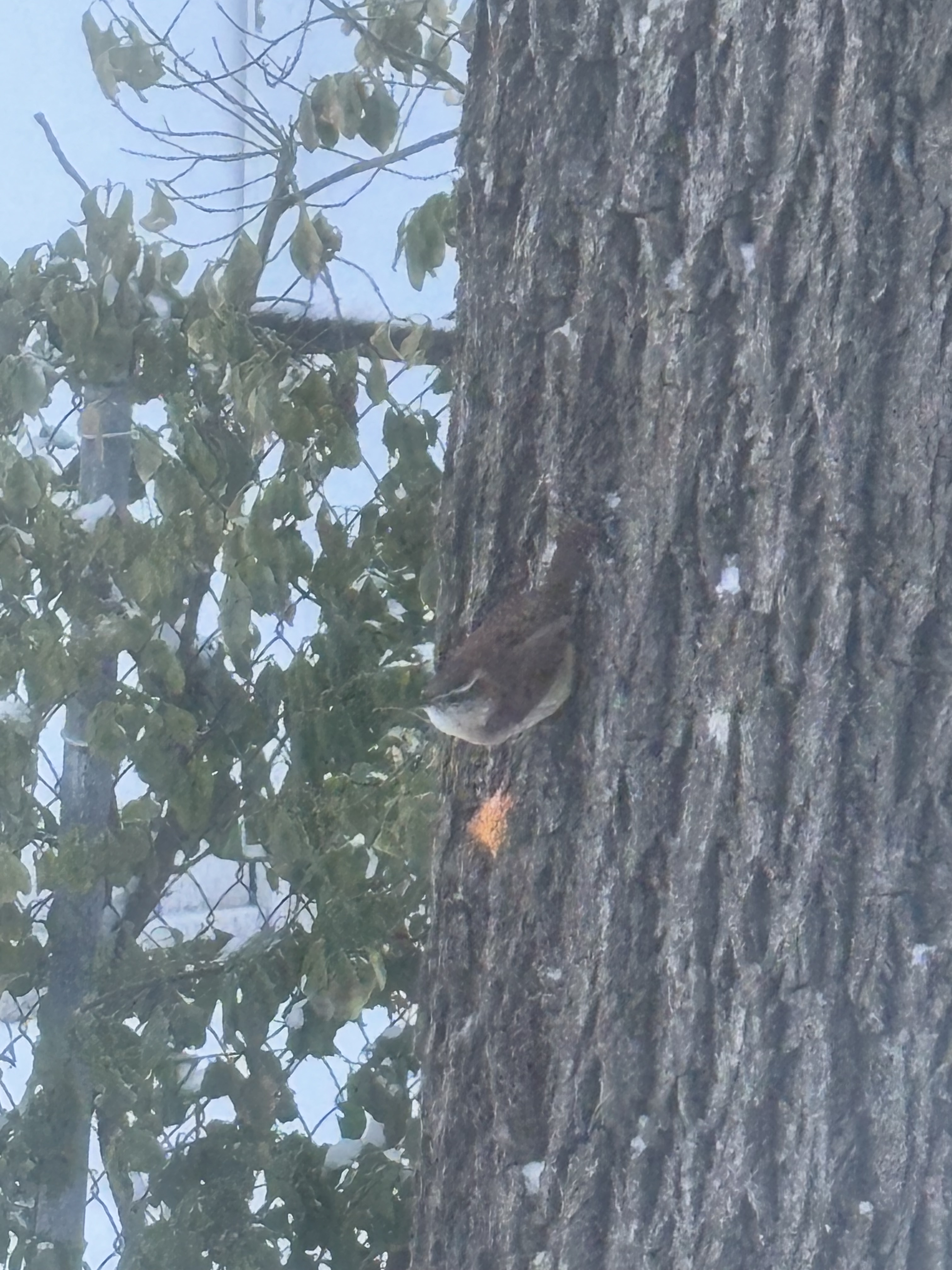
7:28 Carolina Wren begins singing vigorously, then eats some bark butter and fights with another wren
A Carolina Wren visits a smear of bark butter in the snow
7:31 Sunrise
7:38 A flock of House Finches and American Goldfinches flies overhead, calling. A Blue Jay flies into the magnolia tree and begins yelling at everyone
7:43 Golden-Crowned Kinglet and Yellow-Rumped Warbler briefly stop by the yard, joining the flock of activity
7:50 Marty the Mockingbird perches on top of the feeder and begins chasing away other birds
7:57 Song Sparrow sings from the bushes at the back of the yard
7:59 Carolina Wren visits our small window feeder, so far, the only species I’ve seen do so since we put it up last week.
8:00 Mourning Dove flies by, the final species to make the count. End observation.
Total: 18 species
Most notable: Yellow-Rumped Warbler. A bunch of them winter in our area, but they don’t come to our back yard that often
Strangest miss: Downy and Red-Bellied Woodpeckers are usually around, and both showed up later in the day. Eastern Bluebirds are also common in our backyard, but they tend to visit us in the afternoons.
While I very much enjoyed my time, one hour-long watch by itself isn’t particularly laden with importance. The power of careful observation comes with time and repetition. Since moving here in March, I’ve now submitted 21 eBird checklists from our backyard and seen or heard 48 species. I’m starting to get a sense of what’s “normal”. As the seasons go by, it’s exciting to see migratory birds arriving and leaving, behaviors changing, birds molting, and fledglings appearing on the scene. My plan is to repeat my dawn feeder watch three more times this year. I’m excited to compare and contrast these seasonal benchmarks.
Zooming out, my hour-long observation becomes one data point out of the 103 million checklists submitted to eBird. These checklists come from over 1 million birders from across the world. At this scale, scientists can see patterns of migration, habitat use, and population increases and declines. The data helps inform important conservation decisions and even legislation. Not bad for a snowy morning spent in front of a window.
January is coldest month of the year here in Winston Salem. Historically, that means lows around freezing and highs near 50. This week however, winter truly came to the South. Extended time with temperatures in the 20s have iced over portions of ponds and cemented leaves to hardened mud. I was curious to see how salamanders, the most numerous vertebrate denizens of that muck, were handling the artic blast.
Bundling up, I headed over to a local park to begin the search. Unless it’s a warm, wet night when salamanders are migrating to their breeding ponds, finding these little guys mostly involves lifting things. Flipping over rotting logs, moving rocks on the edges of streams, and sifting through leaves in wet depressions are all great strategies for locating the various species. I tried these techniques at several spots with no success and increasingly numb hands. Maybe the cold drove everyone deep underground.
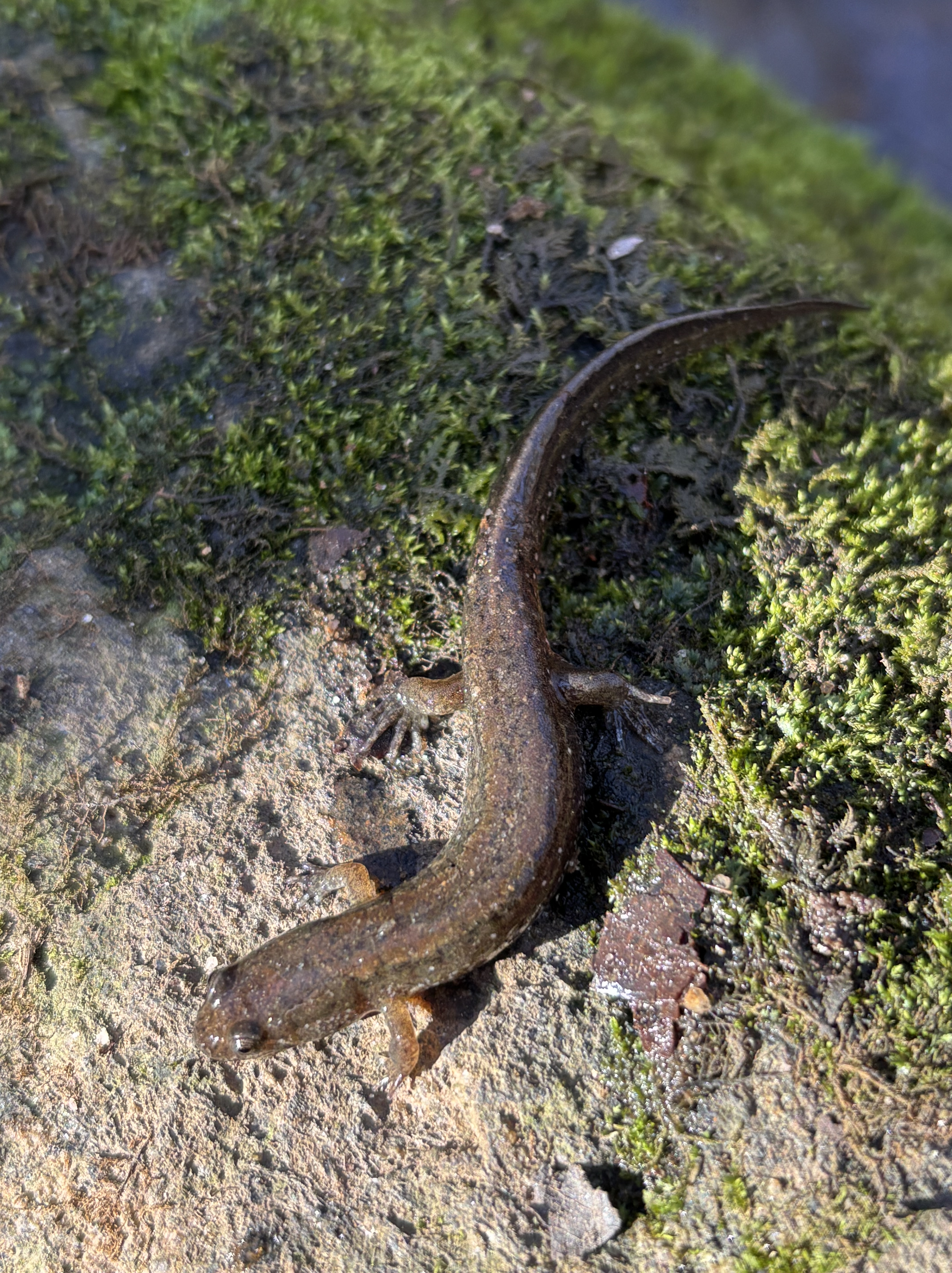
Finally, I lifted a medium-sized moss-covered rock and saw two little eyes staring back up at me from the mire below. I quickly grabbed the little guy to get a closer look. Dark and speckly all over, it had faint orange-red blotches down its back and a lighter angled stripe from the back of its eye to its jaw. That was enough to identify it as a wolf dusky salamander (Desmognathus lycos). Normally, this species is quite squirmy when captured. Not so this time. The salamander sat in my hand as cold and unmoving as the rock from under which it came.
I took the opportunity to carefully pose the salamander on top of a rock for some pictures. My plan was then to hold it for a while to see if the warmth from my hands would gradually get it moving. I looked away for a moment while re-stowing my phone, and to my surprise, when I looked up, it was gone! Somehow a cold-blooded critter living in water just above freezing had mustered up a burst of energy and launched itself off the rock, giving me the slip!
Not to be so easily defeated, I flipped a couple more of the surrounding rocks before relocating the escapee. It was once again motionless, giving no indication of the amazing athletic feat it had just accomplished. I scooped it up and set it down—this time on some leaves a couple feet away from the rocky area. Surely this was a spot where I could watch it move around for a bit, gently redirecting it if it approached a hiding place. When moving quickly, dusky salamanders don’t run as much as pivot forward. Their small legs serve as fulcrums, as they swivel their body in a zig-zag. Their long tails flail back and forth, acting as a counter balance. In describing it, it’s hard to imagine how this motion can be rapid. But before I could act, the little guy covered the distance to the stream, leapt in, and swam, dragon-like, to a crack beneath large rock, disappearing for good.
I was left with my pictures, from which I attempted a sketch. I’m by no means a great artist, and I haven’t captured the correct proportions. but the act of drawing is a powerful way of honing one’s powers of observation. Therefore, I’ll share it here anyway. I learned a lot from the act of sketching, but my biggest takeaway was a confirmation of something I already knew—salamander toes are weird.
The first day of new year is traditionally about new beginnings. For me, along with many birders, one of the most exiting of these is the annual reset of my birding year list. After seeing 423 species of bird across the United States in 2024, the stroke of midnight on New Year’s Eve rewinds my total the whole way back to zero. Why is this exciting? It means for at least couple of days in January, even the most common sparrow or finch “counts” toward a new total. And that list begins with the first bird identified in the new year. For me in 2025, that bird was a Blue Jay.
As many birders do, I record my bird observations with the amazing website/app eBird. Developed by the Cornell Lab of Ornithology, eBird turns observations from folk’s nerdy hobby into an amazing database that is actively used for avian conservation. According to eBird, I’ve recorded a sighting of a Blue Jay 159 times. That might sound like a lot, but I’ve also submitted 1,559 checklists since I began eBirding on January 1, 2013 (my first bird that year, American Crow).
The Blue Jay is certainly an appropriate first for 2025. They only live east of the Rockies and do quite well in suburban and urban landscapes, nicely representing our recent move from the outskirts of Eugene, Oregon to a neighborhood in Winston Salem, North Carolina. Their noisy calls, mobbing behavior, and love of eating the eggs and chicks of other birds have given the Blue Jay a reputation as a loud, brash, bully. That certainly brings to mind a certain political figure set to take office again this year. Their unarguably stunning plumage represents the painting and decorating Jenny and I have planned for our lovely new home. And their bold and inquisitive nature stands in for the exploring we have planned, beginning with a road trip to Austin, Texas next month.
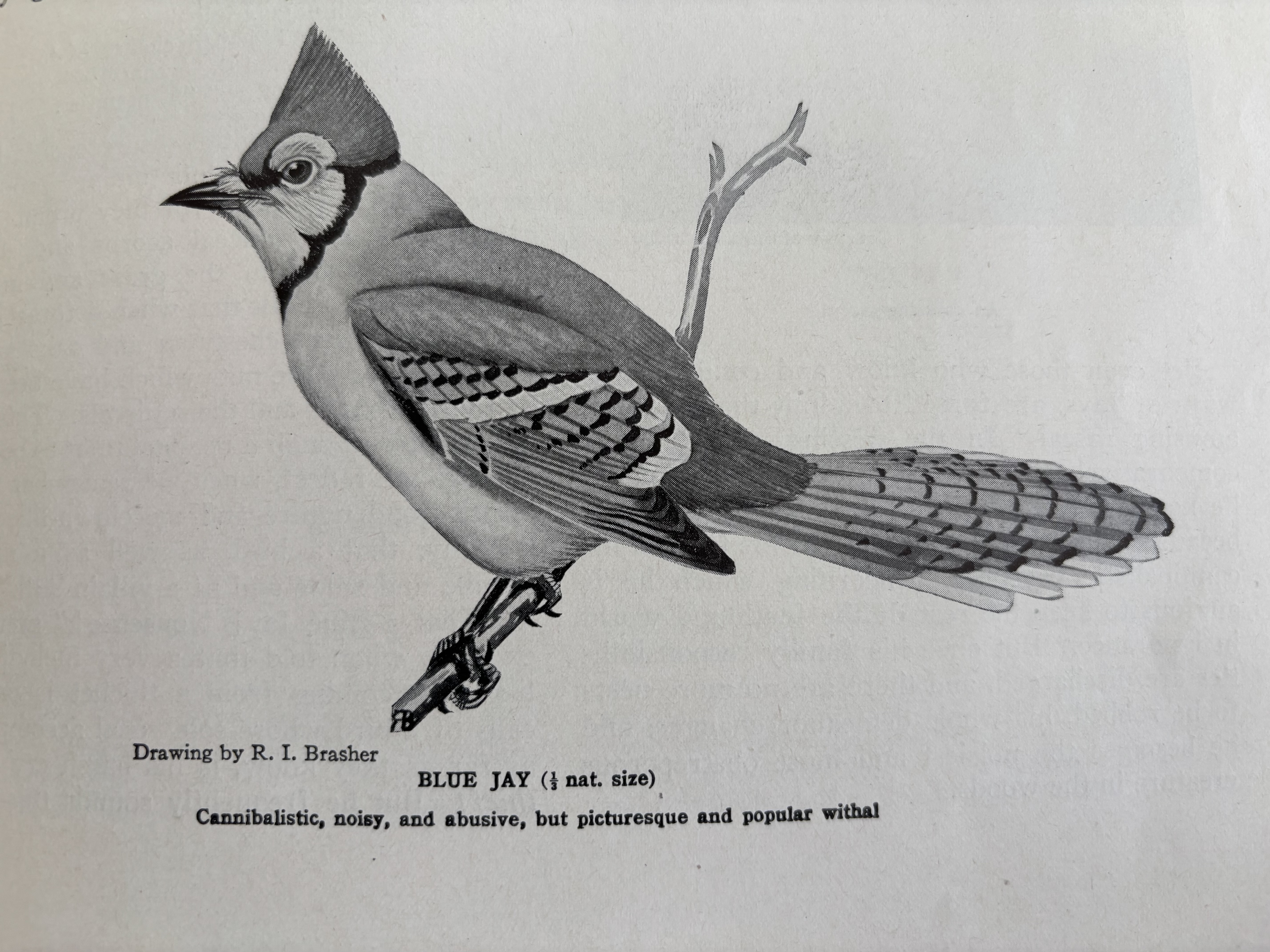
I wanted to look up my first 2025 bird in an amazing tome, Birds of America (1936) edited by T. Gilbert Pearson. Not to be confused withThe Birds of America, John James Audubon’s 19th century artistic masterpiece, this book was the first comprehensive review of the subject of US bird identification, occurance, and behavior. In addition to beautiful color plates by Louis Agassiz Fuertes and numerous line drawings and photos, the text is simply amazing. It was a collaboration of some of the finest naturalists of the day. Pearson, himself, is a particularly interesting man. After child and young-adulthood spent collecting bird eggs and egret plumes for those lucrative but destructive markets, Pearson shifted into illustrious career in bird conservation, centered right here in North Carolina.
While current guidebooks (correctly) strive for objectivity and accuracy, they tend to be short on the beautiful prose and playful personification that elevate these old-timey works (another favorite of mine is William Dawson’s The Birds of California). I’ll just share a couple excellent Blue Jay passages from Pearson’s opus here.
“The Blue Jay is the clown and scoffer of bird-land. Furthermore, he is one of the handsomest of American birds; also he is one of the wickedest, and therein exemplifies the literal truth of the saying “Fine feathers don’t make fine birds”…. Eloquent testimony concerning the commission of [his nest-robbing] crimes is furnished by the outcry set up by [smaller and defenseless] birds, whenever they catch a Jay lurking near their nests. But we need not take the birds’ word alone for it, because he has been caught red-handed by man more than once, in the very perpetration of these villainies…. His service [of caching acorns and chestnuts in a way that aids germination], unconscious though it be, ought not to be ignored, even as we reflect…that a bird, as well as a man, may smile and smile and be a villain still.”
What a delightful character assassination! Happy beautiful and terrible 2025, all.












 botanicalramblings