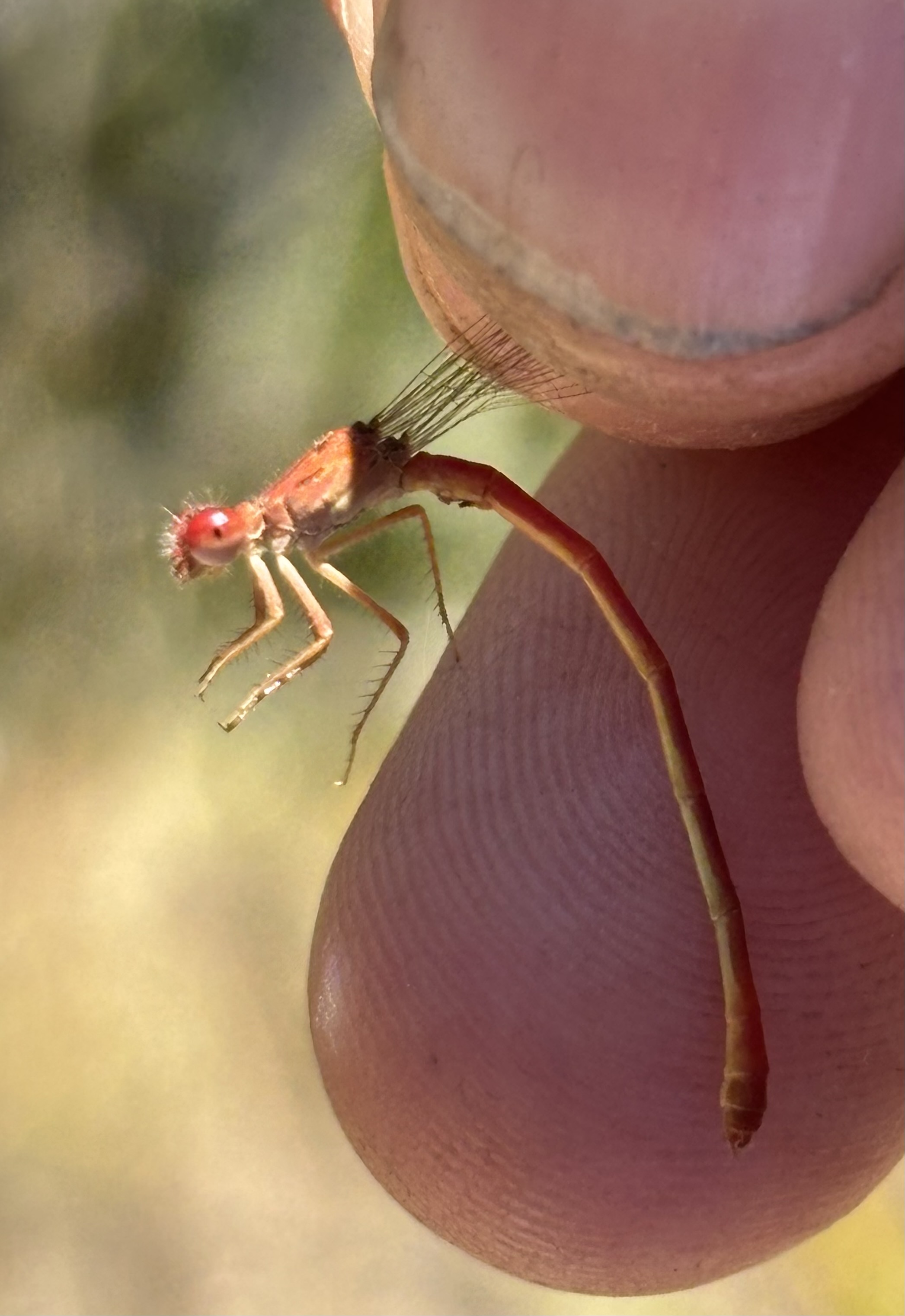
September 28th, 2025: Tarantula Tally

Fall in central and southern California is tarantula season. These largest of North American spiders are a treat to see in grasslands, woodlands and deserts—places where, this time of year, many plants and animals are laying dormant, waiting for rain.

All native tarantulas in California are in the genus Aphonopelma. They live in silk-lined burrows, waiting in ambush for their invertebrate prey to wander by. However, every fall, when they are somewhere around 8-12 years old, a male tarantula develop wanderlust. He travels across the landscape, looking for love. Once he finds the burrow of a female, he politely knocks at the door by tapping the ground with his legs and vibrating his body. If she’s interested, she’ll come outside to mate, storing his sperm in specialized structures under her abdomen called spermatheca until she lays eggs in spring.  

When encountered on their quest, tarantulas are surprisingly docile. Despite having venom, they won’t bite in self-defense. If you want to get a closer look at one, you can put your hand out flat in front of him and he will walk right onto it. It’s important, however, to keep him low to the ground, because a drop from chest height is likely to damage his fragile body. If he does feel threatened, tarantulas do have a cool move. They can fling urticating hairs from their abdomen onto would-be attackers with their back legs.

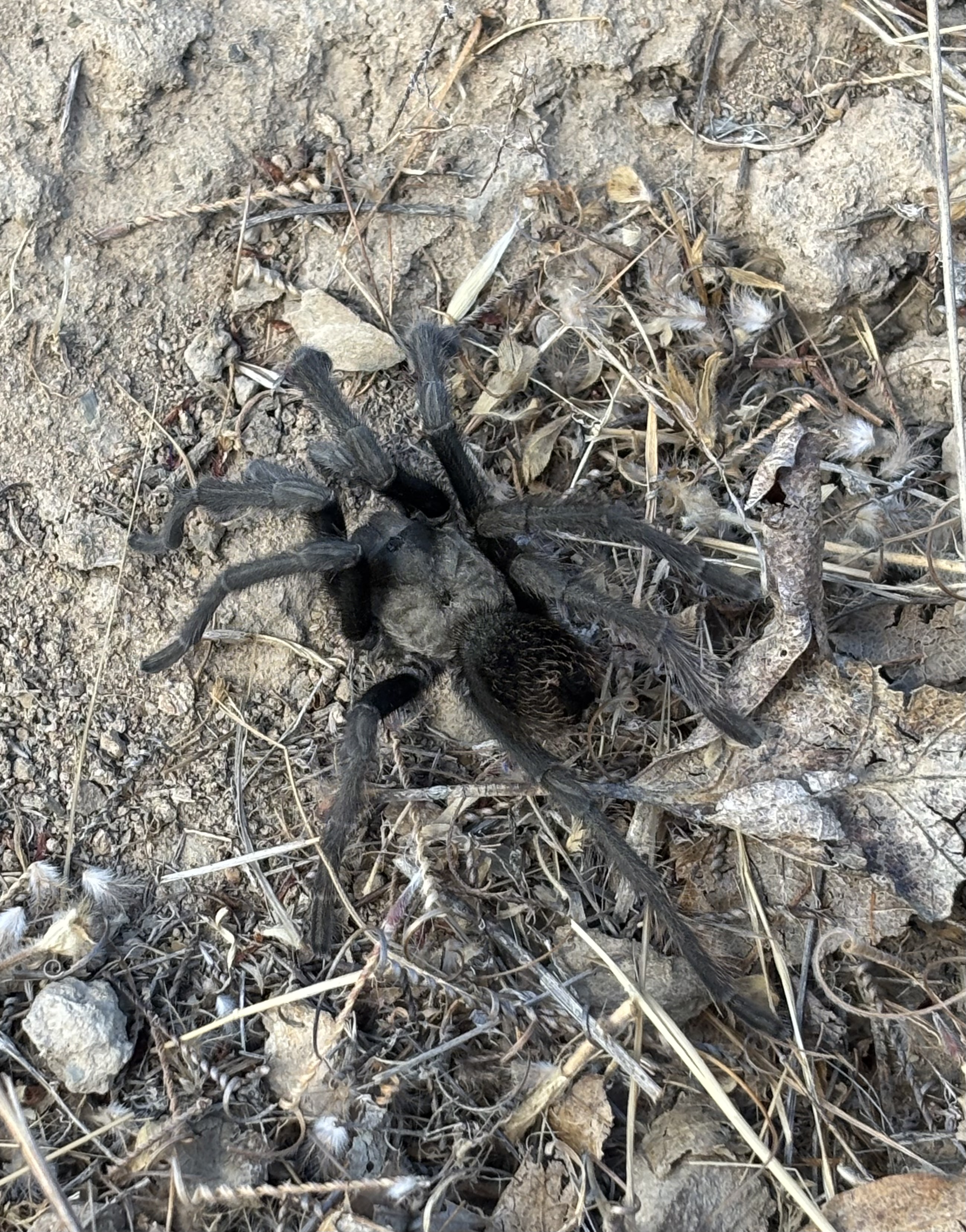
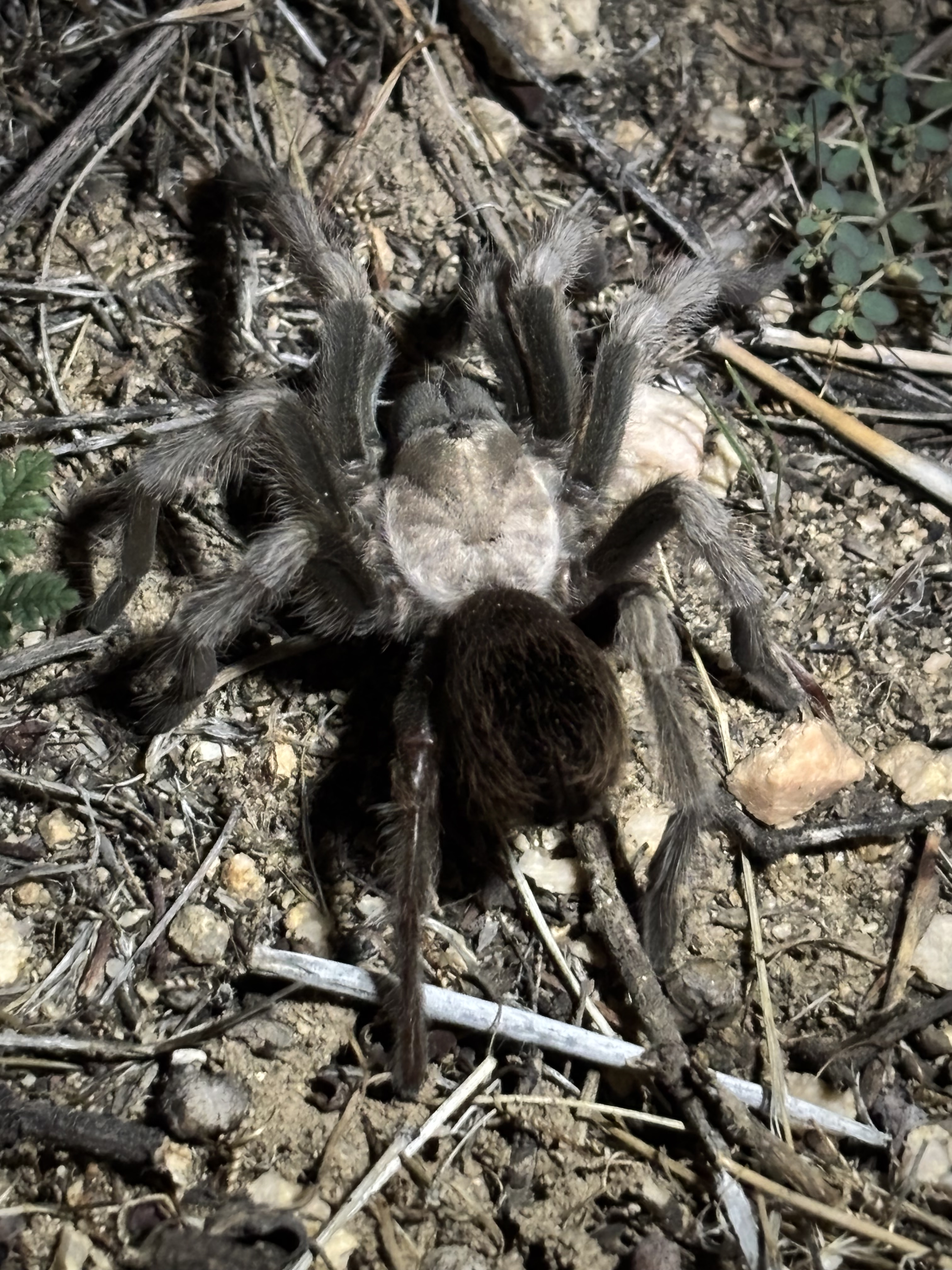
The fall class has set a collective goal of seeing 50 tarantulas over the 50-day run. It’s an ambitious total, but they are present at all of the reserves we’ll be visiting. So far we’ve seen 10. Here are two great examples, one from Blue Oak Ranch Reserve, and on from the Granite Mountains in the Mojave Desert.

Despite the vast difference in habitat (and hundreds of miles that separate them), the most recent phylogeny of the genus lumps them as the same species, Aphonopelma iodius. Other species are possible at Sedgwick later in the trip. I’d wish these fellows good luck, but regardless whether or not they find a mate, it’s a one-way journey. As the season goes on, we’ll see tarantulas with skinnier and skinnier abdomens. While females can live decades safely tucked away in their burrows, after fully depleting their reserves on their perilous journey, all males will die.

September 23, 2025: Fall Feeder Watch

I again waited until the last possible morning to conduct my seasonal feeder watch. I headed out to out to California on the 24th for the third and final run of the course for the year. As I mentioned in my last post, fall is a great season for migrants, so I was hoping to add something new to the yard list. When I get back to North Carolina in mid-November, migration will be mostly over and our winter residents will already be back in town!

7:00 Start of the observation hour. The only sounds are very loud crickets chirping.

7:01 I hear my first bird, a Northern Cardinal chip call.

7:03 American Crows call distantly.

7:07 A Downy Woodpecker calls from the neighboring yard.

7:08 Chimney Swifts circle overhead—my first seen bird. A White-breasted Nuthatch calls.

7:09 A Blue Jay flies into the yard calling.

7:10 Officially sunrise.

7:11 A Carolina Wren sings loudly in the yard. Carolina Chickadees join in.

7:15 An American Robin calls from the trees above.

7:17 A Northern Flicker calls.

7:18 I see a Brown Thrasher hopping around in the back bushes. A Song Sparrow calls from back there as well.

7:20 The local cardinals are calling loudly, but there is generally less bird song than any of my other three dawn feeder watches.

7:25 House Finches fly over calling.

7:33 A couple Eurasian Starlings fly over.

7:35 It is extremely quiet in the yard!

7:39 Three Mourning Doves fly over.

7:40A Tufted Titmouse calls

7:55 Wandering around to the front of the house, I see two small birds at the top of the large oak across the street. After staring for a few minutes, I finally identify one as a Cape May Warbler. The other bird is also a warbler, but I can’t make out which kind.

7:59 A Red-Bellied Woodpecker calls, the last new bird of the count.

Total: 19 Species

Most notable: Cape May Warbler! This is a true long distant migrant. The closest breeding populations are in Maine, and they all fly to the Caribbean for winter. While they are relatively common in the area in migration, they tend to prefer conifer trees. This was new yard bird #63.

Strangest miss: Eastern Towhee. I’m sure these large, resident sparrows were around somewhere, they just didn’t make their presence know during the hour. I was also hoping to tally a Ruby-Throated Hummingbird, as several have been around lately. Unfortunately, they didn’t put in an appearance either.

Comparisons: With everyone so quiet, I totaled five fewer birds than summer, only beating my winter tally by 1 species! All but two of the species overlapped with my summer watch, and only the Cape May Warbler was new (I had a flicker in the spring, but missed it in summer). Across all four seasons, I found 36 species of birds on these dawn watches—over half of the birds I’ve ever seen in the yard!

September 22, 2025: Just passing through

September is one of the best months for birding in much of the United States. That’s definitely true in Forsyth County, North Carolina. Birders like me wake up at dawn most days this month to go stare into the trees. We’re hoping to catch a glimpse of migrating songbirds. Each year, billions of these guys travel from the Northern U.S. and Canada to the Caribbean, Mexico, Central, and even South America and back. Folks in the middle of the country get two shots a year to see them—spring as they hasten north toward breeding grounds, and fall, as they make their way back south. Some species take different routes on their northern and southern journeys, so it’s definitely worth it to bird during both!

All songbirds forage during the day, however they mostly migrate at night. When the winds are right, millions of birds can pass over favored corridors each night. Amazing, their movements are detectable on Doppler radar. The folks at Cornell, in collaboration with Colorado State and UMass Amherst, take that radar data and publish real time and predictive models for each night about where and in which direction migrants are. The predictive capabilities of BirdCast are an amazing conservation tool, as they allow the issuing of “lights out” warnings. Migrating birds can be easily disoriented by light pollution, and getting folks to turn off lights, especially in tall buildings on heavy migration days, can dramatically improve survivorship. The forecast is also helpful for knowing what days might be the best for finding birds the next morning.

In the weeks before I needed to head back to California, and in between trips to the coast, the mountains, and Pennsylvania, I submitted 23 eBird checklists from Forsyth County. Across these lists I found 16 different species of songbirds that don’t breed or winter anywhere in the county—definite migrants. This list included Warbling Vireo, Baltimore Oriole, Gray-cheeked Thrush, and an amazing 13 species of warbler:

Worm-Eating Warbler

Golden-winged Warbler

Blue-winged Warbler

Tennessee Warbler

Cape May Warbler

Magnolia Warbler

Bay-breasted Warbler

Blackburnian Warbler

Chestnut-Sided Warbler

Black-throated Blue Warbler

Palm Warbler

Black-throated Green Warbler

Canada Warbler

While that’s a pretty good list, there are 36 species of warbler that have been seen in the county, and I’ve only seen 24. Finding the rest is a great motivation to keep peering into trees for many Septembers to come.

September 7: Life as a Dragonfly

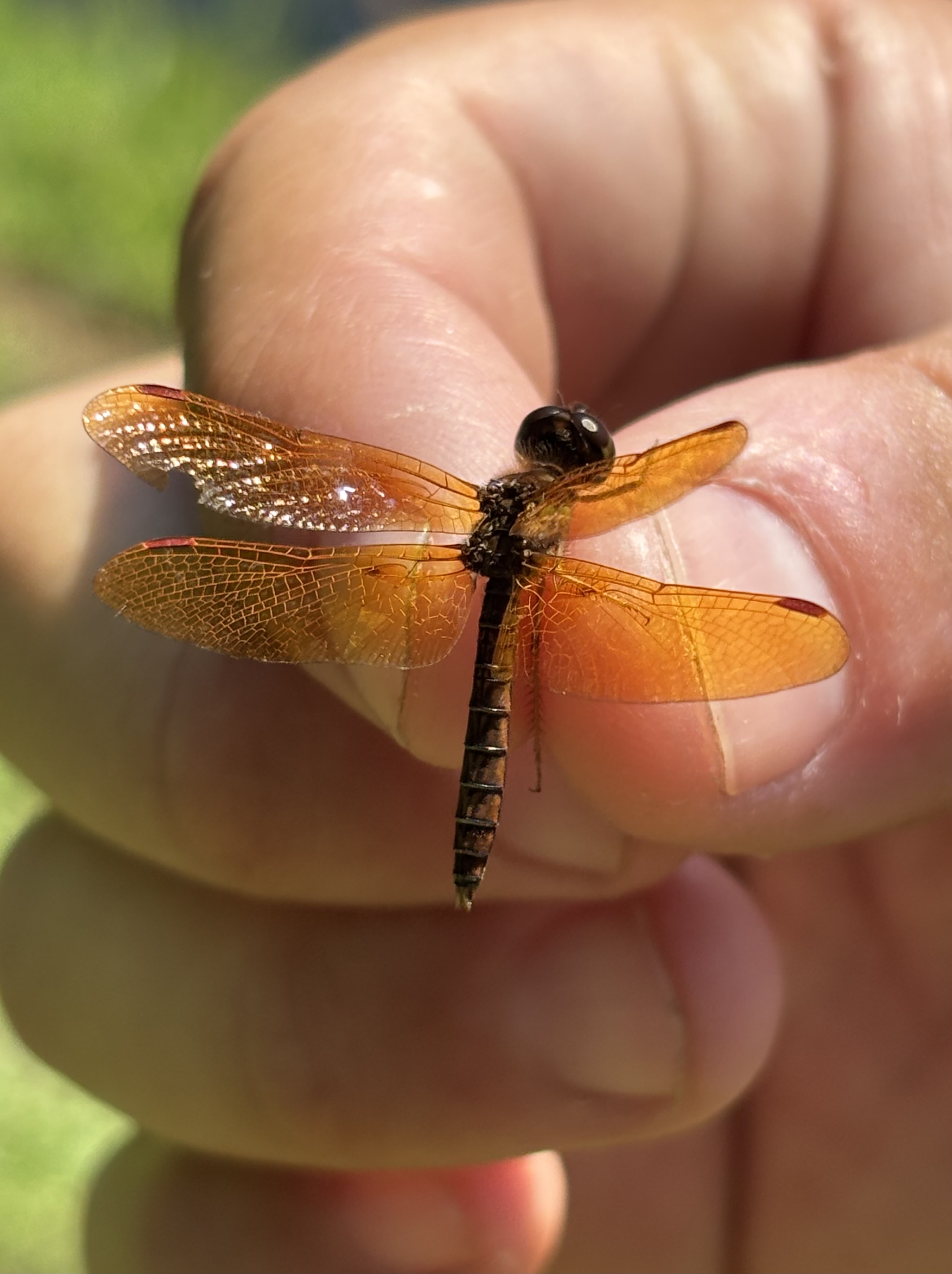
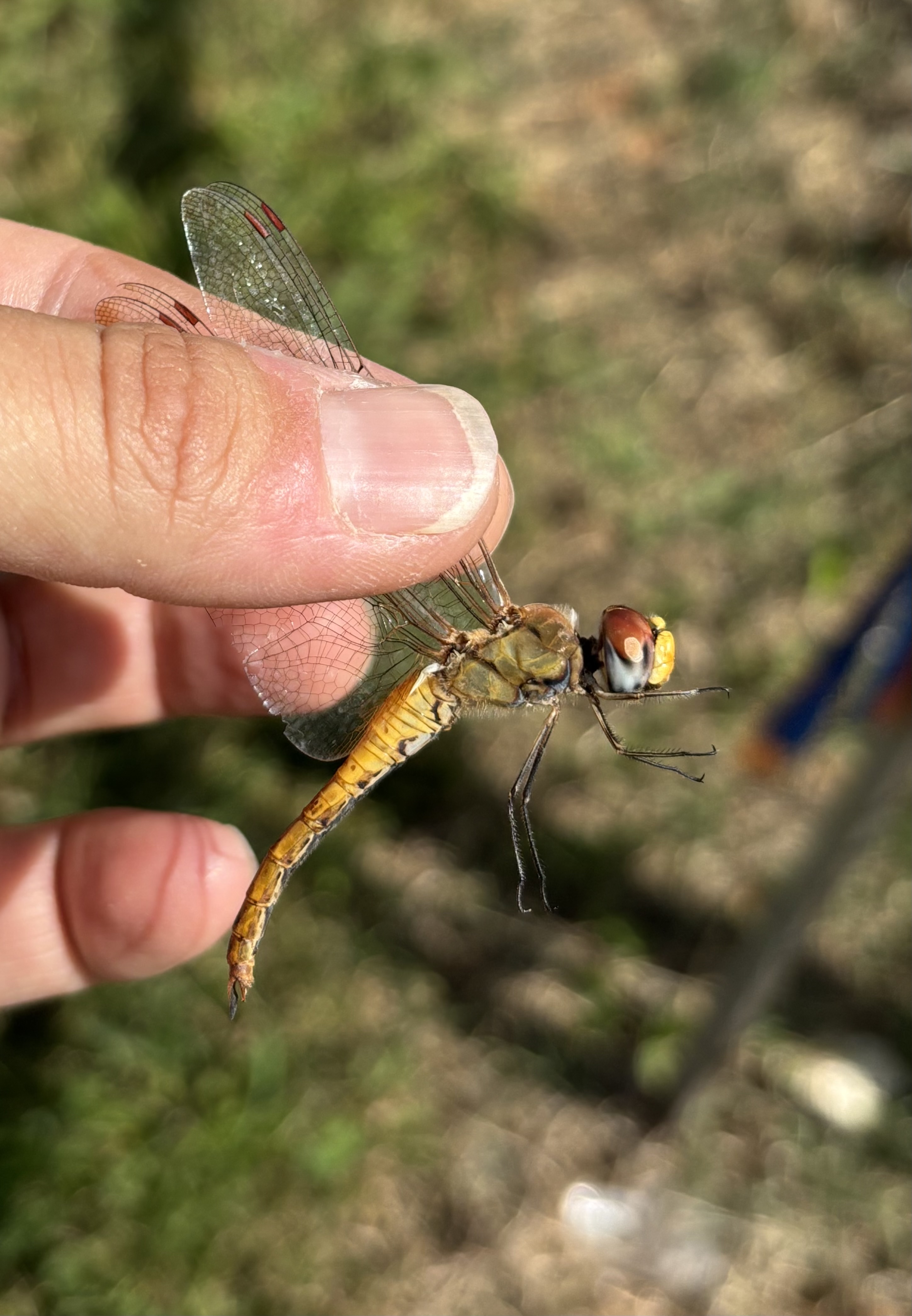
Since getting hooked on identifying odonates in California this summer, I have definitely brought my new obsession back east. In the last month, I’ve found 10 species of damselflies and 19 species of dragonflies in North Carolina. It’s unfortunately the tail end of the season, so with the exception of a few fall-flying species, I’ll have to wait until early next summer to continue my quest.

In the meantime, I want to talk a bit about how one finds dragonflies. Like most hunts, success comes from thinking like the quarry. What habitat requirements do dragonflies need to hunt, mate, and escape predation? What time of day and weather conditions are ideal? Do they fly high in the air, or stay close to the ground? The answer, like most things in nature, is that it depends on the species!

Due to their aquatic larval stage, water is the first thing to which all dragonflies must attend. Different species of larvae prefer different aquatic conditions, and, with some exceptions (such as saddlebags and Aeshna darners), the adults stay close to the preferred type. The biggest divide comes between species that need still waters such as ponds and lakes, and those that need flowing water of rivers and streams. Large groups of odonates can have similar preferences for larval habitat—for instance, most species in the Skimmer Family (Libellulidae) prefer ponds, while those in the Cruiser Family (Macromiidae) are usually in flowing water. But preferences can vary even within genus. I caught this Blue-fronted Dancer (Argia apicalis) at Salem Lake.

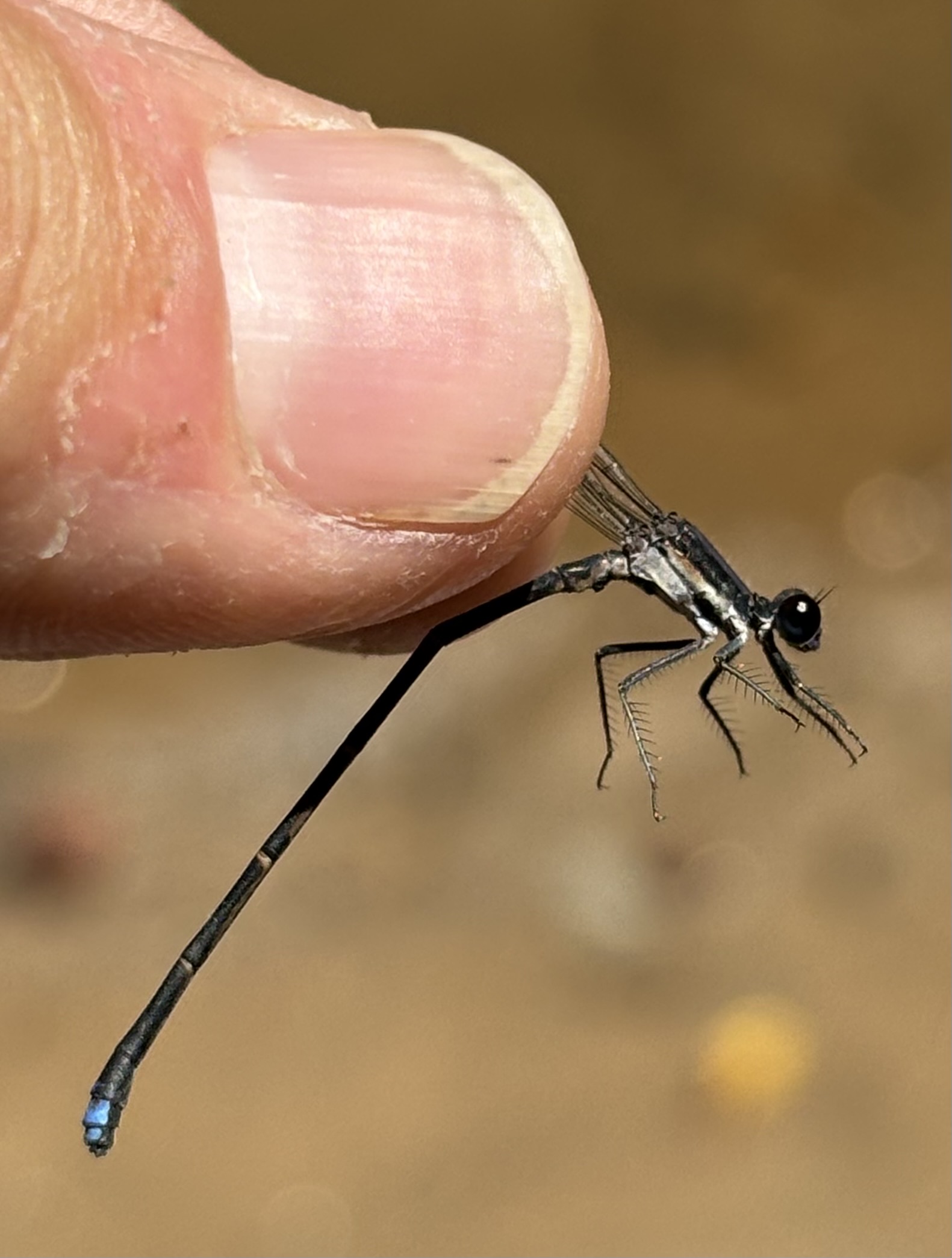
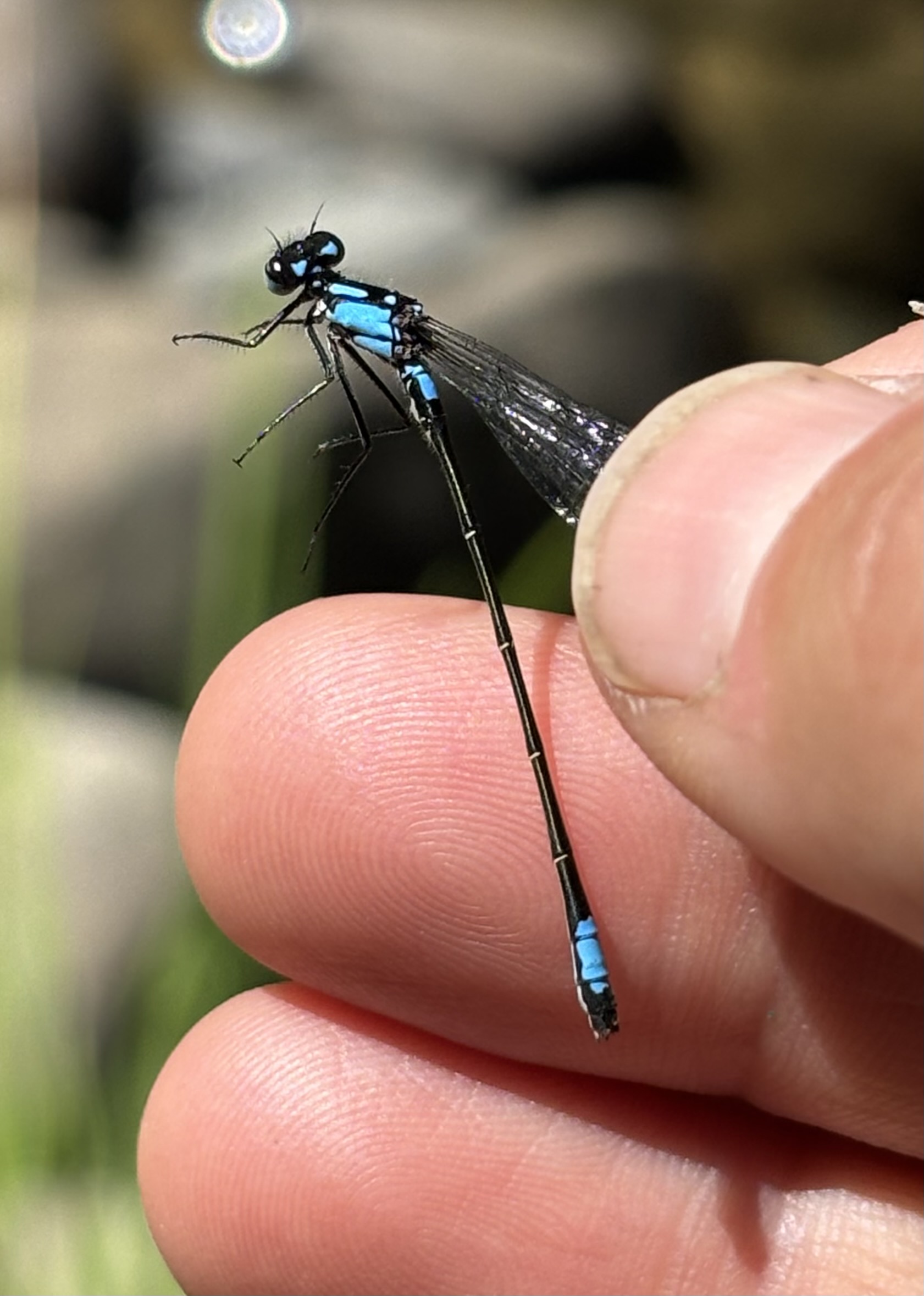
On the other hand, this Blue-tipped Dancer (Argia tibialis), a stream specialist, would never be seen there!

Beyond movement, water quality, substrate type (sandy, muddy, or rocky bottom), amount and type of aquatic vegetation, and the presence of aquatic predators such as fish will determine which species can breed at a body of water. The most unique larval habitat of species I found this month goes to the Seaside Dragonlet (Erythrodiplax berenice), which amazingly lives in salt water!

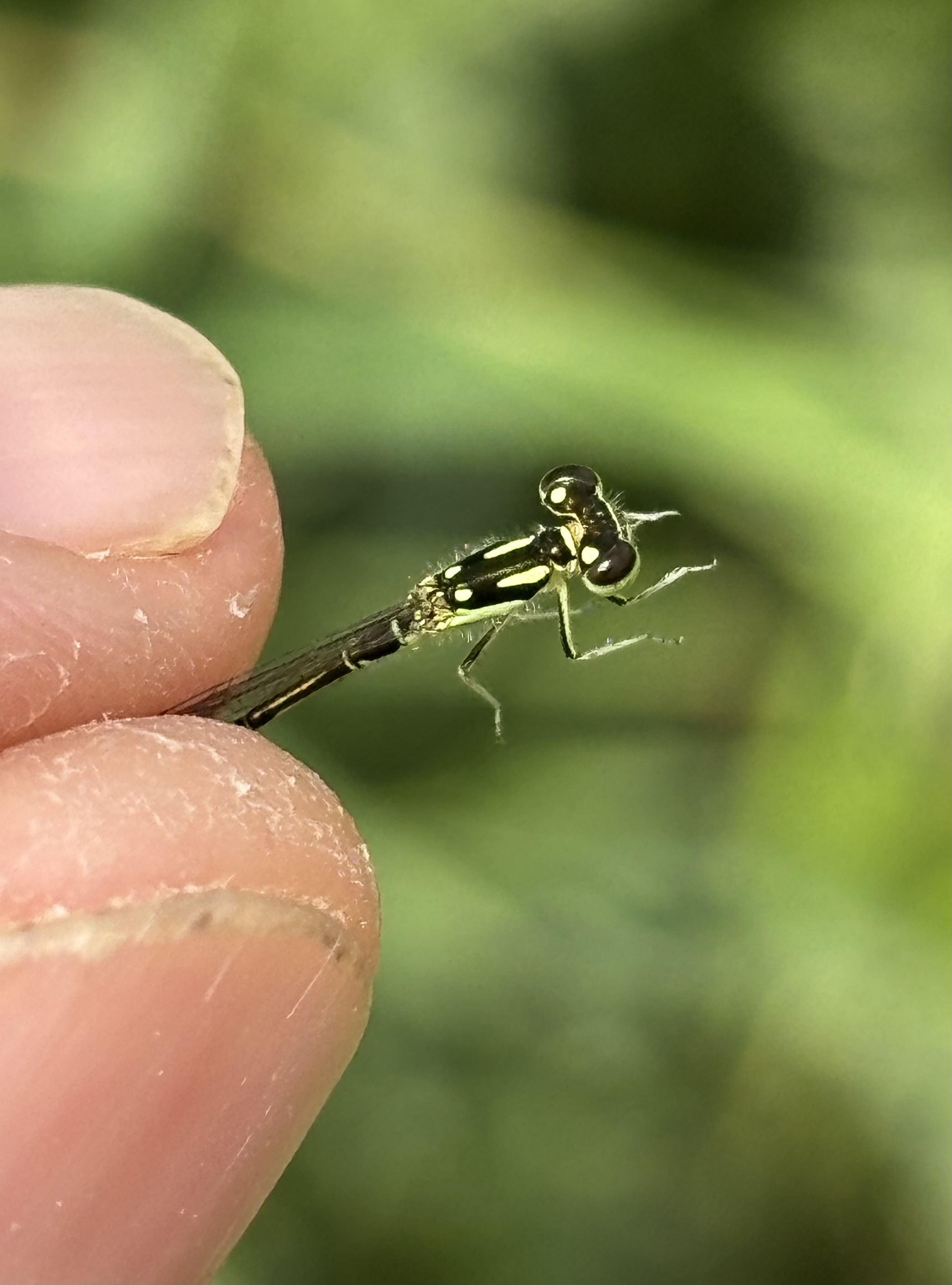
Just like birds, different species of dragonflies can be found in a variety of different microhabitats within a site, from the ground up to the tops of the trees. Males of the species tend to be very territorial, chasing away other individuals, and frequently other species. Females can also be territorial, but are more likely to hide from the advances of the males, who are aggressively pursuing matings. A top-notch territory will have good oviposition sites and plenty of other insects to eat. Small, weak-flying species such as this Fragile Forktail (Ishnura posita) look for lots of vegetation in which to hide.

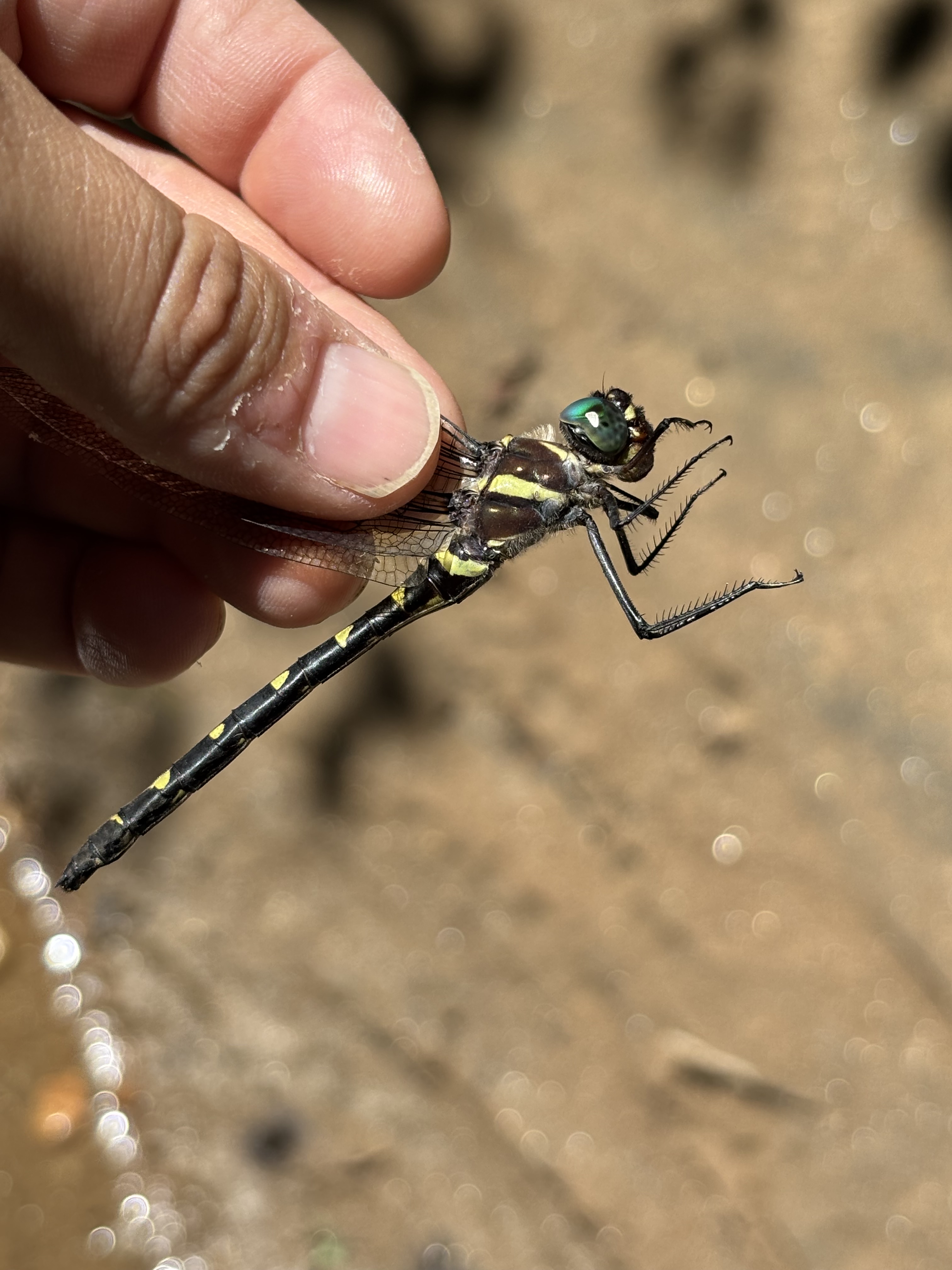
On the other hand, this Dragonhunter (Hagenius brevistylus) is the top insect predator in the streams where it’s found, eating other large dragonflies. It boldly goes wherever it wants.

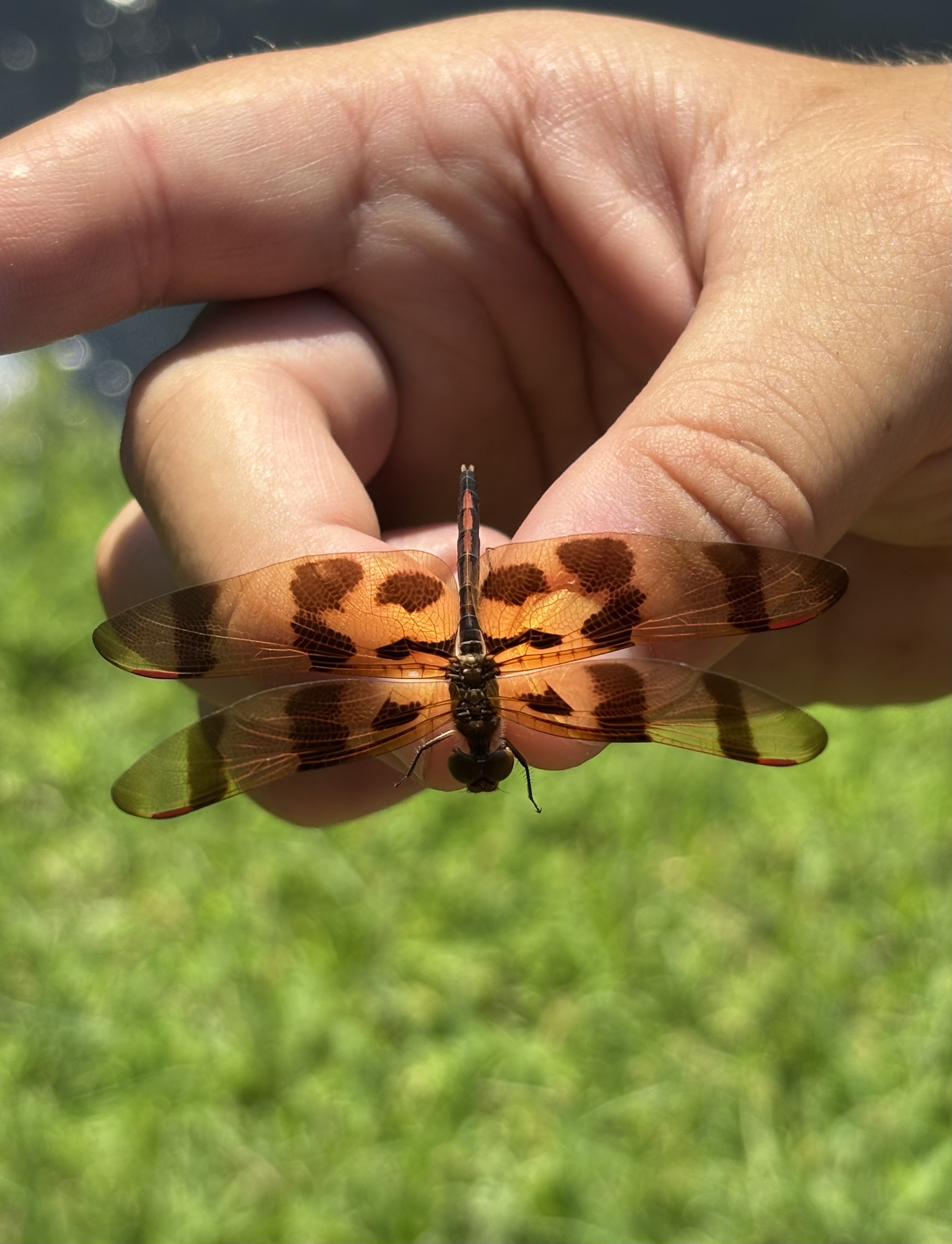
One big split in dragonfly behavior is between perching and patrolling species. Perching species, like this Halloween Pennant (Celithemis eponina) watch for food, friends, and foes from the top of a branch or grass blade.  While perching, they can orient their body toward or away from the sun in order to thermoregulate.

Patrollers, such as this Swift River Cruiser (Macromia illinoiensis), have linear territories of shorelines or sections of streams than they continuously traverse. They are often harder to catch with a net than the perchers!

The size of a dragonfly’s territory varies quite a bit among species, as well. On the small end, species like this Eastern Amberwing (Perithemis tenera) tend to stay within a 15 foot diameter.

Other species, such as the Comet Darner (Anax longipes), defend entire ponds. Finally, a few species, such as this Wandering Glider (Pantala flavescens) are migratory, with individuals travelling hundreds of miles.

The more I look for and learn about odonates, the more amazed by their beauty and variety. With over 100 species left to find in North Carolina, and many more within road trip distance, I know I’ll be chasing after these flying wonders for years to come.

September 3, 2025: Luffa Bees

Despite being in quite early stages of developing our garden, the insect diversity in our yard has been quite high this summer! Maybe I’m grading on a curve based on my experience with California and Oregon. In places with hot, dry summer, many plants have senesced up by August, which doesn’t leave much food for bugs. In any case, it’s been fun meeting some of the local insect species.

The plant in our yard that has lately seen the most visitors is Jenny’s luffa sponge gourd (Luffa aegyptiaca). The few individual luffa vines have taken over an entire raised bed, and are producing a beautiful display of yellow flowers. Like many species in the squash family (Cucurbitaceae), this plant is visited primarily by bees. Also like many squashes, plants produce separate male and female flowers. In order for a plant to produce fruits, bees are absolutely essential. I decided to watch the flowers for an hour in the late morning, photographing and identifying as many floral visitors as I could.

I ended up finding eight different species of bees over the hour (names bolded below). Most species were represented by several individuals and there was never a moment when the plant was completely unoccupied! I was expecting to see at least a couple rogue beetles, flies, or butterflies on the flowers, but nary a one stopped by. I also thought I would see some honey bees (Apis mellifera), but they were also absent. I know current fashion is to pledge to “save the honey bee”—we even have a NC license plate with the phrase. However, honey bees are non-native in the US, can be quite invasive, displacing the native species and doing a worse job than them at pollination. Therefore, I was quite happy to only see native species. I’ll show some pictures and briefly talk about each.

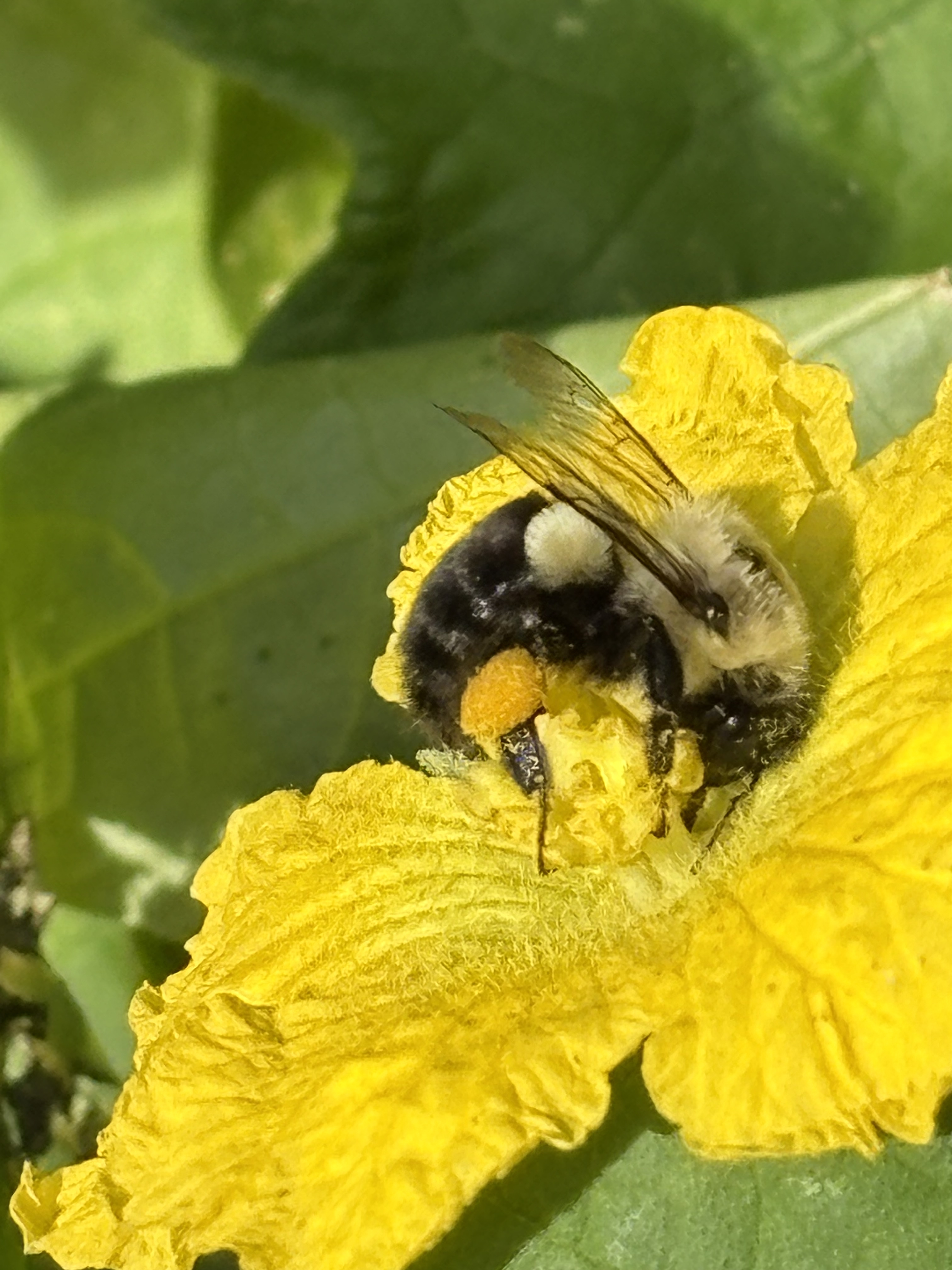
Bombus impatiens (top) and Bombus pensylvanicus (bottom). Bumble bees in the genus Bombus are among the most widely-recognized species of bees—they are probably the only native genus many people can identify. Like honey bees, but unlike most other bees, bumble bees are eusocial, meaning they have a sterile worker caste. They also make small amounts of honey, which they keep in honeypots in their underground nests. Bombus impatiens is by far the most common bumble bee in suburbs across the East. Bombus pensylvanicus, on the other hand, has recently undergone drastic population declines, especially in the northern part of its range. Ironically it has now become rare in places like Pennsylvania (and no, I don’t know why the species name drops the second “n” in “penn”).

Melissodes bimaculatus is in the bee family Apidae like bumble and honey bees. However, females are solitary, digging a hole in flat ground (males just sleep on a plant at night). Like many bees (but unlike honey and bumble bees), they carry pollen in scopae—modified hairs on their back legs. This species is distinguished by its two light spots low on the abdomen.

Ceratina sp. The “small carpenter bees” in this genus are tiny and dark metallic in color. There are a number of local species and it’s beyond my abilities to figure out which one this is from a photo. While they also provision their larvae with pollen, they are relatively hairless. Instead, they eat the pollen and regurgitate it at their nests inside which are inside of hollow flower stems. Besides their lack of hair, they are distinguishable by their barrel-shaped abdomen—thicker than other tiny black bees like Lasioglossum or Andrena. They are also in the Apidae, amazingly as is the largest bee in the area, Xylocopa virginica, which visited the luffa but was too quick for a photo.

Agapostemon virescens. This is an easily identifiable species—locally the only bee with a green thorax and black and white striped abdomen. This species makes communal underground nests, with multiple females sharing one exit hole. However, underground, each female makes her own chamber in which she lays an egg and supplies it with pollen to eat. Agapostemon is in the large family, Halictidae, or sweat bees. They are named because many of them are attracted to human sweat. Agapostemon species are not, but Augochlora pura, a tiny, all green species that I also saw on the luffa, is.

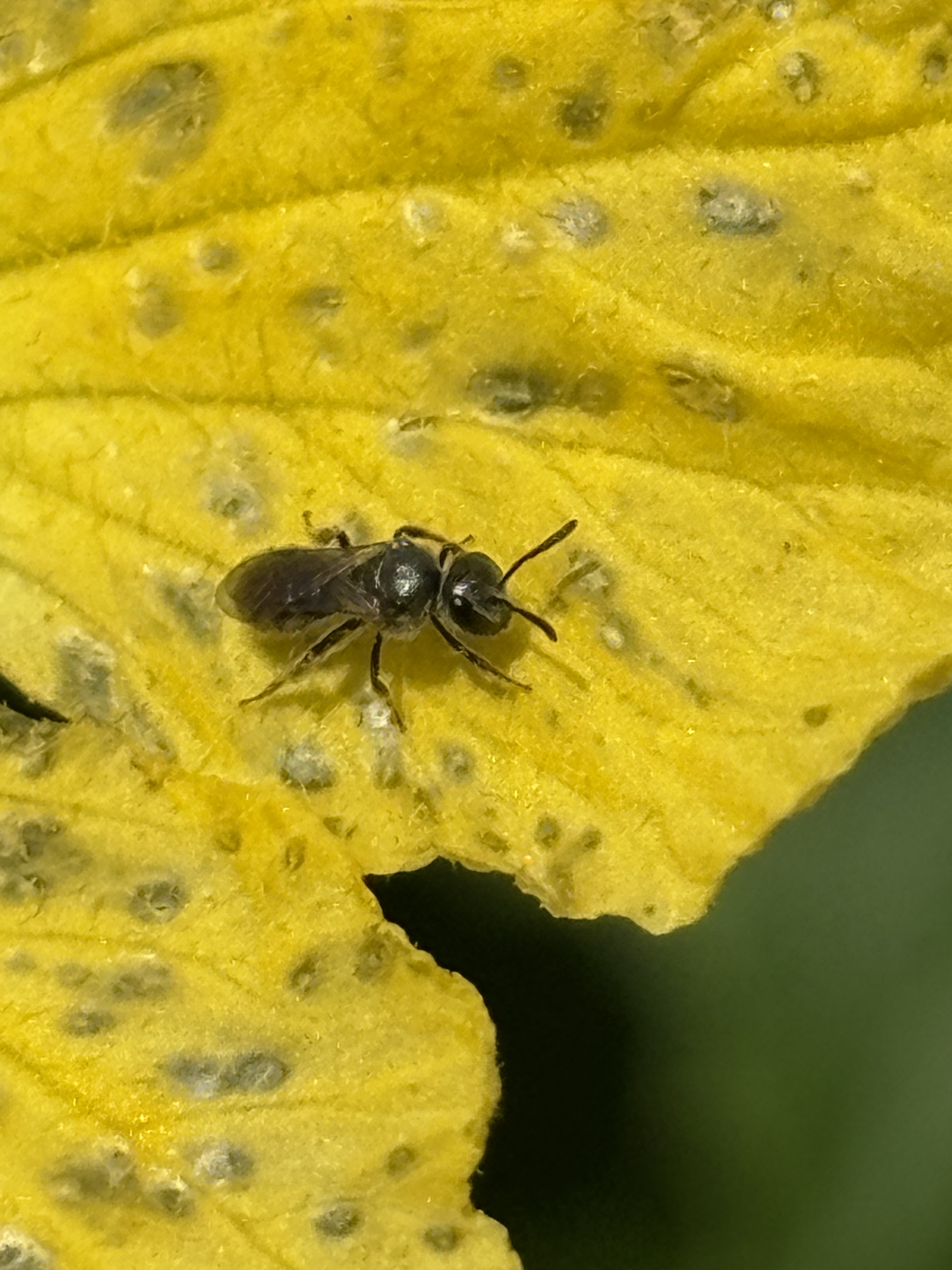
Lasioglossum sp. is another sweat bee that is true to the family name. This is an extremely species-rich genus with a lot of tiny similar-looking bees and I won’t attempt to identify it further (although many of the other species have more striped abdomens than this one).

Megachile exilis was the only visitor in my favorite bee family, the Megachilidae. This family is unique in that their pollen-carrying scopae are under their abdomen. You can see the hairs peeking out in the top picture. Bees in this genus are known as the leaf-cutter bees, because they slice up plant material as nest-lining material in their hollow-stem nests. As a result, they have large powerful jaws (bottom picture). I’m not 100% sure about the species identification (the genus is right), but if it’s correct, there are only a few hundred observations on on iNaturalist.

August 31, 2025: Trail Snacks

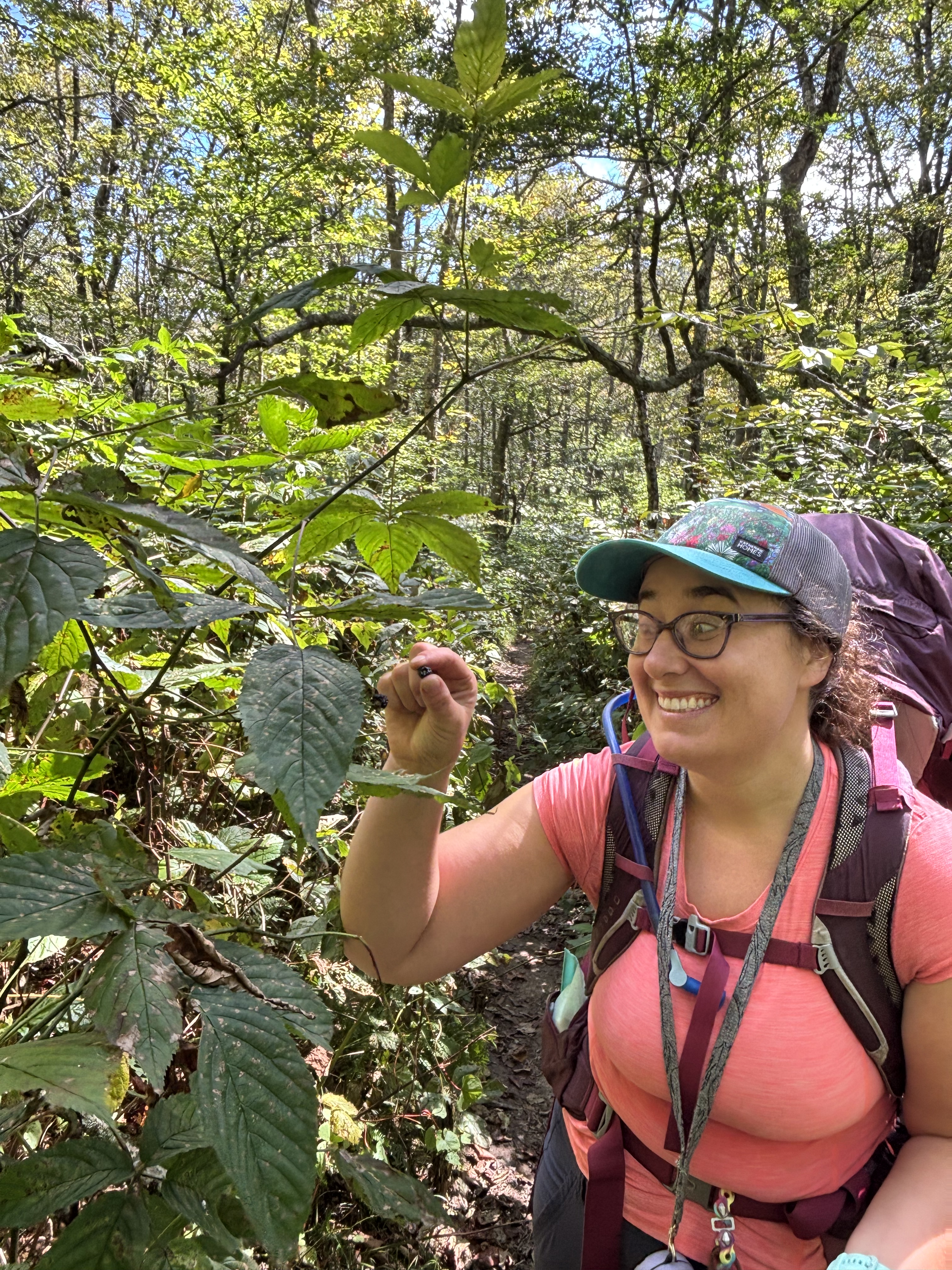
Jenny, Poppy (our dog) and I just returned from a backpacking trip in the Mount Rogers National Recreation Area in Virginia. Despite some rain and routing snafus, the trip was very successful on a few fronts. First, Poppy did a great job on her first backpacking trip, carrying her own food and not pulling on her leash very much at all! Second, we found a number of amazing and rare salamanders (see my Instagram). And finally, we had plenty of trail snacks!

One of the best parts about hiking in the mountains in late summer and fall is the abundance of edible plants. It’s so convenient to grab some tasty fresh berries from a bush rather than take off a heavy pack and settle for a stale granola bar. Yes, there are many species of poisonous plants and mushrooms–I wouldn’t recommend eating anything without identifying it first. But I do have a PhD in botany, and I might as well put it to use!

The two most common berries we snacked on were Rubus allegheniensis (Allegheny blackberry) and Vaccinium erythrocarpum (bearberry). They were both abundant in the shrub balds—treeless expanses along some of the ridges at the highest elevations of our hike. We also found some Cantharellus lateritius (smooth chanterelles) just before dinner, and added the mushroom into our pasta. While I had never the three of these previously, I had eaten close relatives before. The genus Rubus includes all blackberries, raspberries, dewberries, and our personal favorite, thimbleberries. Vaccinium is the genus for all blueberries, deerberries, and cranberries. And the California golden chanterelle (Cantharellus californicus) is the first wild-foraged mushroom I collected myself. Honestly, the flavor on all three was just okay relative to their congeners. But that’s being a bit of a trail snack snob—the berries were juicy, sweet and bountiful, and the mushroom added a nice depth of flavor to our pre-packaged meal.

The Southeast actually has a higher diversity of edible plants and mushrooms than the West Coast. Therefore, there are plenty of future new snacking opportunities along the trails ahead. I’m looking forward to trying the two species of pawpaw (Asimina)that grow natively in the state.

August 16, 2025: Gulf Stream Pelagic

This weekend, Jenny and I drove six hours to Cape Hatteras, picking up my buddy, Abe on the way. Abe and I then woke up at 4:30 in the morning on both Friday and Saturday to hop on a boat. The good ship Stormy Petrel II took us 25 miles off the coast though choppy seas to the continental shelf break and the Gulf Stream. All this so we could stare at some medium-sized gray and white birds.

Far offshore pelagic birding trips such as this one definitely aren’t for everyone (Jenny declined the invite). They’re not even for every birder. Across 2 days and 20 hours of birding at sea, I only saw 18 species, some of which were confusingly similar to each other! But several of these species are challenging or impossible to see from land except near their remote breeding colonies. Pelagic trips are a chance to witness seabirds in their element, whipping through the wind and deftly plucking food from the ocean surface. The number of birds can also be impressive. This weekend saw well over 1000 Great Shearwaters and around 150 Wilson’s Storm-Petrels. And these numbers are on the low side–the Gulf Stream isn’t a particularly productive place. In offshore upwelling systems like the Monterey Bay in California (the location of my first pelagics), seabird numbers can easily hit tens of thousands on a single trip.

I’ll give a short natural history of four highlight birds:

1. Sooty Tern (Onychoprion fuscatus). This was one of 11(!) species of tern we saw this weekend, and maybe the most impressive. It’s a large and relatively powerful species with an all-black back, white crown and belly and a long black bill. The waters off North Carolina are the farthest north this species occurs globally. Generally they are pantropically distributed, nesting in enormous densely packed colonies on sandy spits in all three oceans. Jenny and I actually saw some on Rottnest Island in Western Australia a couple years ago. When not breeding, this tern rarely lands, even on the water, feeding by plucking things like flying fish from at or near the surface. We got to watch feeding flocks doing this calling and circling around large groups of shearwaters. One flock was being harassed by a Parasitic Jaeger—a big arctic-breeding gull relative. A month ago, the jaeger was in the land of the midnight sun while the terns were on a tropical beach. And we saw them interact in North Carolina.

2. Band-rumped Storm-petrel (Hydrobates castro). Storm-petrels are small members of the Tubenose bird order (Procellariiformes).  Tubenoses, which also include albatrosses, shearwaters, and petrels are probably the most pelagic of all birds, many spending most their lives out of sight of land. Storm-petrels actually comprise two of the four families within the order, the Southern Storm-petrels (Oceanitidae), and the Northern Storm-petrels (Hydrobatidae). Southern Storm-petrels have longer legs and shorter wings than their Northern brethren, and tend to forage by slowly fluttering while dangling their feet in the water. Wilson’s Storm Petrels demonstrated this technique throughout much of the trip as they came in to investigate our smelly boat (we were purposely “chumming” by dripping fish oil and other goodies). This species is adorable, but not the star of the show, due to its commonness. By some estimates, it’s literally the most common bird in the world! More exciting to us nerdy birders were the couple of times a subtly different storm-petrel flew by. Like the Wilson’s, it was mostly black with a white rump and a lighter bar across the top of the wing. Unlike the Wilson’s, its legs didn’t stick out past its tail, and, more noticeably, it had a direct flight style with deep wing beats. We watched in delight as one of these Band-rumped Storm-petrels flew circles around the fluttery Wilson’s. Band-rumpeds also have a wide range, but they are no-where common. They breed on remote volcanic islands mostly in the northern hemisphere (being part of the Northern Storm Petrel family), sometimes at very high elevations. They only visit their nests at night, finding them by smell. The birds we saw likely came from islands in the North Atlantic, like the Azores or the Canaries. I loved seeing the contrast between their graceful flight and their awkward squared-off little head!

3. Sargasso Shearwater (Puffinus lherminieri) was bigger than the mocking-bird sized storm-petrels, but not by much! With a 27 inch wingspan and a 7 ounce weight, it’s the smallest shearwater that regularly makes it into North American waters. It’s the only shearwater that breeds in the Caribbean. It’s named after the Sargasso Sea where the bulk of the population spends its time. The Sargasso Sea is a region of the western Atlantic and the only named sea that’s not bounded by land on any side. Instead, four currents, including the gulf stream to the west, flow around it in a clockwise direction forming an enormous gyre. By boating out to the shelf edge, we made into this sea. Here the water is much warmer and noticeably bluer. It also is filled floating mats of Sargassum seaweed. This brown algae is completely pelagic, reproducing vegetatively and floating with the currents. Sargassum forms important habitat for many species fish, shrimp, worms, and other creatures. These, in turn, provide food for the Sargasso Shearwater. Anytime we saw this cute black-and-white bird sitting on the water, a mat of Sargassum was inevitably nearby. If we approached too near, the birds would hurriedly flap their skinny wings in a take-off attempt. However, it seemed like a big effort to get airborne, their belly often scraping on the crests of the waves. Presumably they were weighted down after eating the bounty provided by the Sargassum. Either that, or take-offs just aren’t their forte!

4. Black-Capped Petrel (Pterodroma hasitata) is the true star of a Hatteras pelagic trip. Their genus name, Pterodroma, means “wing runner” in reference to the spectacular arcing and racing flight the 35 members of the genus exhibit. Especially on Saturday, the windier trip, it was truly amazing to watch these acrobats zip by. This species breeds high in the mountains of Hispaniola and, like the Sargasso Shearwater, is a true denizen of the Sargasso Sea. Its namesake black cap is nicely set off by a white collar, belly, and rump, making for a pretty snazzy appearance. We ended up seeing dozens of these birds across the two trips. While those numbers are not unusual for this port—these boat trips rarely miss them—they are definitely not something to take for granted. The Black-Capped Petrel is an endangered species, with no more than a few thousand in the world. They under threat from breeding habitat loss and invasive species such as rats and pigs that eat their eggs, and have lost more than 50% of their population in the past 50 years. To save them, scientists climb the rugged mountain terrain to find and preserve their colonies. Finding them involves listening for their spooky “aawwww” calls (their name on Hispaniola is “diablotín” or “little devil”), or sniffing around for their funky sent (apparently they smell like old books!).

For me, seeing these amazing pelagic birds is well worth the time, money, and threat of sea-sickness that these trips cost. Maybe next year I’ll try one from a different port (Cape May, New Jersey and Cape Cod, Massachusetts have trips), so I can see some different species. Alternatively, I could go back to Hatteras at a different time of year. Regardless, part of the fun is any of these trips can view a species that’s rarely seen in the United States—you really never know what the ocean may deliver!
August 12 2025: The Great Odonate Race Results

The summer 2025 run of my California Ecology and Conservation class concluded today, and with it, my mission to see as many damselflies and dragonflies as I could across the 50 days.  

As we always do, we started the course at Blue Oak Ranch Reserve (BORR) near San Jose. This reserve has a few permanent ponds without any fish—perfect habitat for a number of widely distributed species that breed in still water. While I hadn’t yet conceived of the contest, I couldn’t help but notice five species of dragonfly including the Western Pondhawk (Erythemis collocata), the Black Saddlebags (Tramea lacerata), and the largest species I would see, the Common Green Darner (Anax junius).

After a week, we headed north to Angelo Coast Range Reserve. Odonate habitat here is extremely different—fast flowing rivers and streams that cut through dense forests. That meant there was very little overlap in species. Dragonfly highlights here included the impressive Western River Cruiser, and three species in the Clubtail Family, the Bison Snaketail (Ophiogomphus bison), the Pacific Clubtail (Phanogomphus kurilis), and the Grappletail (Octogomphus specularis).

I also worked on learning my damselflies. These smaller cousins to dragonflies can be tricky to identify. Separating forktails (Ischnura), dancers (Argia), and bluets (Enallagma) involves paying attention to wing position and leg hair length. Telling apart species within these genera often comes down to looking at reproductive parts at the ends of abdomens with a hand lens. Some species are unmistakable however, including the jewel-like American Rubyspot (Hetaerina americana) and the California endemic Exclamation Damselfly (Zoniagrion exclamationis).

I found 16 species at Angelo, 14 of which were new for the list.

After 10 days at Angelo, we moved to Sagehen Creek Reserve in the Northern Sierra. Unlike most taxa in California, odonate diversity actually peaks to the North and at higher elevations. Therefore, I had high expectations for this stop. It did not disappoint. In addition to the amazing highlight of the Black Petaltail (Tanypteryx hageni) which I mentioned in a previous post, the meadows and streams around camp had some new damselflies, such as the Western Red Damsel (Amphiagrion abbreviatum), and some great Meadowhawks, including the Red-Veined Meadowhawk (Sympetrum madidum).

On my off day, my teaching assistant, Eric, and I spent a good chunk of the day odonate hunting, visiting some small ponds near the trail to Castle Peak and some larger ones near Donner Lake. The former spot netted four new species including the Four-spotted Skimmer (Libellula quadrimaculata) and the American Emerald (Cordulia shurtleffii).

The latter added five more, including the Dot-tailed Whiteface (Leucorrhinia intacta) and the Emerald Spreadwing (Lestes dryas). The Sagehen tally ended up at 18 new additions and 24 species in total.

Next, the class went to Sierra Nevada Aquatic Research Laboratory (SNARL) in the Owens Valley. This part of California is biogeographically part of the Great Basin, and thus has many critters that aren’t found in the rest of the state. A trip to the Owens River turned up a Great Basin Snaketail (Ophiogomphus morrisoni), and a lap around an alkali lake (complete with hot springs) netted Desert Whitetail (Plathemis subornata), Alkali Bluet (Enallagma clausum), and Bleached Skimmer (Libellula composita). The snaketail and skimmer, in particular, are beautiful and uncommon species—highlights for sure! I left SNARL with 10 new species (23 total).

The final new stop for the summer was Rancho Marino Reserve. Unfortunately, the combination of cloudy weather, dried-up wetlands, and teaching obligations kept my list lower here. I did manage to find nine species, but only three were new. We then returned to BORR, where I identified the local damselfly species, such as this Desert Firetail (Telebasis salva) having failed to do so during the first stint.

When I set out on the Great Odonate Race, I figured finding forty species over the 50 days of the class would be a challenging, but possible goal. I ended up tallying 53 taxa—just under half of the 108 species found in the state! Here is the complete accounting of my list:

Also see my insta (@botanicalrambler) for more pictures. I’m now totally hooked on Odonates. They are beautiful creatures with really interesting behaviors. Identification involves catching them and examining them with a hand lens—a fun but doable challenge. Conveniently, they also peak in abundance in the middle of summer, when birding gets a bit boring. I’ve already bought a guide to the Eastern species and plan to take my new obsession home.

August 8, 2025: Learning to Hunt

Early August can be a boring time of year for birders. Not only are birds keeping a low profile due to the heat and lack of need to defend a territory, many of them are in heavy molt and looking their scraggliest. Birders often choose to pursue other hobbies during this time of year, and dream of fall migration, which begins in earnest next month. However, if rather than looking for lots of species, you instead focus on watching bird behavior, August can actually be quite fun. It’s the time of year when fledgling birds are at their goofiest!

This week, we’ve returned to Blue Oak Ranch Reserve, and while holding office hours on the back porch of the barn, I’ve had plenty of time to watch some youngsters. While watching California Thrashers learn to flip leaves over and observing Western Bluebirds trying to fly catch has been fun, I’ve particularly enjoyed the antics of the young birds of prey. For some reason, this was an exceptional year for rodent abundance. Particularly voles and deer mice have been just everywhere. The bad news—that seems to have meant an abundance of ticks. The good news—there was plenty of food for baby hawks and owls.

Many birds of prey lay extra eggs beyond what the parents could feed in a normal year. In most years, the last one or two birds to hatch end up getting bullied by their siblings and tend not to make it out of the nest. This year however, the abundance of food led to a higher than average fledge rate. Now, many of the youngsters, still recognizable by their unique plumages, are trying to hunt on their own. And I hate to say, but it does not seem to be going well.

While there are juvenile Red-Tailed Hawks everywhere, one bird in particular has taken up residence in the big valley oak tree by the back of the barn. Every twenty minutes or so for large parts of the day, the youngster swoops down over the large ground squirrel colony, eliciting a chorus of chirps. I don’t know if it’s the approach, the angle, or the speed, but I’ve watched maybe twenty failed attempts. The poor juvenile ends up standing sullenly on the ground before retreating back to the oak tree to sulk before trying again.

We also have a resident juvenile Cooper’s Hawk that’s not faring any better. Cooper’s Hawks specialize on hunting medium sized birds in forested areas. However, this individual doesn’t seem to have gotten the memo. I’ve watched them dive for a ground foraging finches a couple of times, and even make an attempt at a vole without any success. Maybe an apprenticeship program would help them learn some better techniques.

The night shift at BORR is currently being dominated by American Barn Owls in numbers like I’ve never seen. I haven’t seen any hunting occurring—it’s a little harder to watch in the dark. But based on the number of frustrated shrieks and hisses I’ve been hearing, I don’t think it’s going any better.

The coolest failed predation attempt I watched, was from a young Golden Eagle. This largest of raptors dove after a ground squirrel thirty feet away from, missing pretty badly. Unfortunately, junior was subsequently driven away from the area by a team of Common Ravens and Red-Tailed Hawks.

Luckily with the ongoing rodent boom, everyone will have essentially unlimited attempts to perfect the craft of hunting. I hope the practice goes well, and I’ll actually see some successes by the time I return next month.

August 1, 2025: A Shark Attack

We’re now at Rancho Marino Reserve on the beautiful San Luis Obispo Coast. This location has an amazing number of marine mammals, including humpback whales, sea otters, harbor seals, and a resident group of California sea lions. Today, one of the students noticed one of sea lions wasn’t looking so good. She had a huge bite taken out of her side, almost definitely from a great white shark. Wild animals can be amazing at healing from wounds, but this one looked fatal, at least without intervention.

Some of the students wanted to take action. With the reserve manager’s permission, they contacted the Marine Mammal Rescue. The folks at this non-profit organization are quite good at their jobs—they have saved the lives countless critters. They also do the invaluable service of collecting data on mammal strandings and mortalities, which can point to harmful algal blooms, extreme weather events, or other phenomena. However, because the sea lion was at the bottom of a cliff without a clear access point, they were not able to help. Unfortunately, this sea lion will either slowly succumb to her wounds or, unable to forage for fish, eventually die of starvation.

It’s human nature to empathize with a fellow being and want to help assuage its pain. But no one ever said the natural world is a benevolent place. Famously, Alfred Tennyson called nature “red in tooth and claw”. Seals getting bitten by sharks is a perfectly natural (and, if witnessed, awesome!) occurrence along the shore of the Central Coast. While this particular seal’s death won’t provide a meal for a white shark eat, it will mean food for an innumerable and diverse array of scavengers and decomposers.

This desire humans have to help the living things around us can get us into trouble. Wounded animals can lash out at a potential savior, causing injury. Creatures can seem injured because they are sick with something contagious like rabies, and trying to help can be truly life threatening. Often folks think a young animal, like a baby bird or a fawn, is injured when it’s actually totally fine. In that case “helping” actually results in harm. Even if a critter is truly injured and the correct professionals take over the care, saving and rehabilitating animals can be time consuming, expensive, and unfortunately often unsuccessful. I realize it’s not a zero sum game, but putting the resources dedicated to rescue instead toward a beach clean up or toward lobbying the local government to preserve open space would definitely save far more beings in the long run. If it was just me who had found the seal, I wouldn’t have called Marine Mammal Rescue.

To me, the calculus swings in favor of intervention for two reasons. The first is if the injury is the direct result of humans. I would have called if the sea lion was entangled in a fishing net. The second is if the animal is threatened or endangered. I would absolutely call if I was on a beach in Hawaii and found an endangered Hawaiian Monk Seal with a shark bite. Reasonable people can definitely disagree with me about when intervention is appropriate. I okayed the students’ decision to reach out Marine Mammal Rescue, and I would have felt elated if they were able to rescue and rehabilitate the sea lion (or, based on how poorly she looked, if they at least could have quickly euthanized her to end her suffering). But importantly, the decision to intervene needs to be made rationally, with a full appraisal of the situation.

About once a run I take critter saving into my own hands and rescue a bat caught in a room or a lizard stuck to an insect sticky trap. Earlier this run, students came to me because a silly quail chick had been stuck in one of the seasonal cabins for a couple of hours, despite the door being wide open. With the help of Eric, my teaching assistant, I was able to corral the bird and release it back into the wild, pretty much making me a wildlife hero!