I know I wrote a whole post about having trouble picking favorites, but tiger beetles are definitely my favorite type of beetle. These tiny terrors are named for their behavior rather than their stripes (although some of them are pretty stripey). The adults aggressively hunt insect prey that’s sometimes larger than they are by running them down. The larvae live in narrow but deep burrows from which they launch ambush attacks. Both life history stages have massive jaws and a powerful bite they use subdue their struggling meals. Unlike a lot of ground-dwelling beetles, they also are excellent flyers, quickly taking off at the first sign of trouble. That last behavior makes them quite challenging to photograph, especially with just a phone camera. That’s why I’m excited that I managed to get pictures of four different species over the last month in North Carolina.
I found this Apterodela unipunctata (One-spotted tiger beetle) on a hike at Pilot Mountain State Park.

Here’s Cicindela repanda (bronzed tiger beetle) from a farm outside of Winston.

And Ellipsotera marninata (margined tiger beetle) and Habroscelimorpha dorsalis (eastern beach tiger beetle) were sharing a beach on island near Wilmington.

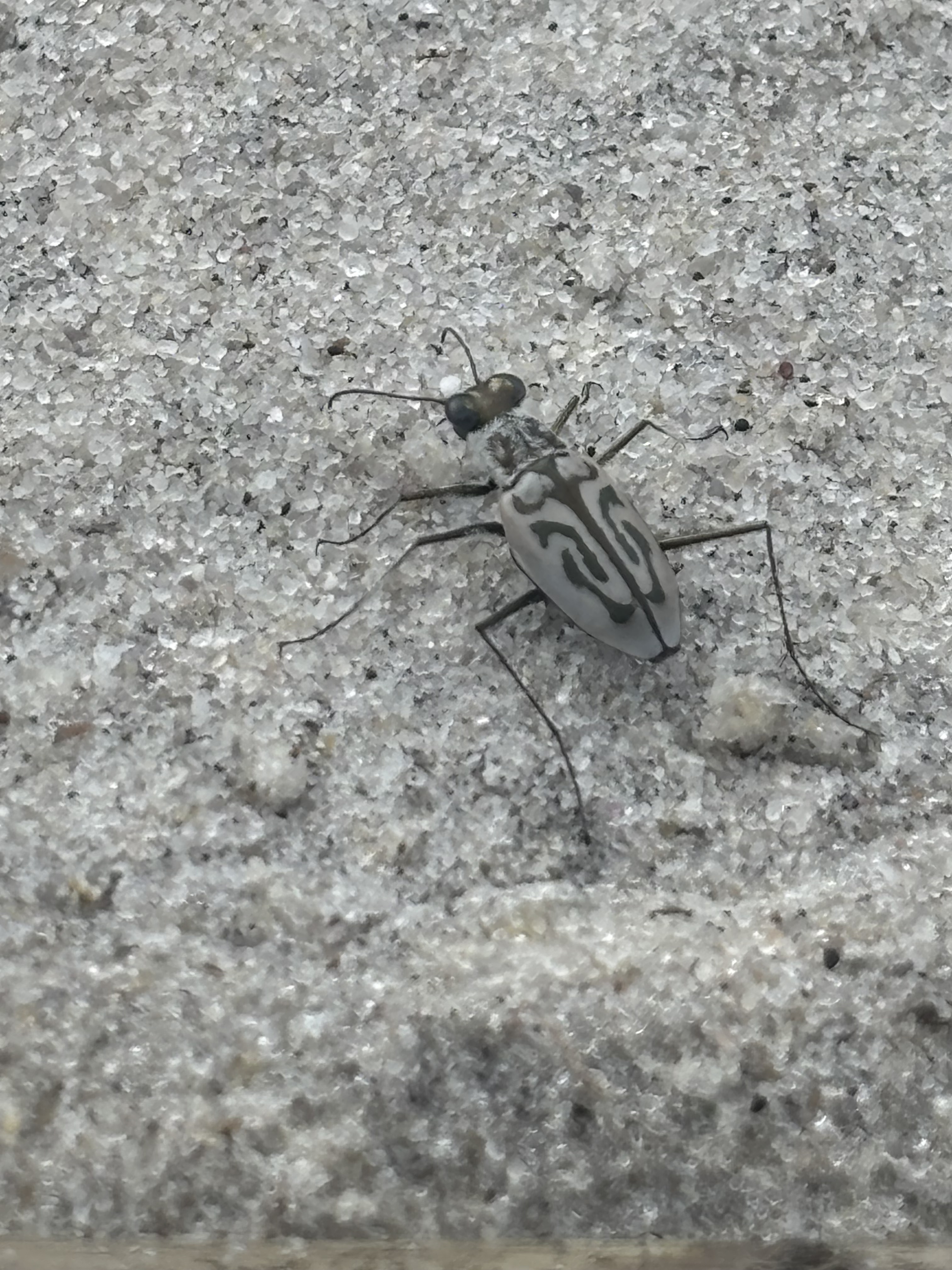
Pretty much all of the over 2,500 species of tiger beetle need plenty of open space. The adults need clear paths with good lines of sight for their hunting grounds, and the larvae need open sandy soils in order to dig their burrows. Therefore, many species are habitat specialists, residing on sand dunes, the edges of streams, or along game trails. These naturally fragmented habitats have led to patchy and sometimes quite tiny species ranges. For instance, the emerald and ivory gem that is the endangered Ohlone tiger beetle (Cicindela ohlone), only occurs in a few coastal prairie remnants around Santa Cruz, California.
Unfortunately, the open spaces in our country are under direct attack by our federal government. They claim that much of the property we collectively “own” as a nation is useless wasteland that would be better utilized by the highest bidder for resource extraction and, disingenuously, housing. In their view, federal lands are an asset that can be sold off in order to make a quick buck. But tiger beetles aren’t the only beings that need places to freely roam. We humans need and have a right to this space. The National Forest and Bureau of Land Management lands that are on the auction block are some of the most awe-inspiring places in our amazing country. And unlike many state and national parks, access is free, dispersed camping is usually available, and activities like hunting, fishing, and fossil collecting are permitted. The fight to keep our public land should just be about its value to humans, though. Just because a parcel of land doesn’t have a breathtaking view, a productive trout stream, or even easy public access, it doesn’t mean we should sell it off. Our country still has vast swaths of wilderness where species from bears to beetles can roam, and we owe it to the tiny tigers and all the rest to fight for every scrap. These are truly our open spaces, and it’s imperative we keep them that way.
 botanicalramblings